Untitled Extract Pages

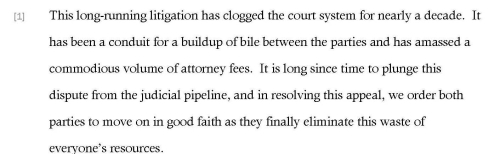
We’re posting the Indiana Court of Appeals’ recent opinion in Hoagland Family Ltd. P’ship v. Town of Clear Lake, No. 18A-PL-2088 (Aug. 28, 2019) not because it says much about eminent domain law, but more because (1) we commented on the case last time it was before the court, and (2) it’s kind of funny. 

From what we can read between the lines, the case probably involved one of those dudes who makes local municipal officials roll their eyes when he shows up. The genesis of the long-running litigation is that the Town wants Mr. Hoagland to connect his house to the municipal sewer system, and stop using his own septic system.

We’ll let you read the relatively short opinion for the details, but why we’re posting it is the court’s use of more than a few evocative words which tell you what the judges really thought of

Continue Reading Indiana Ct of Appeals: Come On Parties, Please Resolve This Steaming Pile Of A Case
Legalalertknick

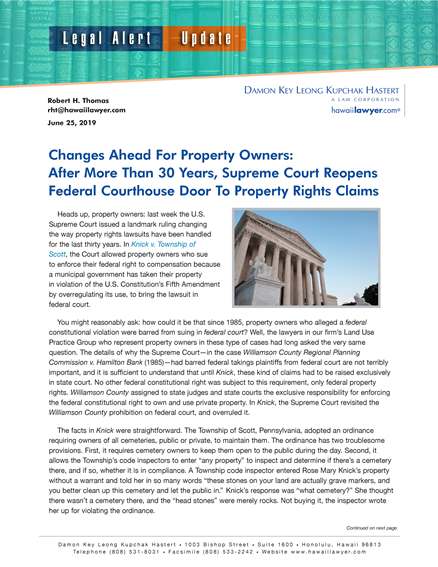
We’ve already set out our general thoughts about the Supreme Court’s decision in Knick v. Township of Scott in a series of posts on the case. But we haven’t yet noted what the case might mean on the ground in Hawaii, our home turf. 

In a client alert we did: Hawaii’s property owners now have many more options for fighting back against oppressive government regulation of property than they did last week: 

  • You can go straight to federal court to claim that a county ordinance or regulation has violated your Fifth Amendment rights, if the regulation allows the public to enter your land, or severely restricts your uses of your property. You no longer need to go to state court at all. You still may choose to do so—and there may be good reasons why you may want to consider state court—but you cannot be forced to.
  • There may


Continue Reading What The US Supreme Court’s Property Rights Decision Means For Hawaii’s Property Owners

In Keeton v. State of Alaska, No. 7366 (May 24, 2019), the Alaska Supreme Court held that a property owner is entitled to interest only on the “amount awarded” — the difference between the quick-take deposit and the eventual final judgment of compensation — and not on that amount plus the statutory attorneys’ fees which the court awarded.

You might have guessed how this one was going to play out, given the usual approach of not including attorneys’ fees and costs within the meaning of just compensation, and the purpose of “interest” being to compensate for the delay in payment of comp (not fees) after the condemnor has actually taken the property. But let’s go through the steps.

Quick take, deposit $15k. Final award of compensation, $24k. Fees of $47k, and costs of $32k awarded to the owner by statute. Also by statute, the court awarded prejudgment interest “on

Continue Reading Alaska: You Only Get Interest On Compensation, Not On Attorneys’ Fees

Pretty simple facts in the North Dakota Supreme Court’s opinion in Lincoln Land Development, LLC v. City of Lincoln, No. 20180117 (Mar. 15, 2019): back in the day (the 1980’s) the City had a dirt road over private property, used to access its sewage treatment plant. Lincoln Land Development bought the property in 2005. Recently, the City graded and paved the road, raised the road bed, and added things like culverts.  

Inverse condemnation? 

The City denied liability, arguing that Lincoln Development didn’t have the right to exclude the City because the City owned an easement — either by express grant, or by implication or estoppel — and thus Lincoln Development didn’t possess property that the City had taken. 

The most interesting part of the North Dakota Supreme Court’s opinion, in our opinion, starts on page 5, where the court discusses the easement by prescription claim (after having agreed with

Continue Reading ND Supreme Court Rejects City’s Claim That “We Already Own The Property By Prescriptive Easement So Are Not Liable For A Taking”

0401191044b_HDR

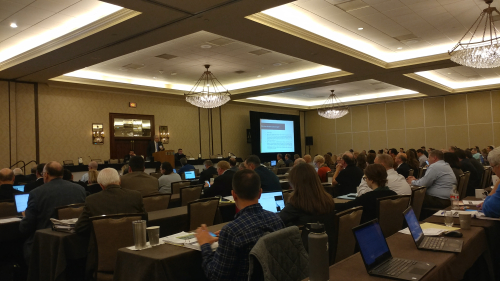
Great crowd today in Austin for CLE International’s Eminent Domain seminar, co-chaired by our colleagues Chris Clough, Sejin Brooks, and Christopher Oddo. We spoke about “National Trends and Developing Issues in Eminent Domain.” 

Here are the cases I referred to which are not included in your written materials:


Continue Reading Materials And Links From Today’s Austin Eminent Domain CLE

We’ve been meaning to post the U.S. Court of Appeals for the Eleventh Circuit’s opinion in Hillcrest Property, LLP v. Pasco County, No. 16-14789 (Feb. 13, 2019), mostly because of the provocative way it starts off: 

The question before us is whether a litigant in this Circuit has a substantive-due-process claim under the Due Process Clause of the Fourteenth Amendment when the alleged conduct is the unlawful application of a land-use ordinance. The answer to that question is a resounding “no”—an answer that this Court delivered in McKinney v. Pate, 20 F.3d 1550 (11th Cir. 1994) (en banc), 24 years ago and has reaffirmed ever since. We held in McKinney that executive action never gives rise to a substantive-due-process claim unless it infringes on a fundamental right. A land-use decision is classic executive, rather than legislative, action—action that, at least here, does not implicate a fundamental right under

Continue Reading 11th Cir: The Use Of Land Isn’t A Fundamental Right, Even If “What happened to [the owner] here was pretty doggone s[tink]y.”

Psweather

If you didn’t register to attend the 36th Annual ALI-CLE Eminent Domain and Land Valuation Litigation Conference later this week in Palm Springs, California, well then, shame on you!

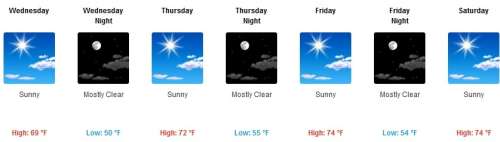
According to the National Weather Service, while you and the rest of the country is freezing, we’ll be enjoying the balmy desert climes, and discussing the topics we love: eminent domain, redevelopment, relocation, regulatory takings, trial and appeal strategies, doctrinal changes on the horizon, hot topics (border wall, pipelines, wildfires, and flooding), and others. 

Featuring a national faculty (many new to the ALI-CLE dais), and attendees from the entire spectrum of practice, academia, and the bench. 

If you are not joining us, be sure to follow along on the blog (we will post updates daily), and on Twitter (@invcondemnation, @ALI_CLE #EminentDomain2019). And plan on joining us in 2020, when we’ll be in a new city (by

Continue Reading ALI-CLE Palm Springs (72º, Sunny) Here We Come

1126181629e_HDR

We’re almost there, but we still have room remaining. At the 2018 Conference in Charleston, we both sold out the registrations and the conference hotel, so we planned ahead for the upcoming 2019 Conference in Palm Springs at the Renaissance Palm Springs Resort

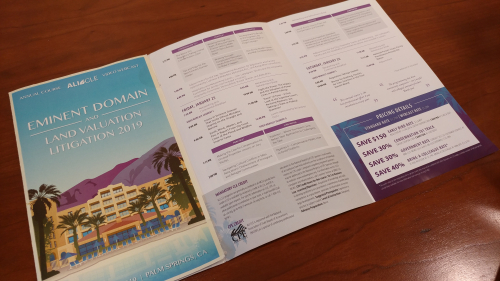
Register here. You will also be able to download the print brochure (above), or find out more details about the agenda and faculty on line. As always, we have assembled a great faculty — many of them new speakers — on the hottest topics in eminent domain and takings law: pipelines, jury presentations, challenging the take, an update on the most important decisions of 2018, pre-condemnation planning (from both the condemnor and property owner perspective), the border wall, and relocation. 

And of course, ethics and the “101” track for those new to the field, or experienced lawyers who would like a refresher on the

Continue Reading Space Remaining Is Limited – Register Now For ALI-CLE Eminent Domain And Land Valuation Litigation Conference (Palm Springs, Jan. 24-26, 2019)

Here’s the motion for leave and proposed brief amici curiae we filed yesterday in an appeal pending in the U.S. Court of Appeals for the Eleventh Circuit. 

This is a pipeline case (another one!) involving land in Florida. The district court got it right, concluding that the property owner/condemnee was entitled to recover attorneys’ fees since state condemnation law governs the case, even though it was in federal court. The court also allowed the owner to testify about the fair market value of her property. The pipeline company appealed, arguing that the fact that Florida law allows recovery of attorneys’ fees in eminent domain cases is irrelevant in a federal eminent domain action because attorneys’ fees are not part of Fifth Amendment compensation. It also argues that the owner should not have been allowed to testify.

We filed the amicus motion and brief on behalf of Owners’ Counsel

Continue Reading “A Property Right It Shall Be” – Fifth Amendment Requires Compensation For Whatever Interests A State Recognizes As Property

Our colleague and co-planning chair Joe Waldo was in town yesterday, so we walked through historic Williamsburg, Virginia (cradle of the Constitution and the Bill of Rights), to invite you to join us for the 36th Annual ALI-CLE Eminent Domain & Land Valuation Litigation Conference (January 24-26, 2019, in Palm Springs, California).

As we wrote in this post, the Conference will feature the nation’s best eminent domain faculty, presenting on the topics we love.

Register now here. Early registration and group discounts available. The 2018 Conference in Charleston sold out, so be sure to sign up now so you don’t miss out. Continue Reading Join Us For The 36th Annual ALI-CLE Eminent Domain & Land Valuation Litigation Conference In Palm Springs (Jan 24-26, 2019)