


20180126_111558_HDR

You’ve known for a while that Palm Springs, California, specifically the Renaissance Palm Springs Hotel (a resort facility, but right in town, so you will have many options for “off campus” activities like art museums, the aerial tram, golf, and whatever suits your fancy, and close-in to the Palm Springs Airport), is the venue for our 2019 ALI-CLE Eminent Domain and Land Valuation Litigation, January 24 through 26, 2019.

Of course, you also knew that the programming would be the usual spread of topical and cutting-edge topics, presented by some of the nation’s experts. But we didn’t give you the details. So here are some of the programs we’re having: 

  • Keynote Address: “Property Rights: Foundation for a Free Society” – Taylor Revley, most recently the past President of the College of William and Mary, and also former law school Dean (as well as a
Continue Reading ALI-CLE 2019 Eminent Domain And Land Valuation Litigation Conference, Palm Springs Agenda – Register Now!

TR

We usually don’t cover trial court orders, but this one is short, and, we think, worth your time reading. 

The issue before the North Dakota District Court (Ward County) was the award of attorneys’ fees following a successful necessity challenge by a landowner. In North Dakota, the award of fees and costs to a defendant is within the trial court’s discretion.

The condemnor didn’t object to the award of fees, but the court undertook its own review to determine the complexity and difficulty of the case. The judge correctly noted that “[i]n most eminent domain cases, the issue of necessity never arises.” Order at  7. The order continued:

In his brief in support of his motion for fees, attorney Boughey cites to recent United States Supreme Court authority to support his argument that questioning the necessity of a taking, and standing up to the often heavy-handed authority

Continue Reading “A Lawyer May Spend A Lifetime Working For That One Magnificent Hour” – ND Court Awards Fees For “A Good Day”

20180717_135234_HDR

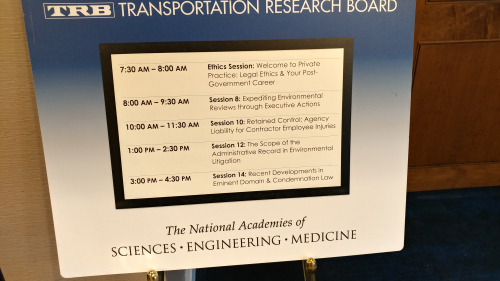
Here are the cases and other items I either spoke about or mentioned at today’s Transportation Research Board‘s 57th Annual Workshop on Transportation Law in Cambridge, Massachusetts:


Continue Reading Links And Materials From Today’s Transportation Research Board Session

Here’s the latest in a case we’ve been tracking, the City of Missoula, Montana’s takeover of a privately-owned water system. In 2016, the Montana Supreme Court held that the city could exercise its power of eminent domain to take the property for a “more necessary” public use. The court allowed the city to take the company, and on remand, the lower court determined compensation. There was also a follow up case on who pays property taxes on land while it is being condemned (the owner, although it may eventually have a claim for a refund from the city once the condemnation is completed and title transfers). 

In City of Missoula v. Mountain Water Co., No. DA-17-0272 (June 5, 2018), the Montana Supreme Court considered the payment of attorneys’ fees and costs. After the owners–the water company itself and its “upstream” owner–rejected the city’s offer of $50 million, the condemnation

Continue Reading Montana: When An Eminent Domain Case Is Complex And Requires Out-Of-Town Talent, A Statutory Cap On Attorneys’ Fees May Not Apply

Here’s what we’re reading today:


Continue Reading Monday Readings: South Africa Takings, Redevelopment, Metes and Bounds, And More

Here’s the latest case on our (second) favorite subject, recovery of attorneys’ fees.

First, let’s be frank: in our experience, many courts don’t really care all that much for requests for fees and costs, for whatever reason. Maybe it’s because the merits have already been decided and these requests are collateral “tails.” Maybe it’s because they don’t think that the applying parties deserve to be reimbursed. Maybe it’s because many judges do not come from a private practice background and therefore are not fully appreciative of the cost of private representation. Maybe it’s because the evidentiary details required to support these requests can be … unexciting. Who can say.

And, as we’ve mentioned previously here, assembling a request for attorneys fees can be a slog. Does anyone really like going through their time entries and bills, redacting stuff, tracking down costs, gathering testimony that fees are “reasonable,” and the like?

Continue Reading Nebraska: Eminent Domain Fee Statute Only Requires Reimbursement Of Fees “Actually Incurred” (So Unsupported Claim Is Right Out)

Here’s the cert petition, recently filed in a case we’ve been following from South Dakota

The statute at issue — the federal Uniform Relocation Assistance and Real Property Acquisition Act — isn’t one that gets a lot of attention, particularly at the Supreme Court. But it’s an area that is ripe for review. The issue in the case is whether a state may deny a property owner recovery of attorneys’ fees for a successful inverse condemnation claim resulting from a federally-funded SDDOT highway project.   

Here’s the Question Presented:

Congress, in 1970, established a uniform policy for compensation of legal costs as the result of unconstitutional takings of real estate. Congress required all federal agencies to pay a successful Plaintiff ’s legal costs when a citizen’s constitutional property rights were vindicated in an inverse condemnation action.

South Dakota refuses to comply with the policy Congress established. This Petition requests

Continue Reading New Cert Petition: Are The Relocation Act’s Attorneys’ Fee Provisions Merely Guidelines?

Here is the video of last Friday’s oral arguments in a case we’ve been following, in which the owners of a mobile home park successfully challenged a California municipality’s rent control ordinance as a taking.

In Colony Cover Properties v. City of Carson, a U.S. District Court for the Central District of California jury awarded the park owner just compensation, concluding that under Penn Central, the rent control ordinance was a compensable taking. The total award to the park owner, including damages for lost rental income, attorneys’ fees, and interest, was over $9 million. As far as we can tell, this is the first case in which a mobile home park owner has succeeded in obtaining compensation for a taking for rent control.

Predictably, the city went ballistic, and its brief in the Ninth Circuit argues the City is the aggrieved party:

In April 2006, Plaintiff Colony Cove

Continue Reading Video: Ninth Circuit Penn Central Oral Arguments

Our upcoming American Law Institute-CLE Eminent Domain and Land Valuation Litigation Conference in Charleston, South Carolina has SOLD OUT our in-person registrations. 

We will have a record attendance (with over 100 first-time attendees) and the conference hotel has informed us that we can fit no more people in the meeting rooms. We cannot remember this happening before, but it tells us that we will have an energizing and exciting conference. 

Thank you to all of you who signed up and are coming or joining in online for the webcast — we’ll see you soon at the “four corners of the law.”

And if you delayed too long in registering, please don’t despair. You can still attend from home or the office because ALI has set up a live webcast of the sessions. Go here for more on how to sign up to attend by webcast.

And stay

Continue Reading ALI-CLE Eminent Domain & Land Valuation Conference – In-Person Registration SOLD OUT (But You Can Still Join By Live Webcast)

As we reported earlier (“Mississippi: Statute That Says No Private Takings For Access Within City Limits Means Just That“), as in many other states, in Mississippi, a private property owner may institute eminent domain proceedings to take a neighbor’s land when doing so is necessary for a landlocked parcel to gain ingress and egress. In that case, the Mississippi Supreme Court held that the requirements of the statute must be adhered to by a private condemnor, and invalidated the taking.

But the court rejected the owner’s request for attorneys’ fees as part of the appeal because the statute provides that these costs are recoverable “in a separate action.”

After the court issued its opinion, the property owner sought attorneys’ fees under a separate statute in the eminent domain code, but the special court concluded the statute didn’t apply because the Supreme Court “has made it abundantly clear that

Continue Reading Private Condemnor Liable For Attorneys Fees When Condemnation For Access Road Fails