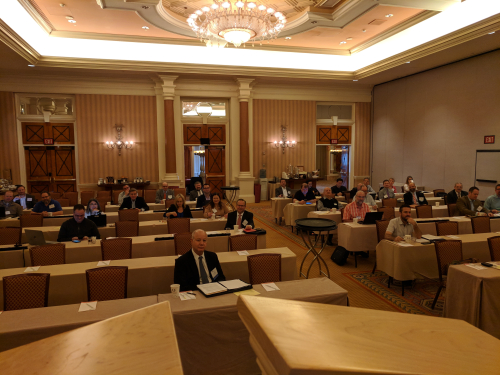
IMG_20171211_090714This photo of the view from the lectern at the start of the day
proves we really
were in the room and not distracted by all the distractions
possible in Las Vegas

Here are the materials and cases which I spoke about earlier today at the CLE International Eminent Domain Conference in Las Vegas. I had the lead off session on updates, and my talk focused on cases that I didn’t cover in the written materials:


Continue Reading Links And Materials From Today’s Las Vegas Eminent Domain Conference
Here’s one we’ve been meaning to post for a while because it is on one our favorite (sub)topics: attorneys’ fees in eminent domain. Indeed, it is about what we consider a very interesting subtopic of the subtopic, the question of whether an owner can recover attorneys’ fees for the efforts expended in recovering attorneys’ fees, the aptly-named “fees on fees” question. We did a case like this a few years ago in the Hawaii Supreme Court, and have been hooked ever since. 

The opinion, Tri-County Metro. Trans. Dist. of Oregon v. Aizawa, No. S064112 (Oct. 5, 2017), is from the Oregon Supreme Court, and overall, may not be that relevant to your specific jurisdiction because it focuses on the court’s interpretation of the Oregon fee-shifting statute and a rule of civil procedure. Thus, your mileage may vary back home. But we encourage you to review it anyway (even in

Continue Reading Oregon: Legislature Didn’t Preclude Condemnee From Recovering “Fees On Fees”

As we noted recently, we don’t usually post trial court decisions. But there are exceptions. The Northern District of Florida’s recent order in Sabal Trail Transmission, LLC v. Real Estate, No. 16-cv-00063-MW-GRJ (June 5, 2017), is one of those exceptions. 

First of all, our New York City colleague Michael Rikon beat us to the punch, and posted a summary of the case on his blog yesterday. Read it.

The issue, as Michael notes, is whether federal or state law applies in a federal Natural Gas Act taking by a private pipeline in federal court. In Sabal Trail, the big difference why choice of law matters is that under the Fifth Amendment, just compensation does not include attorneys’ and other fees, while under Florida’s “full compensation” provision (which we noted here), a property owner may recover fees and costs. 

The District Court rejected the pipeline’s

Continue Reading Florida’s “Full Compensation” Rule (Attorneys’ Fees!) Governs In Federal Natural Gas Act Taking By Private Pipeline

Seattle

My thanks to Bart Freedman (K&L Gates) and Kinnon Williams (Inslee Best Doezie & Ryder) for asking me to speak on national takings and inverse condemnation issues at yesterday’s Eminent Domain conference in Seattle.

As you can see, the room was packed and standing room only. Here are the cases and issues I mentioned during my talk, “National Takings Trends, Hot Practice Areas, and Property Rights in the Age of Trump:”


Continue Reading Cases And Links From Washington Eminent Domain Conference

25103267

Here’s what we’re reading today: 

Continue Reading Area 51 Taking, Dodger Stadium Taking, Attorneys’ Fees

This case — a related case, actually — has been up to the West Virginia Supreme Court before. SeeWest Virginia: DOT Should Not Have Mined Privately Owned Limestone Without Owner’s Permission.” But even though the underlying facts were the same (the DOT mined limestone from private property without first buying it from the landowner), the issues presented in West Virginia Dep’t of Transportation v. Veach, No. 16-0326 (Apr. 17, 2017) were somewhat different.   

In Veach, after the Supreme Court affirmed the earlier case, DOT’s new counsel sought to repudiate a stipulation which prior counsel entered into with the property owners, by which the parties agreed that the landowner owned the limestone. DOT now argued that West Virginia law was that the state owned these mineral deposits, not private landowners.

The trial court rejected this tactic, and the Supreme Court affirmed. The DOT didn’t show that the stipulation

Continue Reading West Virginia: Condemnor Must Abide By Stipulation, Even If Contrary To Law

When most jurisdictions reacted to the U.S. Supreme Court’s decision in Kelo v. City of New London, 545 U.S 469 (2005), they — naturally being aghast at the result — adopted legislation that either purported to make it easier on landowners, or harder on condemnors. Understandable, as the public uproar which Kelo caused has yet to settle down completely even a decade later.

But not Louisiana. Oh no, that state’s legislature apparently decided that Kelo was a good opportunity to make it harder for a property owner to recover compensation. We’re not even going to pretend to understand all that is going on in South Lafourche Levee District v. Jarreau, No. 2016-C-0788 (Mar. 31, 2017),  with its differences between “expropriation” and “appropriation,” compensation measured by “full extent of the loss” versus merely “just compensation,” and the like. Louisiana, after all, can be a whole ‘nother brand of law, sometimes.

Continue Reading La: “Something is wrong” – Post-Kelo Amendments Reduced Compensation For Levee Servitudes From “Full Extent Of The Loss” To Fair Market Value

Another one (short) from the Kansas Supreme Court, this time a straight takings case, and not inverse condemnation

In Pener v. King, No. 114850 (Mar. 24, 2017), the court tackled several issues in a case involving KDOT’s taking of land for highway project. Part of the taking required KDOT to take down the owner’s fences. The owner argued that he should be separately compensated for the cost to replace the fencing. The Supreme Court held that the just comp award included the fencing, and that it wasn’t a separately value taking. The “unit rule” means that property is valued as a whole, not piece by piece. 

The court also rejected the owner’s argument that the just compensation verdict wasn’t supported by the evidence (we will let you read that on your own, if interested), and then concluded by affirming the trial court’s denial of an award of attorneys’

Continue Reading Kansas: Cost Of Replacing Fence On Condemned Property Isn’t Separate, But Part Of Just Comp Award

West Virginia Dep’t of  Transportation v. Newton, No. 16-0325 (Mar. 7, 2017) was the second time that case had come before the West Virginia Supreme Court. As we noted here (“DOT Should Not Have Mined Privately Owned Limestone Without Owner’s Permission“), the court held that the the Department of Highways should have instituted eminent domain proceedings before it started removing Ms. Newton’s limestone from her land. After she prevailed in her mandamus action, WVDOH did so. 

As a result of the condemnation action, Newton was awarded nearly $1 million in compensation, and $250k in attorneys’ fees for the mandamus and condemnation actions under the Uniform Relocation Act, which is incorporated into West Virginia law. The URA provides for fee shifting when an owner is forced to initiate a claim for compensation.

WVDOH appealed, arguing that hey, we condemned Newton’s property (after she won her mandamus action), so

Continue Reading W Va: Relocation Act Attorneys’ Fees Required Where Owner Sues To Compel Condemnation

Here’s an article, recently published by the Urban Lawyer (the law review produced by our ABA section, the Section of State and Local Government Law), with our take on the most interesting and important eminent domain and takings rulings from the past year. 

Many of the cases discussed will be familiar to regular readers, but here it is in one place, and in print. 

Recent Developments in Eminent Domain, 48 Urb. Lawyer 939 (2016)

Continue Reading New Article: Recent Developments In Eminent Domain