


Check this out, a story in the September 28, 2015 edition of the New York Times, “Owner of Grand Central Sues Developer and City for $1.1 Billion Over Air Rights.”

Reminds us of this obscure Supreme Court case we heard about…

The Times reports that the current owner of Grand Central Terminal is, with the counsel of uberlawyers, suing New York City in federal court, alleging a taking and related. So what’s this all about (we thought this was “old, unhappy, far-off things, And battles long ago”)?

Apparently, the city granted a Grand Central neighbor permission to build a massive 1500 feet high office tower, and in doing so, took Grand Central’s property (its air rights) without compensation:

On Monday, Mr. Penson filed a $1.1 billion lawsuit in United States District Court in Manhattan that argued that the administration of Mayor Bill de Blasio, a Democrat
Continue Reading Penn Central, Part Deux? A New Complaint Alleges A Taking Of Grand Central Air Rights

BK-plaque-2015

As we’ve done every year lately, we’re soon headed to the Brigham-Kanner Property Rights Conference at the William and Mary Law School in Williamsburg, Virginia.

This year, the B-K Property Rights Prize will be awarded to Harvard lawprof Joseph Singer, who is, shall we say, an interesting choice, given his theory that a “robust regulatory structure” goes hand-in-hand with property rights, liberty, and the free market. Robust regulation isn’t exactly what you might think of when you think “property rights,” is it? So it should make for an interesting conference.

Professor Singer publishes a blog that is worth following, “Property Law Developments.” It is not one of those blogs that are heavy on the analysis, but its a good place to keep up on recent developments in all things property law. 

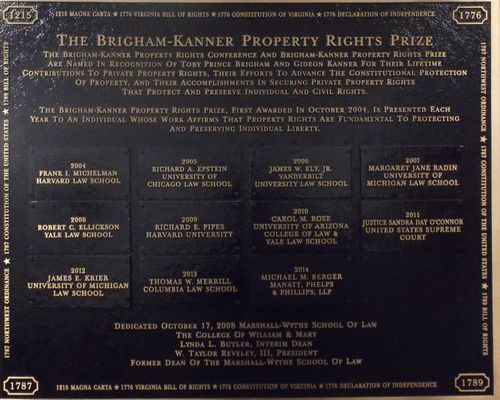
The plaque pictured above is a list of prior prize winners.

Here are the conference details:

Continue Reading Join Us: 2015 Brigham-Kanner Conference At William And Mary Law School

Here’s the audio of the recording of the ABA talk we did last week on the Starr International v. USA takings case, “Taking AIG Without Compensation: The $40 Billion Question,” now ongoing in the Court of Federal Claims. The materials and links referred to in the talk are available here. If streaming doesn’t work for you, download the mp3 here.

Continue Reading Audio Of ABA Talk On Starr International v. United States Trial: Taking AIG Without Compensation – The $40 Billion Question

For those of you who couldn’t join us at the William & Mary Law School last month for the Brigham-Kanner Property Rights Conference (see our report here), the law school has made videos of the four panel presentations available here

They’re high quality videos, so be prepared for big downloads, but the presentations are worth it. While they are all good, our favorite was the impromptu discussion/debate during the third panel, “Balancing Private Property and Community Rights,” featuring panelists Kames Burling (Pacific Legal Foundation), Professors Richard Epstein (NYU), Steven Eagle (Geo. Mason), Mark Poirer (Seton Hall), and James Stern (William & Mary). 

Continue Reading Brigham-Kanner Property Rights Conference – Panel Videos Now Available

  DSCF2208

You can’t have rights without advocates.”

                              – Michael Berger

We’re at the William and Mary Law School in Williamsburg, Virginia today for the 11th Brigham-Kanner Property Rights Conference. As we’ve noted earlier, Michael Berger is this year’s B-K Prize honoree, for his career contributions to property law and his “scholarly work and accomplishments [which] affirm that property rights are fundamental to protecting individual and civil rights.”

The list of past recipients is an All-Star roster of property scholars and jurists, including lawprofs Frank Michelman, Richard Epstein, James Ely, Carol Rose, Thomas Merrill, and Supreme Court Justice Sandra Day O’Connor (the latter perhaps more for where she ended up in her Supreme Court career than where she started). See the plaque on the Law School’s wall for the complete list of

Continue Reading 2014 Brigham-Kanner Property Rights Conference Report: Honoring Michael Berger

A reminder: the 11th annual Brigham-Kanner Property Rights Conference is coming up on October 30-31, 2014, at the William and Mary Law School in Williamsburg, Virginia. As we noted earlier, Michael Berger will receive the Brigham-Kanner Prize, so this one is special – he’s the first practitioner to receive the Prize.

More here, from W&M, including agenda and registration information. Here’s the flyer.

We’re going – hope to see you there. 

11th Annual Brigham-Kanner Property Rights Conference – Oct 30-31, 2014 – Michael Berger

Continue Reading October 30-31, 2014: Brigham-Kanner Property Rights Conference @ William & Mary Law

Like a visiting relative who won’t go home, the idea to seize underwater-but-performing mortgages is still hanging on. The llatest chapter is brought to us by way of our New York colleague Mike Rikon, who writes:

At a press conference on the steps of City Hall, City Council members and housing advocacy groups called on the Mayor to help homeowners who are at risk of foreclosure. Such help would come in the form of using eminent domain to “buy back mortgages where homeowners owe more than their houses are worth.”

According to a CBS report on June 25, 2014, “under the proposed plan, City government would purchase the mortgages from banks and refinance them to match the home’s value to prevent foreclosure.” 

Mike notes that nearly two years ago (and several times since), we suggested that this plan was not clearly legal, and even if it were, was not

Continue Reading Farpotshket Alert: Plan To Take Mortgages By Eminent Domain Is Back

Worth reading: Gideon Kanner, Detroit and the Decline of Urban America, 2013 Mich. St. L. Rev. 1547 (2014), in the forthcoming issue of that august publication. Its not yet available on the law review’s web site, but Professor Kanner has written up a summary on his blog (he might even send you a copy of the complete article if you ask him):

It deals with the causes of decline of older American cities; what caused their populations to leave en masse and move to the suburbs, leaving behind empty swaths of urban desolation (If you want to see how desolate, go to Google, type in “ruins of Detroit” and hit “enter.’ Here are some samples).

His summary includes the key points of the article, and identifies six factors as contributing to urban flight and depopulation, including abuse of the eminent domain power. 

The article is a fascinating and

Continue Reading New Article Of Note: The Role Of Eminent Domain Abuse In Detroit’s Downfall

Each year, the William and Mary Law School’s Property Rights Project awards the Brigham-Kanner Property Rights Prize to a deserving person “whose work affirms that property rights are fundamental to protecting and preserving individual liberty.” This list of past recipients is an All-Star roster of property scholars and jurists, including lawprofs Frank Michelman, Richard Epstein, James Ely, Carol Rose, Thomas Merrill, and Supreme Court Justice Sandra Day O’Connor. 

The Project just announced that Michael Berger has been selected as the 2014 recipient of the Prize. As noted, Mike “is the first practicing lawyer to receive the prize and is widely considered to be among the best takings lawyers in the nation.” The Prize will be presented at the 11th Annual Brigham-Kanner Property Rights Conference, on October 30-31, 2014 at the Law School in Williamsburg, Virginia. 

Here’s the full story:

Berger to Receive 2014 Brigham-Kanner Property Rights Prize


Continue Reading Mike Berger To Receive 2014 Brigham-Kanner Property Rights Prize From William & Mary Law School

Be sure to check out this interview with a person we’re proud to call a friend and a colleague, Gideon Kanner, in the most recent edition of Right of Way magazine, a publication of the International Right of Way Association.

A Fierce Advocate for Just Compensation” is a sitdown with Professor Kanner, and covers a lot of ground, so to speak. The entire piece is worth reading, but here’s what a colleague pointed out as perhaps the best part:

If you represent a property owner in an eminent domain case, particularly an inverse condemnation one, you must understand that your client is persona non grata or the law’s “poor relation,” as U.S. Supreme Court Chief Justice William Rehnquist once said. The California Supreme Court once stated in an opinion that it was its duty to keep condemnation awards down, which is a hell of a hurdle to overcome when your task is to persuade the Justices that your client was undercompensated by the court below. So in those not-so-good ol’ days of the 1960s, when I walked into court, I had my job cut out for me. Sometimes, the hostility emanating from the bench was palpable. As Alex Kozinski, Chief Judge of the U.S. Court of Appeals for the 9th Circuit once noted, what property owners in this field often get from the bench is “thinly-disguised contempt.” This is not a line of work for the faint of heart.

We agree.
Continue Reading Why We Fight: An Interview With Gideon Kanner, “A Fierce Advocate for Just Compensation”