


DSCF1078

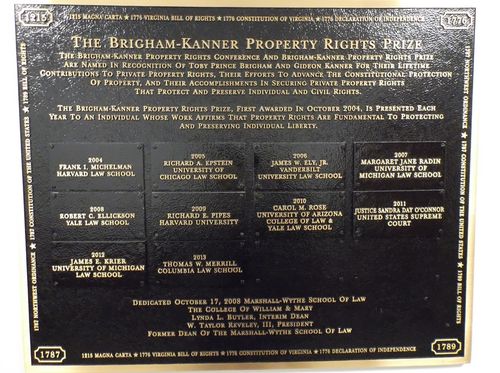
The last couple of days, we’ve returned to Williamsburg, Virginia to attend the annual Brigham-Kanner Property Rights Conference at the William and Mary Law School.

The Conference is the annual gathering of legal scholars and practitioners who focus on property law and property rights to celebrate the award the B-K Prize to “an individual whose scholarly work and accomplishments affirm that property rights are fundamental to protecting individual and civil rights.” The list of past winners is a who’s who of property scholars and includues James Ely, Richard Epstein, Carol Rose, and Frank Michelman.

This year’s prizewinner is Columbia Law’s Thomas Merrill. The Conference panelists have thus far focused on his scholarship, including his landmark article on the right to exclude, titled, not surprisingly, Property and the Right To Exclude, 77 Neb. L. Rev. 730 (1998).
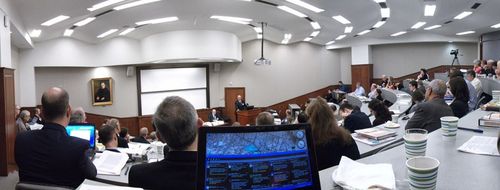
DSCF1087

Our Owners’ Counsel colleage Mark Savin speaking about “Defining the Essence of

Continue Reading 10th Annual Brigham-Kanner Property Rights Conference And Prize – Thomas Merrill
IMG_20121012_135714

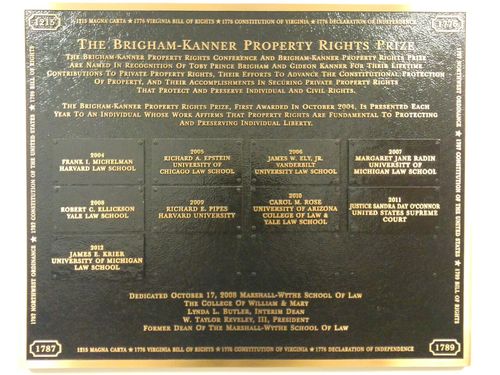
William & Mary Law School, host of the annual Brigham-Kanner Property Rights Conference, has announced that Columbia Law School Professor Thomas W. Merrill will receive the 2013 B-K Prize at the conference (October 17-18, 2013, Williamsburg, Virginia). The photo above is of the plaque on the wall at the William & Mary Law School listing B-K Prize winners.

The Conference agenda and speakers have yet to be finalized, but here’s the tentative list of topics:

  • The Impact of a Leading Property Scholar: Defining the Essence of Property
  • Promoting Government Forbearance
  • The Implications of the Court’s Recent Takings Cases
  • Property Rights in Times of Transition

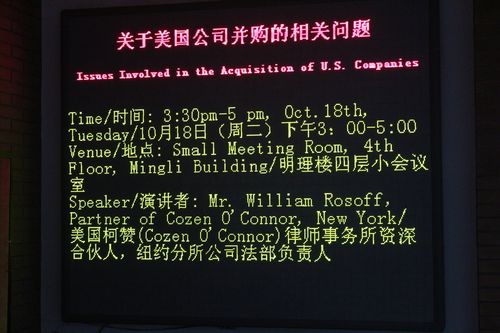
We spoke at the 2012 Conference in Williamsburg, and attended the 2011 Conference in Beijing. The 2013 lineup sounds pretty good, so mark your calendars. Continue Reading 2013 Brigham-Kanner Property Rights Prize: Professor Thomas Merrill

Update: we removed the embedded video that was posted above, since CBS kept replacing it with other clips. Here’s a direct link to the video.

As our readers know, we follow with keen interest events in the People’s Republic of China (does anyone call it that, anymore?), especially those issues related to property and a budding system of private rights. Here’s the latest from CBS’s venerable 60 Minutes, about the housing and real estate markets there. If true, it’s scary stuff, especially when you consider we live in a global economy, with so much of our goods supplied by the PRC.

China has been nothing short of a financial miracle. In just 30 years, this state-controlled economy became the world’s second largest, deftly managed by government policies and decrees.

One sector the authorities concentrated on was real estate and construction. But that may have created the largest housing

Continue Reading 60 Minutes On China’s (Possible) Housing Bubble

A quick one from colleague Christopher Dillon. In How to buy in China, Christopher provides a primer on how to buy a home in the People’s Republic. Tip: it isn’t cheap. He reminds us:

In China all urban land is owned by the state, while rural land is owned by collectives. Private ownership of land is forbidden, and urban land used for housing is leased from the state for a 70-year term. When you buy a home in China, you purchase the structure and the remainder of the land lease.

Just in case you are thinking of doing a “Depardieu.” You know, the Russian actor.Continue Reading Buying Property In China

Here are my remarks from last week’s Brigham-Kanner Property Rights Conference at the William & Mary Law School in Williamsburg, Virginia. Our panel spoke on “Property Rights in Times of Economic Crisis,” and included lawprofs James W. Ely (Vanderbilt), William Fischel, (Dartmouth), and Eric Kades (William & Mary). See the complete faculty list and agenda here.

+++++++++++++++++++++++++++++++++++++++

Aloha, I bring you greetings from the land of Midkiff, the land of Lingle.

I practice in the jurisdiction that believed it would cure our economic ills to use eminent domain to bust up the legacy land trusts, and make sure that everyone who owns a home could also own the fee simple interest.

Which they may now do, provided they can afford our median price for a single-family residence, $637,000.

I practice in the jurisdiction that believed that it would be a good idea to try and bring

Continue Reading Professor Ely, You Magnificent Bastard, I Read Your Book!

There’s still time to join us later this week at William & Mary Law School in Williamsburg, Virginia for the 2012 Brigham-Kanner Property Rights Conference, and the award of the B-K Prize to University of Michigan lawprof James Krier for his lifetime contributions to property law scholarship.

The Conference includes a day-long series of discussions on property rights, featuring leading scholars and practitioners. Topics include “The Impact of a Leading Property Scholar,” “The Judiciary’s Role in Shaping Constitutionally Protected Property,” “Property Rights in Times of Economic Crisis,” and “Property’s Moral Dimension.” The day will wrap with a roundtable discussion, “How Fundamental are Property Rights?” The complete agenda is available here.

I will be speaking on the panel about “Property Rights in Times of Economic Crisis,” discussing why property rights are even more important when times are tight.

Register on-line here. If you can’t join us, I will

Continue Reading 2012 Brigham-Kanner Property Rights Conference

Here’s a follow up to our earlier brief post about the opinion in Lavan v. City of Los Angeles, No.11-56253 (Sep. 5, 2012), in which a 2-1 Ninth Circuit panel held that the Fourth and Fourteenth Amendments protect the homeless against the City of L.A.’s seizure and destruction of their “momentarily unattended” property. The city undertook these efforts to clean up the “skid row” section of downtown.

Honolulu has an ordinance that has a similar purpose and design (to prevent the homeless from clogging up the parks and sidewalks with their “stuff”), but it is constructed quite differently. Instead of prohibiting property from being left unattended, it prohibits the “storage” of property in public spaces, with “storage” being defined as being left somewhere for more than 24 hours. Leave it unattended for more than that time, the city will scoop it up and store it at the owner’s

Continue Reading More On The Ninth Circuit’s Ruling That Homeless Have Property Rights, Too