


Even though the Oklahoma Supreme Court’s decision in Snow v. Town of Calumet, No. 119,758 (June 21, 2022) is short, we think it is worth reading because is clarifies who can bring an inverse claim, and what exactly do these claims allege.

In 1978, the Snows’ predecessor-in-title granted the Town an easement to maintain sewer lines. The easement was temporary and expired 6 months after the Snows purchased the property in 2010. But after the temporary easement expired, the Town didn’t cease its use of the property. Flash forward 7 more years, and the Town asked the Snows to grant it perpetual easements for its continued use. The Snows asked for compensation, but the Town said no.

Next up, the Snows’ trespass and inverse lawsuit in state court, with the Town counterclaiming with a quiet title claim asserting it had acquired a perpetual easement by prescription. Cross motions for
Continue Reading Oklahoma: The “Taking” Occurs When Govt Changes Its Use Of A Previously-Granted Easement

In Skatemore, Inc. v. Whitmer, No. 21-2985 (July 19, 2022), the U.S. Court of Appeals for the Sixth Circuit held that neither the Just Compensation Clause, nor the Fourteenth Amendment abrogated the states’ immunity from being sued in federal court for compensation for takings.

This is another one of those cases where — due to Co-19 — businesses forced to close or limit operations by the state (here, Michigan) brought regulatory takings claims in federal court. The claims included takings, and the relief sought was just compensation (no prospective injunction or declaratory judgment). The complaint named state officials (in their official capacities) and state agencies as the defendants. The district court dismissed for lack of jurisdiction and for failure to state a claim. 

The Sixth Circuit affirmed. The court rejected the argument that a state’s Eleventh Amendment immunity from being haled into a federal court without consent does not

Continue Reading CA6: State Officials Enjoy 11th Amendment Immunity From Just Compensation Claims In Federal Court

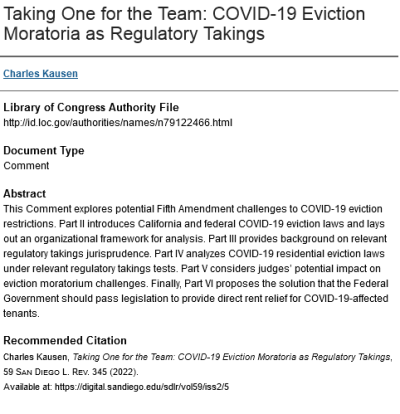
Screenshot 2022-07-02 at 09-16-05 Taking One for the Team COVID-19 Eviction Moratoria as Regulatory Takings

Check it out: a new article from the San Diego Law Review that’s worth reading. Here’s the Abstract:

This Comment explores potential Fifth Amendment challenges to COVID-19 eviction restrictions. Part II introduces California and federal COVID-19 eviction laws and lays out an organizational framework for analysis. Part III provides background on relevant regulatory takings jurisprudence. Part IV analyzes COVID-19 residential eviction laws under relevant regulatory takings tests. Part V considers judges’ potential impact on eviction moratorium challenges. Finally, Part VI proposes the solution that the Federal Government should pass legislation to provide direct rent relief for COVID-19-affected tenants.

Get the pdf here: “Taking One for the Team: COVID-19 Eviction Moratoria as Regulatory Takings,” 59 San Diego L. Rev. 345 (2022).

Our take on Co-19 takings (not just eviction moratoria) here. And our thoughts on emergency response laws, generally.Continue Reading New Article: “Taking One for the Team: COVID-19 Eviction Moratoria as Regulatory Takings”

The U.S. Court of Appeals for the Seventh Circuit’s decision in Nowlin v. Pritzker, No. 21-1279 (May 20, 2022), adds to a long line of rulings denying takings claims for coronavirus-related business shutdowns. 

This one challenged the Illinois governor’s executive orders which required “non-essential” businesses to shut down or reduce operations, and limited the size of gatherings. The plaintiffs brought the usual host of constitutional claims (a total of six), which included (naturally) a takings claim. The district court, after granting leave to allow the filing of an amended complaint, dismissed all six claims, concluding either that the plaintiffs had not alleged particularized injuries (and thus lacked standing, and thus the court lacked jurisdiction), or that the complaint failed to state claims.

The Seventh Circuit affirmed that all claims, with the exception of the takings claims, lacked jurisdiction because the plaintiffs had not alleged specific injuries. The court subject

Continue Reading CA7: Co-19 Shutdown Complaint Does Not Meet “Demanding test for alleging a regulatory taking”

Here’s a pretty rare one: a trial court entering summary judgment on liability in favor of the property owner in a takings case. Yes, you read that right.

And to top it off, this ruling comes in a case in which the taking alleged was a police invasion and destruction of a home for the valid public purpose of apprehending a holed-up criminal, a brand of claim that has not met with a whole lot of success. See, for example, this case from the Tenth Circuit, and this case from the Supreme Court of South Carolina.

In this order, the U.S. District Court for the Eastern District of Texas held the City of McKinney liable for a physical taking. The entire order is worth reading, but here are some of the highlights.


Continue Reading District Court: City Liable For Physical Taking For Destroying Home While Apprehending A Criminal

Another takings challenge to a Co-19 shutdown, another “no taking” result.

This time, it is from the Florida District Court of Appeal (Fifth District). In Orlando Bar Group, LLC v. Desantis, No.5D21-1248 (Apr. 8, 2022), the court affirmed dismissal of takings challenges to the governor’s emergency order that barred certain alcohol sales, and limited the service in bars. Orlando-area bar owners sued for inverse condemnation.

The Fifth District concluded that this did not result in a taking. First, the court held that it would not apply a categorical physical rule, because Cedar Point Nursery is not applicable. In that case, the owners were asserting their right to exclude the public, but here the bar owners claimed that the restrictions abrogated their right to include patrons and others. Slip op. at 7 (“The COVID orders at issue here did not permit third parties to access Appellants’ property; they did

Continue Reading Fla App: No Taking, Because COVID Is A Really Good Reason To Shut Bars Down

Here’s the latest case challenging a pandemic-related eviction moratorium, this one from Minnesota and the U.S. Court of Appeals for the Eighth Circuit.

In Heights Apts, LLC v. Walz, No. 21-1278 (Apr. 5, 2022), the court reversed the district court’s dismissal of a property owner’s takings claims. The owner challenged the Minnesota governor’s residential eviction moratorium and later extensions. Like a lot of these things, the Minnesota version was not a rent “holiday” (tenants were still, technically speaking, on the hook for the rent, and there were several limited exceptions under which the property owner could evict). But for the most part, the Minnesota measure, like a lot of these things, effectively left property owners holding the economic bag (good luck collecting thousands in back rent), and turned their units into public pandemic housing. 

The owner’s complaint raised Contract Clause, Petition Clause, and Takings claims.

Before we get to

Continue Reading CA8: Yee v. Escondido Doesn’t Save Eviction Moratorium From Takings Review

Lately, we’ve been zeroing in on one of the lesser known parts of the Supreme Court’s takings canon, Yee v. City of Escondido, 503 U.S. 519 (1992), where the Court concluded that a city ordinance that limited the amount a property owner could charge a tenant for rent was not a physical invasion taking.

In Yee, the Court held that the ordinance did not intrude on the owner’s right to exclude because the owners had invited their tenants to intrude on their property when they let them become tenants. Yeah, that invitation and resulting intrusion was conditioned on the tenant paying each month a specific amount of rent and the ordinance effectively rewrote that agreement, but the plaintiff raised only a facial categorical takings claim (and thus the question of whether the city-mandated lower rent prohibited a fair return to the owner was an issue that the owners could

Continue Reading Wash App: No Taking Of Right To Exclude Because Eviction Moratorium Merely Lets Tenants Remain

A fitting way to bid adieu to 2021: Ruble v. Tate-Nadeau, No. 4-20-0641 (Dec. 28, 2021), in which the Illinois Appellate Court held that the governor’s tavern and dine-in restaurant Covid-19 shut-down orders were not takings of personal property under section 7(4) of the Illinois Emergency Management Act.

This was not a claim for a constitutional taking, but only under the Act, which obligates “the State to pay just compensation” if it “take[s] possession” of personal or real property. The plaintiffs alleged that the governor had taken possession of their properties by forbidding use of their businesses. The trial court dismissed the petition for failing to state a claim.

Because the plaintiffs’ claims were “solely and exclusively” under the Act, the appeals’ court’s analysis was limited to statutory construction of the term “take possession of” personal or real property. The court concluded that “[t]his language contemplates the physical

Continue Reading Illinois Governor Did Not “Take” Property Within Meaning Of Emergency Act By Co-19 Business Shut-Down Orders

There’s not a lot of direct takings love in the U.S. Court of Appeals for the Second Circuit’s opinion in Melendez v. City of New York, No. 20-4238 (Oct. 28, 2021), but there’s enough there that you might want to read it anyway.

Because the opinion resurrected the plaintiffs’ Contracts Clause claim. You heard that right, their Contracts Clause claim. The plaintiffs asserted that New York City’s ordinance that prohibiting “threatening” a tenant due to their Co-19 status violated free speech and due process rights, and the city’s ordinance voiding personal guarantees for commercial leases impaired their lease contracts. The district court dismissed the case for failure to state a claim, concluding that the guaranty ordinance served a legitimate public purpose and did not favor any class.

The Second Circuit affirmed dismissal of the free speech and due process claims, but also concluded that the complaint alleged a plausible

Continue Reading CA2: NYC’s Eviction Moratorium May Have A Contracts Clause Problem