IS WM

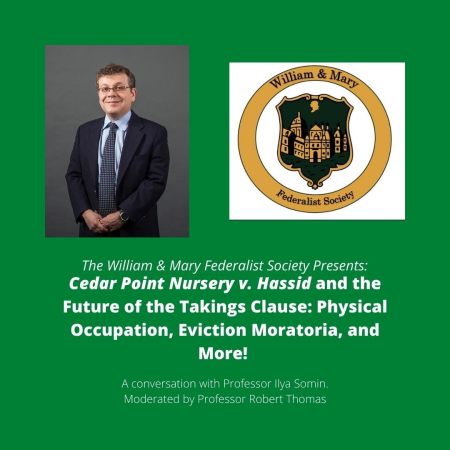
Next Tuesday, September 28, starting at 12:50pm ET, we’ll be moderating a talk sponsored by the William and Mary Law School chapter of the Federalist Society.

Professor Ilya Somin, a nationally-recognized expert in eminent domain, takings, and related topics, is zooming in to speak about “Cedar Point Nursery v. Hassid and the Future of the Takings Clause: Physical Occupation, Eviction Moratoria, and More.”

And guess what? You can Zoom in too. It’s open to the public, and it’s free.

So mark your calendars and join us for Prof Somin’s thoughts on the cutting-edge issues in property rights. Here’s the Zoom link: https://us02web.zoom.us/j/89365248145. See you on Tuesday!Continue Reading Join Us (For Free!): Lawprof Ilya Somin On “Cedar Point Nursery v. Hassid and the Future of the Takings Clause: Physical Occupation, Eviction Moratoria, and More” (Tues. Sep. 28, 2021, 12:50pm ET)
All the topics you want to know about, presented by top-notch faculty from across the nation. Sessions include:

  • Keynote: Do Animals Have Property Rights?
  • Did the Supreme Court Signal a New Direction in Property Rights in Cedar Point Nursery?
  • Maximizing Relocation Benefits: Understanding the Law and Regulations to Ensure Fairness
  • Challenging Public Use: Lessons From a 67-Day Trial
  • COVID Takings
  • Property Rights as Civil Rights
  • Eminent Domain National Update
  • Federal Court and the Daubert Challenge: How to Prepare
  • How to Position Your Client for the Fallout When Projects Don’t Get Built
  • Rural Broadband and the Emerging Constitutional Challenges
  • Are Precondemnation Entry Statutes Still Valid After Cedar Point Nursery?
  • How Condemnor and Property Owners’ Counsel Prepare the Battlefield
  • How Will the Trillion Dollar Infrastructure Bill Impact Your Practice?
  • Ethics
  • …and more, including a full slate of networking and social events!

We’ve sold out the last few years, so don’t Continue Reading Registration Open Now: ALI-CLE Eminent Domain & Land Valuation Litigation Conference, Jan 26-29, 2022, Scottsdale

There’s not a whole lot in the U.S. Supreme Court’s order granting an injunction on appeal that suspends application of a part of New York State’s eviction moratorium until such time as a cert petition is filed. The claims in that case are due process claims regarding the deprivation of a hearing, not takings. 

But check out the three-Justice dissent, authored by Justice Breyer (joined by Justices Sotomayor and Kagan).

Why? Because it may give some clues how they see the various federal, state, and local moratoria operating, and in doing so may have given us clues about how they might treat a takings challenge. As you know, several takings challenges are in the pipeline, including cases against the CDC moratorium, California’s, and the City of Los Angeles’s.

Check out page 3 of the dissent:

First, the legal rights at issue in this case are not “indisputably

Continue Reading Three Justices: After An Eviction Moratorium Expires, “eviction proceedings will be conducted exactly as they were before”

The hits keep coming. There have already been complaints alleging takings against the feds for the CDC eviction moratorium, and against the State of California for its moratorium. 

Now this, a complaint against the City of Angels alleging that its version of the moratorium works a taking, either a per se physical invasion taking, a regulatory taking, and a taking under California law.  

Not much more to say about it, unless you want to check out the LA Times’ report on the filing, “Landlord sues L.A. for $100 million, saying anti-eviction law caused ‘astronomical’ losses.”

Barista’s note: sorry about the potty-mouth movie clip at the top, but we’ve always thought this character’s sardonic comment about an ongoing situation (the 1968 Tet Offensive) really encapsulated the burden-spreading vibe of Armstrong v. United States, 364 U.S. 40, 49 (1960) (“The purpose of the Takings Clause is to “bar

Continue Reading New Complaint: LA’s Eviction Moratorium Is A Taking

According to that trustworthy source Wikipedia, in drama, the term deus ex machina (“God from the machine”) “is a plot device whereby a seemingly unsolvable problem in a story is suddenly and abruptly resolved by an unexpected and unlikely occurrence. Its function is generally to resolve an otherwise irresolvable plot situation, to surprise the audience, to bring the tale to a happy ending, or act as a comedic device.” It is mostly considered a “lazy or cheap” trope.

And that takes us to the various federal, state, and local eviction moratoria that are (or were) in effect at various points in the covid epidemic. To us, those have mostly seemed like cases of kicking the can down the road (to use another overworn trope) because although couched as merely temporary withholding of the usual eviction remedy for nonpayment of rent, in a great number of cases the practical effect

Continue Reading What The Deus Ex Machina? – Federal Court Complaint: California’s Eviction Moratorium Is A Taking

Programming note: as we noted here, we’ve recently moved our email subscribers to a new service. If you are already subscribed to our email updates you should not need to do anything, except look for the emails coming from Feedblitz, not Feedburner. If you want to sign up for email updates anew, go here. If you experience technical issues, or receive duplicate email notifications, please let me know.

Now back to your regularly scheduled programming…

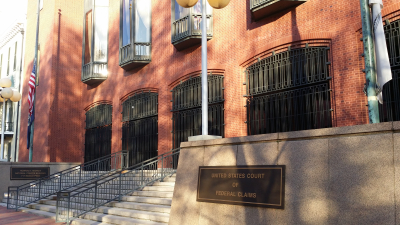
20151205_150106

Check out this Complaint, filed last week which asks the U.S. Court of Federal Claims to award property owners an unspecified amount (noted as $26 billion in the cover sheet) in just compensation for the taking of the plaintiffs’ property by the Center for Disease Control’s order temporarily halting residential evictions.

The Complaint alleges a physical invasion taking because it precludes “property owners from excluding [tenants] and leasing

Continue Reading New Takings Complaint: $26 Billion For CDC’s Eviction Moratorium

For your Monday reading, Amnon Lehavi, Temporary Eminent Domain, 69 Buff. L. Rev. 683 (2021). From the Abstract:

Times of emergency call for drastic measures. These steps may include the physical takeover of privately-owned assets by the government for a certain period of time and for various purposes, aimed at addressing the state of emergency. When will such acts amount to a taking, and what compensation should be paid to the property owner? How do temporary physical appropriations during times of emergency diverge, if at all, from temporary takeovers in more ordinary times?

The doctrinal and theoretical analysis of potential temporary takings has been done mostly in the context of non-physical government intervention with private property, such as when a local government imposes a temporary moratorium on land development until a certain condition is met. This Article focuses, however, on less investigated scenarios of temporary physical takeovers or other forms of government invasions. It seeks to identify the differences between a temporary invasion and a permanent occupation of property considered a per se taking under the Loretto rule. In so doing, this Article argues that while the alleged distinction between prevention of public harm and promotion of public benefit often proves untenable in evaluating whether a permanent government measure constitutes a taking, it might make more sense in exploring temporary acts.

Temporary eminent domain—referring here to various types of acts amounting to time-limited physical takings, even if not initially recognized as such by the government—may diverge from permanent eminent domain in yet another key element: identifying the basis for just compensation. Under long established (although often criticized) rules, compensation for a permanent taking is based on identifying the “fair market value” of the rights taken, while ignoring the effects that the public use for which the underlying asset is taken might have on the property’s long-term value.

The allegedly parallel metric used in the case of temporary takings,one of “fair rental value,” may often prove inadequate, both practically and normatively. This Article argues that because of unique aspects of temporary physical takings, legal rules on compensation should often seek to identify lost profits or actual damage. Moreover, in some cases, in which there is a direct relation between the pre-appropriation use of the asset and its post-appropriation use by the government, just compensation might also be based on a certain portion of the value of the public use. This is especially so when the time-sensitive value of the asset during such public use is particularly high. On this point, the Article offers an analogy to rules pertaining to compulsory licenses for patents.

Check it out.
Continue Reading New L. Rev. Article: “Temporary Eminent Domain”

The facts that compelled the U.S. Court of Appeal to conclude as it did in Yawn v. Dorchester County, No. 20-1584 (June 11, 2011) are pretty straightforward.

In response to a threatened public health viral crisis (no, not COVID, but Zika [remember that one?]), the county decided to spray insecticide. Some areas could not be reached by truck, so it was decided that aerial delivery was the way to go. The county put out press releases, and called local beekeepers to allow them to cover their hives (the insecticide, you see, doesn’t discriminate between mosquitos and bees, and is equally fatal to the latter unless the hive is covered). The pilot even testified that he had a map of the location of beehives, and that he turned off the sprayers as he approached those areas.

But Yawn, a beekeeper, did not get the warnings. The result: lots

Continue Reading CA4: No Taking When Aerial Pesticide Spray Killed Bees … But Not Why You Think

PXL_20210402_173956850
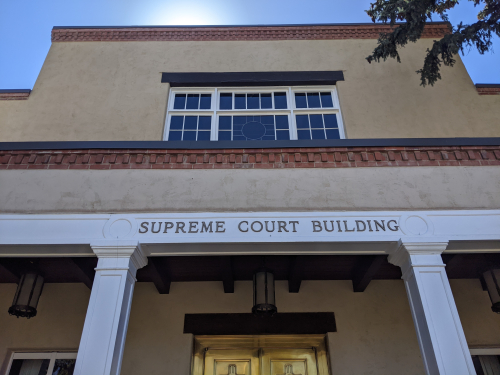
The New Mexico Supreme Court

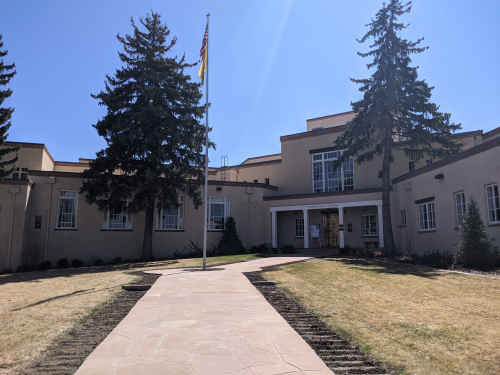
In what amounts to an advisory opinion, in State of New Mexico v. Wilson, No. S-1-SC-3850 (June 7, 2021), the New Mexico Supreme Court (courthouse pictured above) concluded that the State’s public health orders that impose “restrictions on business operations regarding occupancy limits and closures cannot support a claim for a regulatory taking requiring compensation[,]” either under the New Mexico Constitution or under New Mexico’s statutes.

We just published an article in the William and Mary Bill of Rights Journal about the subject of “coronavirus takings,” so naturally we’re intrigued by what the New Mexico court has to say. If you are also interested, read on.

PXL_20210402_173846557

This case is in the Supreme Court as a result of the State’s petition, asking the court to weigh in after 14 separate lawsuits were filed by business owners and others challenging the state’s orders that “restricted mass

Continue Reading NM Supreme Court’s Advisory Opinion: COVID Orders “cannot support a claim for a regulatory taking” – Health Measures Are “Background Principles”

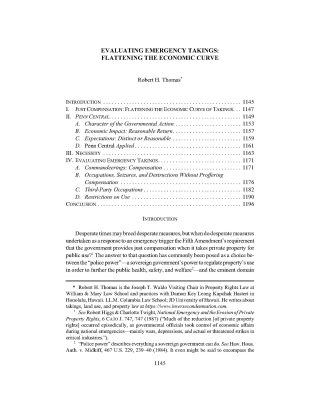
Title page

Wondering about so-called “covid takings” such as business lockdowns, seizures, commandeerings, eviction moratoria, and whether these might be takings?

If so, check out our latest article, Evaluating Emergency Takings: Flattening the Economic Curve, just published in the latest issue of the William and Mary Bill of Rights Journal.

Here’s the Intro to the article:

Desperate times may breed desperate measures, but when do desperate measures undertaken as a response to an emergency trigger the Fifth Amendment’s requirement that the government provide just compensation when it takes private property for public use? The answer to that question has commonly been posed as a choice between the “police power”—a sovereign government’s power to regulate property’s use in order to further the public health, safety, and welfare —and the eminent domain power, the authority to seize private property for public use with the corresponding requirement to pay compensation. But that should not be the question. After all, emergencies do not increase government power, nor do they necessarily alter constitutional rights, and an invocation of police power by itself does not solve the compensation question, but is merely the predicate issue: all government actions must be for the public health, safety, or welfare, in the same way that an exercise of eminent domain power must be for a public use.

This Article provides a roadmap for analyzing these questions, hoping that it will result in a more consistent approach for resolving claims for compensation that arise out of claims of emergencies. This Article analyzes the potential takings claims stemming from emergency measures, mostly under current takings doctrine. Which types of claims are likely to succeed or fail? In “normal” times, it is very difficult to win a regulatory takings claim for compensation. In the midst of emergencies—real or perceived—the courts are even more reluctant to provide a remedy, even when they should, and emergencies are a good time to make bad law, especially in takings law. Can a better case be made analytically for compensation?

Part I summarizes the economic “flattening the curve” principle that motivates takings claims for compensation. Part II sets out the prevailing three-factor Penn Central standard for how courts evaluate claims that a health, safety, or welfare measure “goes too far” and requires compensation as a taking, examining the character of the government action, the impact of the action on the owner, and the extent of the owner’s property rights. Deep criticism of the Penn Central standard is beyond the scope of this Article, and here, I accept it as the default takings test. But I argue that the government’s motivation and reason for its actions—generally reviewed under the “rational basis” standard—should not be a major question in takings claims. Rather, as this Article argues in Part III, the government’s emergency justifications should be considered as part of a necessity defense, not subject to the low bar of rational basis, but a more fact and evidence driven standard of “actual necessity.” Part IV attempts to apply these standards and examines the various ways that emergency actions can take property for public use: commandeerings, occupations of property, and restrictions on use. I do not conclude that the approach will result in more (or less) successful claims for compensation, merely a more straightforward method of evaluating emergency takings claims than the current disjointed analytical methods.

In sum, this article argues there is no blanket immunity from the requirement to provide just compensation when property is taken simply because the government claims to be acting in response to an emergency, even though its actions and reasons may satisfy the rational basis test. Instead, claims that the taking is not compensable because of the exigency of an emergency should only win the day if the government successfully shows that the measure was actually needed to avoid imminent danger posed by the property owner’s use and that the restriction on use was narrowly tailored to further that end.

One final word: the editors at the Bill of Rights Journal have been fantastic to work with to get this piece publication ready. Offering helpful comments, gently suggesting that certain parts are not working (but never insisting, and giving the author a lot of discretion), and getting the citations squared away: I could not have asked for more helpful editing. Congratulations on the publication of your latest issue. 

Thomas, Evaluating Emergency Takings: Flattening the Economic Curve, 29 Wm. & Mary Bill of Rights J. 1145 (2021)

Continue Reading New Law Review Article (Ours) – “Evaluating Emergency Takings: Flattening the Economic Curve,” 29 Wm. & Mary Bill of Rights J. 1145 (2021)