


Court of Federal Claims | Federal Circuit

We’re continuing our Detroit-themed posts today, with this one about auto bailouts and takings.

We generally don’t post trial court decisions, preferring to wait until we have a published opinion from a court of appeals. But from time to time, we have made exceptions, like here, where the counsel involved are well-known and the issue looks like one that might eventually go up the chain, and indeed has once already.

So it is in Colonial Chevrolet Co., Inc. v. United States, No. 10-647C (Sep. 9, 2015), in which the Court of Federal Claims denied the government’s motion to dismiss a takings claim. The plaintiffs are (former) General Motors and Chrysler dealers whose dealership contracts were sloughed off as part of the $38 billion bailout of the auto manufacturers. As part of the deal, the companies were required to cancel many of their franchise agreements, “forcing the dealerships to close.” According to the plaintiffs, “Chrysler

Continue Reading CFC: Auto Bailout Could Have Resulted In A Taking Of Dealerships’ Contracts
To those able to join us today for IMLA’s “The Takings Issue” webinar, thank you. Here are the links to the items which I discussed:

On Koontz:

On California Building Industry Ass’n v. City of San Jose:


Continue Reading Links From Today’s “The Takings Issue” Webinar

Check out the Federal Takings blog, which notes that the Supreme Court has asked the federal government to respond to the cert petition in Ministerio Roca Solida, Inc. v. United States, No. 14-5058 (filed May 27, 2015). The government previously waived its right to respond.

The issue presented in the case is one which the Supreme Court dodged in in United States v. Tohono O’odham Nation, 131 S. Ct. 1723 (2011): whether 28 U.S.C. § 1500’s jurisdictional bar — which deprives the Court of Federal Claims of jurisdiction if a related case is pending in another court at the time the CFC complaint is filed — operates in takings claims, which are required to be split between the CFC and the district courts (aka the “Tucker Act Shuffle”). We filed an amicus brief in Tohono, arguing that the statute cannot be read to deprive takings plaintiffs of

Continue Reading SCOTUS Requests Response To § 1500 Petition

Remember the Roca Solida case? That’s the follow up to the Supreme Court’s recent decision in United States v. Tohono O’odham Nation, 131 S. Ct. 1723 (2011), highlighting the jurisdictional problem in takings cases which that case left open. We labeled it a “jurisdictional ambush” that awaits any property owner who has a takings claim against the federal government.   

The question presented by the cert petition in Roca Solida is whether 28 U.S.C. § 1500, the statute which deprives the Court of Federal Claims of jurisdiction over a case if a related case is pending in another court at the time the CFC complaint is filed, applies to takings claims. In Tohono O’odham, which was not a takings case, the Court held that the statute prohibited the CFC from taking jurisdiction over the Nation’s monetary claim against the United States, when its related claims against the federal

Continue Reading Amici Brief In § 1500 Case: Congress Cannot Limit Property Owners’ Rights To Just Compensation By Narrowing CFC Jurisdiction, Especially With An Absurd Statute

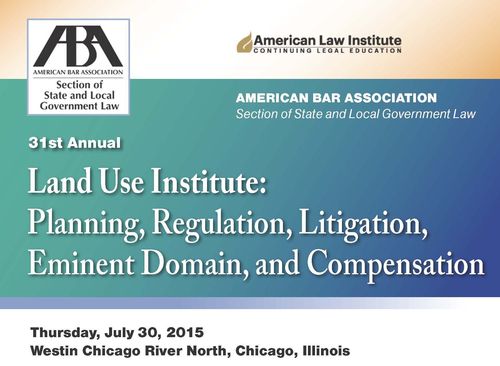
LUI header

The Land Use Institute, a program that for many years has been planned by co-chairs Frank Schnidman and Gideon Kanner, has found a new home with the American Bar Association’s Section of State and Local Government Law as the main sponsor. It also has a new Planning co-chair, Dean Patty Salkin of Touro Law School, who has stepped in for Professor Kanner.

This program is designed for attorneys, professional planners, and government officials involved in land use planning, zoning, permitting, property development, conservation and environmental protection, and related litigation. It not only addresses and analyzes the state-of-the-art efforts by government to manage land use and development, but also presents the key issues faced by property owners and developers in obtaining necessary governmental approvals.

This year, the one-day program is being held in conjunction with the ABA Annual Meeting in Chicago. It will be held on Thursday, July 30, 2015

Continue Reading Land Use Institute: Planning, Regulation, Litigation, Eminent Domain, and Compensation – 31st Annual Conference, Chicago, July 30, 2015

We are distracted today so haven’t had the time to write up our initial thoughts about Horne v. Dep’t of Agriculture, No. 14-275 (June 22, 2015), the California raisins takings case which the Supreme Court decided yesterday.

So instead we did this video, a take off on those goofy tech “unboxing” videos.

We’ll have more in the traditional format once we have a chance to write something down.  Continue Reading Unboxing Video: Horne v. Dep’t of Agriculture

… look no further than the above report from The Daily Show.

Yeah, it’s satire and does at times make light of a serious case, but the USDA was trying to defend a regulation that branded the Hornes as “raisin outlaws,” going so far as to hire a private security firm to “investigate the product” that the Hornes were defrauding the government of (dried fruit).

Top off “the world’s most outdated law” with the Ninth Circuit’s ridiculous avoidance after the Supreme Court’s earlier remand (the Takings Clause does not apply with equal force to personal property as it does to land) , and you have the recipe for success and an 8-1 ruling. 


Continue Reading Here’s Why The Supreme Court Held The Raisin Marketing Order Was Unconstitutional…

Update: here’s more Horne talk, in addition to our own initial thoughts in the above video and this post (“Magna Raisins: 8-1 SCOTUS Says There’s A Taking, But Not All Agree On Remedy“):


Continue Reading Raisin Round-Up

Here’s the podcast of our recent talk to the American Bar Association’s Section of State and Local Government Law about the (then) upcoming decision in Horne v. Dep’t of Agriculture, No. 14-275. Transcript here, if you’d prefer to read it.

This is a preview of the decision. But since we made some predictions — several of which bore fruit in today’s opinions — we thought we’d post it while we digest the Court’s opinions. 

As you may know, the Court today issued its opinions, with eight justices concluding that the raisin marketing order is a physical taking of property, rejecting the Ninth Circuit’s holding that the physical takings rules do not apply when personal property is involved.

We’ll have more analysis shortly, including a round-up of how other commentators view the case. Stay tuned. 


Continue Reading Podcast: Leviathan Shrugged? The Supreme Court’s Raisin Takings Case

We’ve already weighed in on how the Court of Federal Claims’ decision holding that the government’s takeover of AIG was an illegal exaction, but that it wasn’t a taking. But here are the thoughts of others:

  • Lawprof Ilya Somin: “Court rules that federal takeover of AIG was an “illegal exaction,” but not a taking” (“As Judge Wheeler notes, the rule that illegal exactions cannot qualify as takings is based on longstanding precedent. But I am nonetheless skeptical of its validity. It seems to me that a taking occurs any time the government seizes private property, regardless of whether the government’s action was otherwise properly authorized or not. just as unauthorized government action can violate other constitutional rights, such as those protected by the First Amendment or the Fourth Amendment, so too it can violate the Takings Clause of the Fifth Amendment. Nothing inherent in the logic of either


Continue Reading AIG/Starr Round-Up