


Court of Federal Claims | Federal Circuit

ALI-CLE-2016-masthead

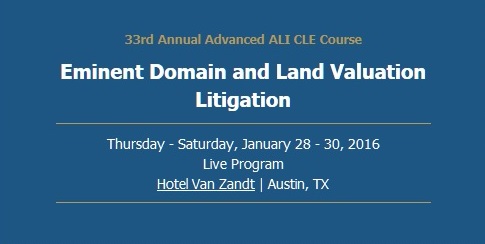
We’re exactly one month away from the 2016 Eminent Domain and Land Valuation Litigation / Condemnation 101 Conference, which runs from January 28-30, 2016, in Austin, Texas. 

Together with our friends and colleagues Joe Waldo, Jack Sperber, and Andrew Brigham, we think we’re put together a pretty good program that covers a lot of ground. This is the first time the conference has been to Austin, and we’re hoping for a good turnout. 

Here’s the full agenda for the program. 

If you have not already signed up, there is more than enough room, and there’s still time.

If you haven’t yet pulled the trigger, we’d like to convince you to come. So over the next few days, we’re going to be posting highlights from the agenda, featuring our stellar faculty.

  • We’ll start off with a talk welcoming us to the city by Austin Mayor Steve Adler


Continue Reading Counting Down To The ALI-CLE Eminent Domain Conference (Austin, Jan 28-30, 2016)

When we hear the word “trona,” we think of Trona, California, a hardscrabble San Bernardino County town near Death Valley.

We just thought we’d get that out of the way, because today’s case from the Federal Circuit, Barlow & Haun, Inc. v. United States, No. 15-5028 (Oct. 9, 2015), doesn’t involve the town, but it does involve trona mining (in Wyoming). 

It seems that the federal government preferred trona mining to oil and gas development. The Bureau of Land Management “indefinitely suspended” oil and gas leases on federal public lands in one part of Wyoming, because oil and gas development posed risks to trona mining. Barlow had 26 oil and gas leases with BLM, and it sued for a taking, and for breach of the leases. 

After trial, the Court of Federal Claims concluded that the breach of contract claim failed on the merits, and that

Continue Reading Fed Cir: Claim That BLM Suspension Of Oil And Gas Leases Was A Taking Isn’t Ripe Because BLM Didn’t Really Suspend The Leases

One for all you Court of Federal Claims mavens: a new cert petition, filed On Wednesday, that once again puts front and center 28 U.S.C. § 1500the statute which bars the CFC from hearing claims that are “pending in any other court” against the United States.  

The statute was last interpreted by the Supreme Court in United States v. Tohono O’Odham Nation, 563 U.S. 307 (2011), a case in which the Nation alleged in a District Court lawsuit that the federal government had breached trust duties it owed. Almost immediately thereafter, the Nation filed a claim in the CFC for money damages based on the same theory. The CFC’s limited jurisdiction does not allow it to hear claims for declaratory relief, and District Courts are without power to make the federal government pay significant money damages. Meaning that claims like the Nation’s (and takings claims

Continue Reading New Cert Petition: Federal Circuit Expanded § 1500’s Jurisdictional Bar

One for all you civil procedure and jurisdiction wonks. The background facts are a bit detailed, so please bear with us. 

Normandy Apartments in Tulsa, Oklahoma made a series of agreements with the federal government: in return for Normandy agreeing to rent to low-income Section 8 tenants and maintain the premises, the Department of Housing and Urban Development would pay the difference between the tenant’s contribution and the rent. The last of these agreements was not with HUD, but with the Oklahoma Housing Finance Authority, although the terms were essentially the same. Normandy also agreed with HUD that in return for renting to low-income tenants, Normandy could prepay its HUD-backed mortgage. Like the Section 8 contract, this agreement obligated Normandy to maintain the premises, a standard enforced by HUD inspections.

Normandy failed several inspections, and after some back-and-forth about whether Normandy was entitled to correct the alleged failings, HUD informed it

Continue Reading Fed Cir On Judicial Estoppel, The Tucker Act Shuffle, And Penn Central

In 1989, agents of the Libyan government blew up a plane of civilians, killing 170 passengers and crew. Victims’ families brought suit against the Socialist People’s Libyan Arab Jamahiriya in U.S. District Court in D.C. for damages, and after winning summary judgment, the court entered judgments totaling approximately $1.3 billion. Libya appealed to the D.C. Circuit.

The very day the appeal was filed, the U.S. government and Libya entered into a settlement agreement which established a $1.5 billion settlement fund to compensate U.S. victims, and a $300 million fund to compensate “Libyan victims of U.S. airstrikes.” The two governments agreed that the funds were in full settlement of all claims for its respective nationals. As a consequence of this agreement, all pending lawsuits in the courts were “terminated.” The U.S. intervened in the D.C. Circuit appeal, and asked the court to dismiss. The court agreed, and terminated the appeal

Continue Reading CFC: Terrorism Victims Properly Alleged Their Judgments Against Libya Were Taken By Govt Settling Claims By Agreement

Here’s the recently-published brochure with more details about the ALI-CLE Eminent Domain and Land Valuation LItigation conference, set for Austin in January 2016. 

In the coming days and weeks, we’ll be posting more details about the conference. Our co-planning chairs Joe Waldo, Jack Sperber, and Andrew Brigham have assembled a great agenda, taught by the usual stellar faculty. If eminent domain, appraisal, or land use is your thing, you really should attend. 

33d Annual ALI-CLE Eminent Domain and Land Valuation Litigation Conference, Jan. 28-30, 2016, Austin, TX

Continue Reading ALI-CLE Eminent Domain And Land Valuation Conference: Full Brochure

In Dimare Fresh, Inc. v. United States, No. 15-5006 (Oct. 28, 2015), the Federal Circuit held that the FDA wasn’t liable for a taking when it issued an incorrect food safety warning that hurt the tomato market, because it was just a warning and didn’t come with coercive action like a quarantine or a recall. In other words, just sayin.

The FDA thought that certain types of tomatoes from certain growing areas might be responsible for a salmonella outbreak. So it “went loud,” which in today’s internet-fueled media environment meant that over the course of the next few days, it issued two press releases, the first which identified the type of tomatoes it believed were involved (“raw red plum, red Roma, or round red” — a pretty wide net), and a second which let certain geographic areas off the hook. The FDA also briefed the media, narrowing the suspected

Continue Reading Just Sayin: No Taking For FDA Salmonella Warning Which Killed Tomato Sales

ALI-CLE-2016-masthead

Here’s the full agenda for the 2016 Eminent Domain and Land Valuation Litigation / Condemnation 101 Conference, January 28-30, 2016, in Austin, Texas. 

Together with our friend and colleague Joe Waldo, we think we’re put together a pretty good program that covers a lot of ground. This is the first time the conference has been to Austin, and we’re starting off with a talk by Austin Mayor Steve Adler, who in his former life was an eminent domain lawyer. Other highlights:

  • Professor Ilya Somin will speak about his recently-published book in a segment entitled “The Impact of Kelo and the Limits of Eminent Domain.”
  • Pipelines and Energy Corridors: Valuation Perspectives of Condemnors and Condemnees” with the lawyers on the front lines of one of the hottest topics in eminent domain law nationwide.
  • Retired Minnesota Supreme Court Justice Paul H. Anderson will give us his tips


Continue Reading It’s Here – 2016 ALI-CLE Eminent Domain Conference: Complete Agenda, Faculty, Registration Information

Here’s the Brief in Opposition in the case which asks whether takings claims against the federal government — which we described as subject to a “jurisdictional ambush” due to the old Tucker Act Shuffle — are subject to the rule of 28 U.S.C. § 1500 set out in the Tohono O’odham case. 

If that’s a lot to digest in one sentence, here’s the slightly longer story. The core issue is one we’ve dealt with extensively before, and which the Supreme Court dodged in in United States v. Tohono O’odham Nation, 131 S. Ct. 1723 (2011), namely, whether § 1500’s jurisdictional bar operates in takings claims, which are required to be split between the CFC and the district courts (aka the “Tucker Act Shuffle”). We filed an amicus brief in Tohono O’odham, arguing that the statute cannot be read to deprive takings plaintiffs of their right to secure just compensation, when they

Continue Reading BIO In Tucker Act Jurisdictional Ambush Case: Takings Claims Subject To § 1500’s Rules

A short one from the Federal Circuit, Rasmuson v. United States, No. 14-5089 (Oct. 5, 2015), that comes out of a rails-to-trails case, but has wider applicability. 

The case involved the usual: plaintiffs owned lands over which the railroad had rights of way, and when the railroad ceased operating and the Surface Transportation Board issued a Notice of Interim Trail Use, the owners’ takings claim ripened because but for the issuance of the NITU, under Iowa law the land otherwise would have reverted back to the owners. So far, so good. 

In the valuation trial, the Court of Federal Claims applied the “before and after” method, and concluded that the “before” condition of the land was as it existed before the trails easements, but that the appraisers should “ignore any physical remnants of the railway’s use, which would have remained if the railway easement had been permitted to lapse.

Continue Reading Federal Circuit: “Before” Condition Must Account For Railroad Junk That Would Have Been Left Behind