Court of Federal Claims | Federal Circuit

A short (unpublished) one from the Federal Circuit, Albright v. United States, No. 19-2078 (Dec. 1, 2020).

This rails-to-trails takings case turned on the predicate question: do the plaintiffs own private property? That question turned on the lex loci, and whether, under Oregon law, the original right-of-way conveyance meant to grant to the railroad an easement or a fee simple interest. 

Thus, the opinion naturally relies solely on Oregon’s property law: if the grant was for a limited purpose (“right of way” or “railroad”), then it was an easement; if the grant did not specify the use or was otherwise unlimited, it was a conveyance of fee simple. That was enough for the federal court:

In addition, none of the deeds provide for a reverter or otherwise contain language limiting the use that the grantee could make of the land. To the contrary, each of the deeds purport

Continue Reading Fed Cir: No Taking, Because Oregon Property Law Is Clear (But Is It?)
IMG_20190925_175845

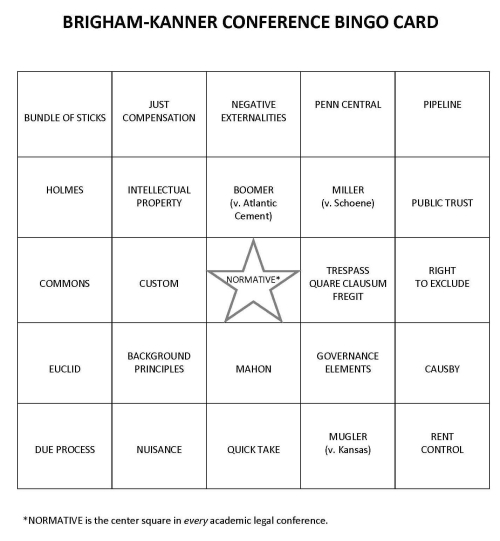
Although it is set to launch this Friday, October 2, 2020, there’s still more than enough time to register (and room at the inn) for you to join us for the 17th Annual Brigham-Kanner Property Rights Conference at the William and Mary Law School.

Like everything else this season, the Conference is online (register here), and although we would have preferred to gather in-person of course, the online format has some advantages: the number of attendees isn’t limited by the classroom size (this year’s registrations are at record levels), you don’t need to travel to Williamsburg, and the Conference is free if you don’t want Virginia CLE credit for attending. What a deal.

In our opinion, this is the best legal academy/practicing bar conference on property law. This year, the Conference honors the Brigham-Kanner Prizewinner, Harvard Law School Professor Henry Smith.

Here are the panel topics

Continue Reading There’s Still Room: Join Us For The 17th Annual Brigham-Kanner Property Rights Conference (Online, Free!)

IMG_20191203_064308

Today, the U.S. Supreme Court is considering our cert petition during the Court’s “long conference.”

This is the case focusing on the interplay between Williamson County‘s “final decision” ripeness rule and the “case and controversy” injury-in-fact standing requirement, and asks: if the government makes its final decision, but the plaintiff isn’t injured until later, has there been an actionable taking? 

Often, the date on which the government ripens a takings claim by making the final decision to apply the regulation to the plaintiff’s property, and the date on which the plaintiff’s property rights are actually affected are the same. But here, the two key events happened on different dates. The feds allege they made their final decision to jettison in the GM bankruptcy the plaintiffs’ tort and related claims on July 1, 2009. The Federal Circuit accepted the government’s assertion that final decision occurred when it uploaded its

Continue Reading Considered In Today’s SCOTUS Conference: What Triggers The Takings Statute Of Limitations?

Well, that didn’t take long: as we surmised back when the CDC first issued its order halting residential evictions until the end of the year due to COVID (see “How Can? U.S. DHS: National Eviction Moratorium (Roscoe Filburn Could Not Be Reached For Comment),” the order has resulted in a complaint in the U.S. District Court for the Northern District of Georgia that alleges the order is unconstitutional.

No takings claim (not the right court to raise a just comp claim), but there’s a lot “there,” so to speak: admin law (CDC exceeded its authority), violation of the right of court access, Supremacy Clause, Tenth Amendment, anti-commandeering, this is an invalid exercise of legislative power under Article I.

No takings claim, but read the complaint anyway.  

Complaint, Brown v. Azar, No. 1:20-cv-03702 (N.D. Ga. Sep. 8, 2020)

Continue Reading Complaint (N.D. Ga.): CDC Eviction Moratorium Is Unconstitutional (No Takings Claim, However)

In Hawaii we employ a phrase, “how can?” as a shorthand response when you’re wondering how something can be. It’s easy, short, and more efficient than saying “I’m sorry, I don’t understand how you think you can accomplish this.”

Thus, “how can?” was our first response when the U.S. Department of Health and Human Services’ recently-released agency order establishing a covid response nationwide residential eviction moratorium crossed our desk yesterday. By what authority does the federal government purport to dictate (yes, we’re going to use that word) whether state and local governments (and state courts) allow evictions for not paying rent? We thought that property law was one of those local things?

Just as we were about to dive in, our friend and colleague Tony Della Pelle produced an analysis more cogent than “how can?” In “COVID Eviction Freezes – Who Is Supposed To Pay?,” Tony asks, “Did

Continue Reading How Can? U.S. DHS: National Eviction Moratorium (Roscoe Filburn Could Not Be Reached For Comment)

News just in: we’ve just received confirmation that the Conference will not be in-person in Scottsdale in January 2021, and we’re going online.

Not a big surprise, but still a bit disappointing, and it’s a shame that the circumstances won’t allow us to meet in-person to talk shop and to renew our friendships like we do every year. 

But rest assured we’re making lemonade out of these lemons, and we’d appreciate everyone holding the dates on your calendars to join your colleagues from across the nation for the online Conference. And no, we’re not going to do two-and-a-half-days remotely, we’re paring down the agenda and will be focusing on hot topics, and great presenters. The remote format has some advantages, and we’re taking advantage of the circumstances to plan a conference more interactive and a bit different than usual.

This will also be a great program for first-time Conference participants.

Continue Reading Breaking: News About The 2021 ALI-CLE Eminent Domain & Land Valuation Litigation Conference (Jan. 28-29, 2021)

Reading through the Federal Circuit’s opinion in Christy, Inc. v. United States, No. 19-1738 (Aug. 24, 2020) (a case we’ve been following since its inception; see here for the complaint), doesn’t hold out a lot of hope for something new, because the Federal Circuit already ruled in Golden v. United States, 955 F.3d 981 (Fed. Cir. 2020), that cancellation of a patent via inter partes review is not a taking. That precedent took care of the Christy plaintiffs’ main beef.

But they also alleged that the fees they paid to the PTO for issuance and maintenance of the patent were exactions. They wanted the fees they had paid refunded. Why should we have to pay for what the government eventually held was an invalid patent? No dice, held the court. An “exaction” is for money paid “in contravention of the Constitution, a statute, or a regulation.”

Continue Reading Fed Cir: No Taking For Invalidating Patent By Inter Partes Review (But You Knew That Already)

Here’s the cert petition that we’ve been waiting to drop in a case we’ve been following. Last we checked in, the Ninth Circuit (with concurral) had denied en banc review, over a dissental.

In Cedar Point Nursery v. Shiroma, 923 F.3d 524 (May 8, 2019), a 2-1 panel of the Ninth Circuit affirmed the dismissal of a complaint for failure to plausibly state a takings claim under Twombly/Iqbal.  At issue was a regulation adopted by California’s Agricultural Labor Relations Board which requires agricultural employees to open their land to labor union organizers. The regulation is framed as protecting the rights of ag employees to “access by union organizers to the premises of an agricultural employer for the purpose of meeting and talking with employees and soliciting their support.”

The panel majority viewed the complaint as alleging a Loretto physical invasion taking, and held the

Continue Reading New Cert Petition: Does A Physical Invasion Taking Require 24/7 Occupation?

It was mostly a win for the property owners in today’s Federal Circuit opinion in Hardy v. United States, No. 19-1793 (July 15, 2020).

The opinion isn’t heavy on the takings doctrine. It spent most of the time affirming the Court of Federal Claims’ conclusion that the plaintiff-owners owned property under Georgia law (their predecessors had conveyed easements, not fee simple interests, and thus maybe had their reversionary interests taken when, after the rails were abandoned, they were converted to trails use).

Check it out for the nuances of Georgia property law. Is this an easement, a fee, a right-of-way, or something else? Whatever the feds wanted them to be, the court agreed with the owners that Georgia said they were easements. And we know who defines property, mostly, for purposes of the takings clause in this case: Georgia.

The balance of the opinion was more of a draw

Continue Reading A Not Too “Takey” Takings Opinion From The Federal Circuit