


This just crossed our desk in a case we’ve been following (link includes the numerous merits and amicus briefs filed in the case), the California Supreme Court’s opinion, authored by the Chief Justice in California Building Industry Ass’n v. City of San Jose, No. S212072 (June 15, 2015). 

The bottom line is the court agreed that rational basis review is the applicable standard:

As noted at the outset of this opinion, for many decades California statutes and judicial decisions have recognized the critical need for more affordable housing in this state. Over the years, a variety of means have been advanced and undertaken to address this challenging need. We emphasize that the legal question before our court in this case is not the wisdom or efficacy of the particular tool or method that the City of San Jose has adopted, but simply whether, as the Court of Appeal held

Continue Reading Cal Supreme Court: Affordable Housing Exaction Subject Only To “Aliens Might Have Done It” Rational Basis Review

A couple of noteworthy conferences upcoming, one in-person, the other a “webinar” format:

  • The first is “Kelo: A Decade Later” at the U. Connecticut Law School, Friday, March 20, 2015, from 8:30 am – 4:30 pm. The conference promises to “look back at the decision and its repercussions,” and includes the lawyers for Ms. Kelo and the City of New London. “The conference will then explore the role of eminent domain in government planning generally. What role does and should eminent domain play in economic development?  What is the impact of post-Kelo changes to state law?  Does eminent domain have distinctive impacts on low income communities?  Leading scholars and practitioners in law, planning, sociology, and economics will explore these questions.” We note that our Connecticut Owners’ Counsel colleague Dwight Merriam is one of those “leading practitioners,” and will be moderating a panel entitled “Eminent Domain and Economic Development”


Continue Reading Upcoming Conferences – Kelo In Connecticut, APA And The ESA

We can’t hear or read the word “plethora” without thinking of the “¡Three Amigos!” scene with Jefe and El Guapo, so when the California Court of Appeal “apologize[d] for the plethora of statutory citations and footnotes” (in a footnote!) in the latest opinion about the fallout and intragovernmental battle over the money in the wake of the “Great Dissolution” of California’s redevelopment agencies, we naturally had to post the video.

Bottom line: the agreements which the County entered into as the successor to the county redevelopment agency “are ‘enforceable obligations’ of a former redevelopment agency that continue to be payable out of property taxes before distribution of the remainder to the taxing entities.” Slip op. at 2. 

County of Sonoma v. Cohen, No. C075120 (Cal. App. Mar. 12, 2015)


Continue Reading Cal App: “A Plethora of Statutory Citations And Footnotes” In The Latest Redevelopment Chapter

Worth reading: “Legislative Exactions after Koontz v. St. Johns River Management District,” an article by colleagues Luke Wake and Jarod Bona, recently posted to SSRN. Here’s the abstract:

Decided in June, 2013, Koontz v. St. Johns River Management District settled a long-running debate among scholars as to whether the nexus test — first pronounced in Nollan v. California Coastal Commission — applies in review of monetary exactions. In the preceding years, the lower courts had largely resolved this question in the government’s favor — limiting Nollan to its facts, and holding the nexus test inapplicable if a challenged permit requires the applicant to pay or expend money as a condition of permit approval. Further, the trend among the lower courts held the nexus test inapplicable in review of legislatively imposed exactions, regardless of whether the contested condition requires a dedication of real property or money.

Without question

Continue Reading New Article: “Legislative Exactions after Koontz v. St. Johns River Management District”

No, it’s not about the weird dude down at the Planning Department, but a new (draft) article by two familiar property lawprofs, Lee Fennell and Eduardo Penalver. Here’s the abstract:

How can the Constitution protect landowners from government exploitation without disabling the machinery that protects landowners from each other? The Supreme Court left this central question unanswered — and indeed unasked — in Koontz v St. Johns River Water Management District. The Court’s exactions jurisprudence, set forth in Nollan v. California Coastal Commission, Dolan v. City of Tigard, and now Koontz, requires the government to satisfy demanding criteria for certain bargains — or proposed bargains — implicating the use of land. Yet because virtually every restriction, fee, or tax associated with the ownership or use of land can be cast as a bargain, the Court must find some way to hive off the domain of exactions

Continue Reading New Article: “Exactions Creep”

Here’s the final program and faculty list for the 2015 Hawaii Land Use Conference, coming up Thursday and Friday, January 15-16, 2015, in downtown Honolulu.

This is the bi-annual gathering of Hawaii’s land use mavens, and this year’s program has two very special presenters. Storied lawprof Richard Epstein (perhaps more than a “mere mortal”) will be presenting the keynote talk on “Stealth Takings: Exactions, Impact Fees and More,” and our ABA colleague Patty Salkin, Dean of the Touro Law School, will get us our Ethics CLE credits with her usual exciting program on ethics topics. (As someone who has attended more than few of her presentations, we can report that it is worth the price of admission alone, and even though “ethics CLE” and “exciting” are words we usually do not associate with each other, Dean Salkin’s presentation is the exception.)

Our panel on “

Continue Reading Still Time To Join Us For The 2015 Hawaii Land Use Conference (Jan. 15-16)

We bring you the latest guest post by colleague Paul Schwind, who has been tracking the issues and arguments that recently led the Hawaii Supreme Court to conclude, in DW Aina Lea Development, LLC v. Bridge Aina Lea, LLC, No. SCAP-13-0000091 (Nov. 25, 2014), that the Hawaii Land Use Commission wrongfully rescinded an earlier reclassification of land (read: “rezoning” to all you non-Hawaii land users).

The oral argument recording is posted above.

We’ll post up our thoughts on the decision in a separate post. 

—————————————————————-

Hawaii Supreme Court In Aina Lea: The Rationales Behind The Opinion

by Paul J. Schwind*

Robert has asked me to summarize the rationales behind the holdings in the Hawaii Supreme Court’s recent opinion in DW Aina Lea Development, LLC v. Bridge Aina Lea, LLC, No. SCAP-13-0000091 (Nov. 25, 2014), which he summarized the following day, outlining the litigation history of the

Continue Reading Guest Post – Hawaii SCT In Aina Lea Case: The Rationales Behind The Opinion

2015 Hawaii Land Use Law Conference Banner - Credits

Registration is now open for the 2015 Hawaii Land Use Law Conference, to be held in downtown Honolulu on Thursday-Friday, January 15-16, 2015.

This is the bi-annual conference, co-chaired by U. Hawaii lawprof David Callies and land use lawyer Ben Kudo, that brings together the big names in our area of law. In other words, the one conference you don’t want to miss if you are a Hawaii land use or property lawyer, in-house counsel, a planner, an appraiser, a property owner or manager, or a law student interested in these topics. 

Download the full brochure here, or view it below. 

The keynote speaker this year is lawprof Richard Epstein, addressing “Stealth Takings: Exactions, Impact Fees and More.” Immediately following his talk, I will be moderating a panel on “Impact Fees and Exactions After Koontz,” with colleagues Bruce Voss and David Brittin. The rest

Continue Reading Registration Open: 2015 Hawaii Land Use Law Conference, Jan. 15-16, 2015

9780199322541_450After a couple of days detouring to election law, today we’re back to our usual programming.

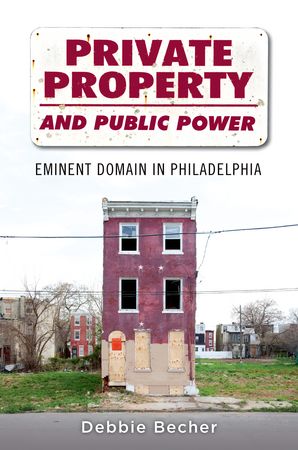
We caught wind of an upcoming book (September 2014), “Private Property and Public Power: Eminent Domain in Philadelphia,” by Barnard College Professor Deborah Becher. “Her book—the first comprehensive study of a city’s eminent domain acquisitions—explores how and why Philadelphia took properties for private redevelopment between 1992 and 2007.” Sounds intriguing. More information about the book here.

Here’s an interview with Professor Becher about the book and her study, which lists some of her more controversial — and debatable — conclusions. Highlights:

  • “The problem is that pundits and activists present the transfer of ownership to a new private owner as the fundamental problem. They say that if government were to take property for a school, a highway, or a public park, abuse wouldn’t be an issue, and that all takings for new


Continue Reading Upcoming Book: Private Property and Public Power – Eminent Domain in Philadelphia

Here’s more on a post in May in which we suggested you should get your hands on a copy of Professor Gideon Kanner’s latest article, Detroit and the Decline of Urban America, 2013 Mich. St. L. Rev. 1547 (2014). He writes about the role of eminent domain as one of the six factors contributing to urban flight and depopulation of major cities such as Detroit. Unfortunately, we could only post a reference to the article, but not the article itself.

Now we can. Here it is. It is a quick and enlightening read.

Continue Reading Kanner: Detroit and the Decline of Urban America