


Our thanks to Jacob Cremer for the heads-up on the Florida Court of Appeals’ decision in Ocean Palm Golf Club Partnership v. City of Flagler Beach, No. 5D12-4274 (May 30, 2014). Jacob did not post any analysis (undertstandable because his law firm is involved in the case) so we’ll add our two cents.  

Here’s the BLUF: the city’s refusal to change the zoning on a 9-hole golf course and a surrounding parcel to allow residential development did not deprive the parcels of their value, and were not a taking. 

Here’s the longer story. The case involved two parcels, one the golf course, and the other, a vacant parcel. At one time, they were a single parcel owned by a single owner, but by the time of the litigation, they had been subdivided and separately owned by two separate but related entities. Back in the day, the city

Continue Reading Fla App: Because A Golf Course That Eventually Went Broke (And Was Later Bought By The City) Was “Profitable,” City Not Liable For A Taking

Battle for Brooklyn film poster

You remember Battle for Brooklyn, the documentary which chronicles the eminent domain fight over New York’s Atlantic Yards project? (Read our review of the film here to refresh your recollection.)

Well here’s the latest chapter. Or perhaps “epilogue” is more appropriate, because the former property owners have long since been evicted, the homes have been razed, and the New Jersey Brooklyn Nets are ensconced in the Barclays Center. (The promised affordable housing and “jobs, jobs, jobs?” Eh, not so much, but who’s counting?)

According to this story in the New York Times, preservationists are planning to award the private beneficiaries of the city’s exercise of eminent domain something called the “Jacqueline Kennedy Onassis Medal.” Seriously:

The Municipal Art Society is well known for campaigns to save Grand Central Terminal and Lever House and to stop towers that would have cast long shadows over

Continue Reading Atlantic Yards: How About Calling It The “Jay Z” Medal?

A must read from our colleague Professor Steven Eagle (author of the Regulatory Takings treatise) about the Koontz case, Koontz in the Mansion and the Gatehouse, forthcoming in the Urban Lawyer.

Here’s the abstract:

This Article focuses on problems in implementing the U.S. Supreme Court’s expansion of its doctrine of unconstitutional conditions pertaining to land development approvals in Koontz v. St. Johns River Water Management District. As earlier developed in Nollan v. California Coastal Commission and Dolan v. City of Tigard, the doctrine applied only to unrelated or disproportional exactions of interests in real property. The doctrine was expanded in Koontz to include denials of development approval after landowner refusal to accede to unreasonable exaction demands, and also to exactions of money as well as real property interests.

Drawing an analogy to Yale Kamisar’s disparate treatment of criminal defendants in the “mansion” of the judicial system and the “gatehouse”

Continue Reading New Article: “Koontz in the Mansion and the Gatehouse” (Professor Steven Eagle)

Worth reading: a new working paper on exactions and Koontz by a Pacific Legal Foundtion Fellow (PLF represented the prevailing property owner in Koontz).

The article, “Nollan and Dolan and Koontz – Oh My! The Exactions Trilogy Requires Developers to Cover the Full Social Costs of Their Projects, But No More,” by Christina Martin,

argues that, contrary to appalled assertions of some observers, the U.S. Supreme Court’s decision in Koontz v. St. Johns River Water Management District is a straightforward application of Nollan v. California Coastal Commission and Dolan v. City of Tigard. Nollan and Dolan established that when government requires a permit applicant to give up property in exchange for a permit, the demand must be closely related and roughly proportional to the development’s social cost. Anything that exceeds those bounds violates the unconstitutional conditions doctrine by burdening the right to just compensation for a taking. Koontz

Continue Reading New Article On Nollan-Dolan-Koontz

Before we get to the California Supreme Court’s opinion in Sterling Park, L.P. v. City of Palo Alto, No. 204771 (Oct, 17, 2013), here’s what we think is the money quote:

For these reasons, we believe Fogarty and Williams correctly interpreted [Cal. Cov’t Code] section 66020. The statute governs conditions on development a local agency imposes that divest the developer of money or a possessory interest in property, but not restrictions on the manner in which a developer may use its property. [Cal. Gov. Code] Section 66499.37 governs the latter restrictions.

Slip op. at 17.

The court backed into defining “exaction,” since the case involved the choice of which statute of limitations applied to the plaintiff’s challenge to the city’s requirement that developers who want to build (in this case, a 96 unit condominium project) must either set aside a certain percentage of units for sale

Continue Reading Cal Supremes: “Exaction” Includes Demand For Land Or Money

DHM_IMLA

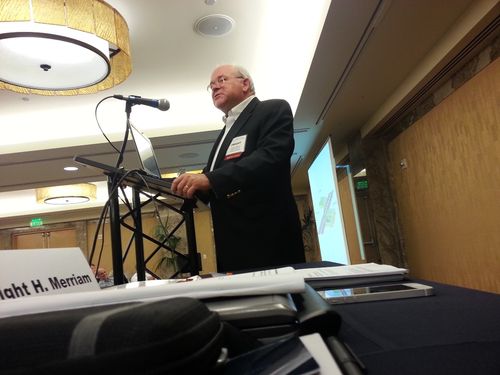
A big thanks to my Owners Counsel of America and ABA State and Local Government Law Section colleague Dwight Merriam for emceeing today’s well-attended double session on land use and takings law at the International Municipal Lawyers Association’s 2013 annual meeting in San Francisco. Dwight and I were joined by land use expert Cecily Barclay, who presented sessions on Harvey Cedars, while I covered Koontz and Dwight did the relevant parcel/Lost Tree sessions. Continue Reading IMLA Conference Session On Koontz, Harvey Cedars, Relevant Parcel

A link to a story worth reading about the U.S. Supreme Court’s decision in Koontz v. St. Johns River Water Management District, No. 11-1147 (June 25, 2013).

In Developing Story at Florida Trend (“The Magazine of Florida Business”), our Owners’ Counsel of America colleague Amy Brigham Boulris is quoted along with the property owner/petitioner Coy Koontz, and two lawprofs who don’t care for the decision.

Check it out, it’s a quick read. Continue Reading Worth Reading On Koontz: “A 20-year legal battle over a water management district’s condition for development is over – sort of.”

Here’s one not to miss, not only because it’s free, but because it features our PLF colleague Paul Beard II, arguing and prevailing counsel in Koontz v. St. Johns River Water Mgm’t Dist., No. 11-1447 (June 25, 2013): on Wednesday, July 17, 2013, from 2:00 – 3:30 pm ET, Greenberg Traurig and PLF are sponsoring a live chat:

In Koontz, one of the most important Takings Clause cases in recent years, the U.S. Supreme Court held that the doctrine of  unconstitutional conditions established in the Nollan and Dolan cases applies to all land use permit applications – even if the excessive condition leads to a permit denial, and even if the condition involves the payment of money rather than dedication of real property. This extension of Nollan/Dolan principles has far reaching implications for real estate, environmental, and other federal and state permitting actions. The significance and implications

Continue Reading Upcoming Live Chat: Koontz – How Far Has Nollan/Dolan Been Extended

On Wednesday, July 17, 2013, from 4:00 – 5:30 pm ET, I will be a panelist in the American Planning Association’s above-titled teleconference.  The session was put together by our ABA and OCA colleague Dwight Merriam, and in additon to Dwight and me, includes Professors David Callies (U. Hawaii) and Carol Brown (U. Richmond), John Baker, an attorney with Greene Espell in Minneapolis, and our ABA colleage and fellow U. Hawaii alum Julie Tappendorf.

Here’s the description of the program:

The U.S. Supreme Court ended its term with a decision that will change planning and regulation — but by how much, and will the change be for better or worse? Koontz v. St. Johns River Water Management District is the most important planning law case in nearly a decade, and already there is widespread disagreement about what it means.

A diverse panel of land use lawyers will examine

Continue Reading Upcoming Teleconference: Lessons from Koontz – Game Changer or Just a Little Rule Refinement?

Update: From the July 13 WaPo: As Wal-Mart threatens to walk, what’s next for a dying shopping center? (“The Skyland Shopping Center in Southeast Washington is amost dead. Shops are shuttered and windows broken.” Gee, we wonder why?). See also Gideon Kanner’s thoughts on the story at “Another Kelo Case in the Marking?

————————————————————————-

You remember the Skyland redevelopment project in Washington, D.C., don’t you? That’s the one we’ve covered before, which has resulted in boocoo court decisions, most of them unfavorable to the small property owners whose businesses were considered “blighting factors” to the surrounding area, and thus stood in the way of a redevelopment project coveted by the city fathers and mothers. See DeSilva v. District of Columbia, No. 10-CV-1069 (Feb. 24, 2011); Rumber v. District of Columbia, 487 F.3d 941 (D.C. Cir. 2007); Franco v. National Capital Revitalization Comm’n, 930 A.2d

Continue Reading If This Wasn’t So Depressing (And Predictable), It Might Be Funny