Pace
22nd annual Alfred B. DelBello Land Use
and Sustainable Development Conference

Come, join us (and others) on Thursday-Friday, December 7-8, 2023, at Pace Law School in White Plains, New York for the Land Use and Sustainable Development Conference (this year’s conference theme is “Balancing Economic Realities with Environmental and Social Concerns”).

We’re speaking about the 100th anniversary of the modern regulatory takings doctrine, which got its start nearly 101 years ago with the Supreme Court’s opinion in Pennsylvania Coal Co. v. Mahon, where the Court held that property may be regulated, but if the regulation “goes too far,” it will be deemed a taking.

Here’s a description of the program:

The 100th Anniversary of Pennsylvania Coal vs. Mahon: How the Takings Clause Became the Primary Check on Government Power When SCOTUS Abandoned Review Under the Due Process and Contracts Clauses During the New Deal

The Takings Clause and 100

Continue Reading Join Us For 100 Years Of Pennsylvania Coal (Pace Land Use Conference, Dec. 8, 2023)

Euclid_front

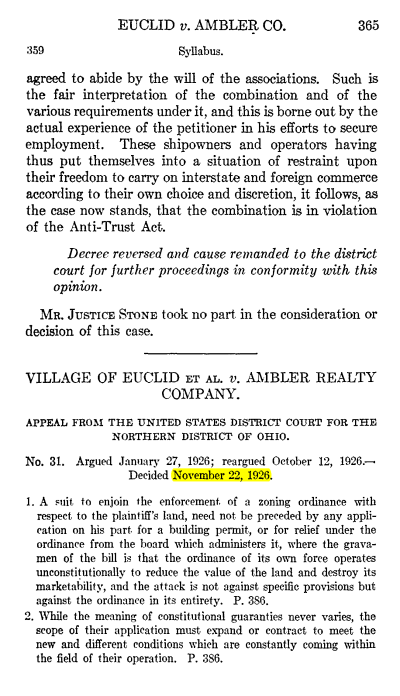
On this day in 1926, the United States Supreme Court issued its landmark opinion in Village of Euclid v. Ambler Realty Co., 272 U.S. 365 (Nov. 22, 1926).

You know this one (shame on you if you don’t!) – it is the case in which the Supreme Court first upheld — against a facial due process challenge — the validity of this thing we call “zoning.” While in the intervening century, zoning has become a catch-all term for regulatory restrictions on the uses of real property, land users know that “zoning” — ackshually — refers only to the regulation and separation of uses, and restrictions on density, and height regulation.

While “Euclid” and “Euclidean zoning” have become part of the land use lexicon and landscape, the decision might have been seen at the time as somewhat surprising. After all, the Supreme Court was in

Continue Reading (Un)Happy 97th Birthday, Euclid!

ALI-CLE brochure cover page

Here’s the brochure and the full agenda and registration information for the upcoming ALI-CLE Eminent Domain and Land Valuation Litigation Conference at the JW Marriott in New Orleans, February 1-3, 2024.

This is the long-running nationally-focused conference on all things eminent domain, takings, valuation, and related. We have three tracks, from which you can choose a la carte – Practice, Substantive, and Condemnation 101:

For over 40 years, we’ve been bringing eminent domain practitioners together to examine the latest issues, engage in healthy debate, and get the information they need to stay current in their practice. This year – our 41st – is THE perfect time to reunite with your eminent domain colleagues. There will be plentiful opportunities to meet and mingle with the faculty and other registrants – throughout the conference and at evening social events. Attendees come back year after year to make new friendships and renew

Continue Reading Here’s The Program For The 41st ALI-CLE Eminent Domain And Land Valuation Litigation Conference, Feb 1-3, 2024, New Orleans

A quick one from the Alabama Supreme Court. In Dixon v. City of Auburn, No SC-2022-0741 (Oct. 27, 2023), the court rejected a property owner’s claim that the city outlawing short term rentals of residential properties — when the plaintiff had been renting his basement for a while — was not a violation of the Alabama Constitution.

The court rejected the argument that Dixon’s use was a nonconforming use or vested right, and concluded that his right to do so was not so because he had no legal right to rent out his property before the STR ordinance. The court rejected his claim that in the absence of regulations limiting that right, he could rent short term, because the zoning code prohibits any uses not expressly allowed. Slip op. at 10.

And here’s the interesting bit. Although Dixon styled one of his claims as “an ‘unlawful taking without just

Continue Reading Alabama: Banning Short-Term Rentals Is Constitutional (PS – “the Alabama Constitution does not recognize regulatory-takings claims”)

In Van Sant & Co. v. Town of Calhan, No. 22-1190 (Oct. 13, 2023), the U.S. Court of Appeals for the Tenth Circuit considered the claim of the operator of a mobile home park who asserted a due process property right to instead use its property as a RV park. Here’s why the court said no.

Van Sant was using its property as a mobile home park. It decided to use its land instead as a RV park. Turns out that the local municipality doesn’t much care for RV parks — or at least the way that Van Sant was going to use its property — so the Town shifted from a regime that didn’t regulate RV parks to a regime that prohibited or tightly controlled RV parks on certain lands (lands that looked an awful lot like Van Sant’s). And to cap it off, the Town’s new regulations

Continue Reading CA10: Absence Of Restrictions On Land Uses Isn’t A Due Process Property Right

A really quick one from the U.S. Court of Appeals for the Seventh Circuit.

In Willow Way, LLC v. Village of Lyons, No. 22-1775 (Oct. 5, 2023), the panel held that the plaintiff/property owner did not sufficiently plead federal diversity of citizenship jurisdiction over his state law takings claim.

After providing notice, the Village demolished Willow’s dilapidated house, which the Village deemed a nuisance. Willow instituted a federal court lawsuit, alleging violation of the U.S. Constitution’s Due Process Clause, and an Illinois law inverse condemnation claim. Federal subject matter jurisdiction was based on a federal question (due process) and supplemental (Illinois takings claim). The district court dismissed the due process claim, and declined to continue to exercise supplemental jurisdiction over the state law takings claim.

What about diversity of citizenship jurisdiction?, Willow argued at the Seventh Circuit oral argument. Sure, why not, responded the panel. The court “invited Willow

Continue Reading CA7: When Pleading A Diversity-of-Citizenship State Takings Claim In Federal Court, It Helps To Allege The Plaintiff’s Citizenship

The Sixth Circuit these days. Lots of property and takings-related stuff being decided in that court. See here, here, here, here, here, and here for some examples.

The latest is O’Connor v. Eubanks, No. 22-1780 (Oct. 6, 2023), in which an unsigned panel opinion (with concurrence of Judge Thapar in the result, but not in the reasoning), held that state officials sued in their individual capacities have qualified immunity from takings claims which seek just compensation. But are not similarly immune from procedural due process claims.

Short story: O’Connor was the payee on two checks that were delivered to his property. Apparently he got neither, so the payors turned the checks over to the State of Michigan, which treated them as unclaimed property.

Michigan’s unclaimed property statute moves fast. It requires that the State, after first publishing notice, to sell or liquidate the property

Continue Reading Backing Into Williamson County Again – CA6: We Already Said That State Officials Sued Individually For Compensation Have Qualified Immunity

Isnt_it

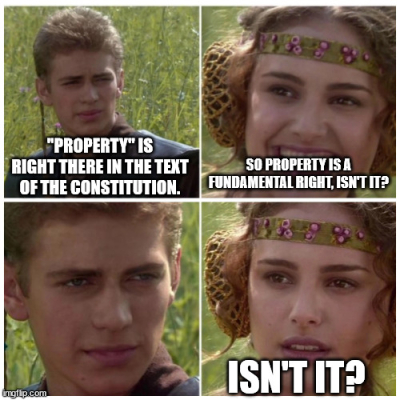
To us, one of the strangest things in constitutional law is the conclusion that although private property is a fundamental right for purposes of the Just Compensation Clause, it isn’t fundamental for purposes of the Due Process Clause. When your private property is taken you must be provided compensation. But when you are deprived of property, all you get is rational basis review. But both “property” and “private property” are right there in the text of the Constitution. How can courts conclude that a property right isn’t fundamental?

Doesn’t compute for you either?  The lower courts are indeed all over the place on this one. Check out cases like this one, and compare the reasoning to cases like this one.

Last week, our firm filed a cert petition asking the Supreme Court to take up the issue. The case involves property owners’ Due Process challenge to the City

Continue Reading New Takings Cert Petition: The Right To Exclude Is A Fundamental Right Isn’t It?

Interested in the intriguing question of whether a court ruling can “take” property? If so, check out the latest cert petition on the issue.

Let’s start with the Questions Presented:

1. Is a state supreme court able to “side-step” the just compensation requirement of the Fifth and Fourteenth Amendments by simply removing preexisting property rights of owners to real property?

2. Is the North Carolina Supreme Court’s decision in holding that an established right of private property no longer exists a taking in violation of the Fifth and Fourteenth Amendments to the United States Constitution?

3. Is the North Carolina Supreme Court’s grant of title and ouster of property rights without payment of just compensation a violation of the due process clauses of the Fifth and Fourteenth Amendments to the United States Constitution?

You remember the last time that the Supreme Court ventured into this area, it wasn’t exactly a

Continue Reading New Cert Petition: “It is Time to Recognize the Judicial Takings Doctrine”

Here’s the cert petition, recently filed, which asks the Supreme Court to review the California courts’ decision that the state’s “unclaimed property” statute  — by which the State is able to grab billions of dollars of private property on the theory that the owners abandoned it. The statute requires the State to try and locate the owners, but the petition alleges the procedures do not provide adequate notice to the owners, and that the State doesn’t really try all that hard to tell them.

Here are the Questions Presented:

1. Whether the Controller’s actions under color of the California Unclaimed Property Law, Cal. Civ. Proc. Code §§ 1300, et seq. (“UPL”), violate the Due Process Clause of the Fourteenth Amendment because they deprive owners of their property without affording constitutionally adequate notice.

2. Whether the Controller’s actions under color of the California UPL violate the Takings Clause of the

Continue Reading New Cert Petition: California’s Escheat Procedures Cheat Due Process (And Take Property To Boot)