Untitled Extract Pages

Two years ago, Owners’ Counsel of America endowed a scholarship in the name of its founder, property rights advocate and trial lawyer Toby Prince Brigham (1934-2021). The scholarship is for a second- or third- year law student to attend the annual three-day ALI-CLE Eminent Domain and Land Valuation Litigation Conference (the upcoming Conference will be in New Orleans, Louisiana, February 1-3, 2024).

The Conference affords the Scholar an all-expenses-covered opportunity to meet and network with leading property rights and eminent domain lawyers from across the country, while also learning about property law and practice. 

Here’s the official description from OCA:  

In honor of Toby’s legacy of professionalism and achievement, in 2021 OCA established the Toby Prince Brigham OCA Scholarship to pay for all expenses of a second or third year law student to attend the ALI-CLE Eminent Domain conference and associated OCA events held annually in January. This unique

Continue Reading Owners’ Counsel Toby Prince Brigham Scholarship – Applications Being Accepted

Here’s the latest in an issue we’ve been following.

Let’s say the government thinks you have committed a crime (or someone else has). To investigate, it seizes property as evidence or potential evidence. But after things wrap up and it no longer needs the property as evidence, the government doesn’t return it to its owner. Taking or no taking?

Some courts say it could be a taking. Others say no.

In Jenkins v. United States, No. 22-1378 (June 28, 2023), the U.S. Court of Appeals for the Federal Circuit said maybe. Or at least it isn’t not a taking simply because the government was lawfully exercising its police power. And if there may be open questions about the whether the owner sought recovery of the property through available procedures or outright abandoned it, then a court entering summary judgment for the government isn’t right.

Most of the

Continue Reading CAFED: Just Because The Govt Seized Property As Evidence Doesn’t Mean It Can Keep It Without Compensation

In Sterling Hotels,LLC v. McKay, No. 22-1345 (June 22, 2023) the U.S. Court of Appeals for the Sixth Circuit considered whether a hotel could sue a state elevator inspector who barred the hotel from operating its elevators for reasons the state’s Elevator Safety Board had not approved. As a result, the hotel couldn’t rent rooms on five of its six floors. 

Federal complaint — including a takings claim against the inspector in his individual capacity — followed. The district court declined to address whether the inspector had qualified immunity from the takings claim. Next stop, Sixth Circuit.

Did the inspector violate the hotel’s “clearly established constitutional rights” and thus not enjoy immunity? Nope:

Sterling next argues that McKay engaged in an unconstitutional regulatory taking when he sealed the elevators. At the time of the alleged taking, however, no court in this circuit had yet decided whether an officer could

Continue Reading CA6: We Haven’t Already Said Individual Govt Officials Can Be Liable For Takings, So They’re Immune

In this very short (but apparently published) opinion, the U.S. Court of Appeals held that it was not right to dismiss a claim on the pleadings and that factual development is warranted, even where the complaint alleges that a municipal land use ordinance is arbitrary and capricious, and the city claims it has a rational basis for the ordinance.

And when we say “short,” we mean it. Here’s the entirety of the opinion:

Plaintiffs here appeal the Rule 12(b)(6) dismissal of their complaint alleging that the City of New Braunfels’s zoning regulation banning short-term rentals of residential properties in certain areas of the city is unconstitutional. The district court ordered dismissal by approving a few conclusory paragraphs in the magistrate judge’s recommendation. This court’s relevant case law, however, indicates that some factual development may often occur in these cases, and that summary judgment may often follow. See, e.g

Continue Reading CA5 Makes Short Work Argument That Asserting A Rational Basis For A Short-Term Rental Ban Is Enough To Secure Pleadings Dismissal Of Arbitrary And Capricious Challenge

A new cert petition to check out. We don’t need to explain it much, because the petition does a good job of it.

Here’s the Question Presented:

New York State redevelopment agency seized, via eminent domain, a large tract of real estate occupied by an existing building in downtown Brooklyn for redevelopment. The building, partially used for office space, included a useable basement of over 13,000 square feet, which had a government-issued certificate of occupancy. During eminent domain proceedings, the lower court ignored the certificate of occupancy’s determination of a usable basement as a valued property interest.

The question presented is:

1. Are government-issued attributes of private property (e.g., certificates of occupancy, building permits, business permits) entitled to constitutional protection under the Fifth Amendment when they are seized under the government’s eminent domain power, just as they are presently entitled to constitutional due process protection under the Fourteenth Amendment?

Follow

Continue Reading New Just Comp Cert Petition: Is Due Process Property Just Compensation Property?

Caesar
We’ll be rendering to unto Caesar, but first we must
decide: classic or creamy?

That was quick: it seems like it was only yesterday — or maybe more accurately, less than a month ago — that we were listening in live to the Supreme Court as it heard arguments in Tyler v. Hennepin County, No. 22-166, our law firm’s case which argues that Hennepin County’s keeping the excess equity in Ms. Tyler’s home over what she owed in property taxes and fees is an uncompensated taking of private property and also violates the Excessive Fines Clause.

This morning, the Court issued this unanimous opinion authored by Chief Justice Roberts (again proving he’s the Court’s “property guy”), in which the Court held that the County’s seizing Ms. Tyler’s condo to satisfy her tax debt and then “keeping the change” is a taking. It’s a relatively short opinion with no

Continue Reading Unanimous SCOTUS: “state law cannot be the only source” Of Property Rights, And “traditional property law principles” As Enforced By The Takings Clause Play A Role

We’re not going to dwell too much on the U.S. Court of Appeals’ opinion in Fox v. Saginaw County, No. 22-1265 (Apr. 28, 2023), because even though it is a case involving the “home equity theft” takings issue argued at the Supreme Court last week, this one tells us more about civil procedure than takings. 

The Fox case is a class action, and several of the defendant counties may engage in the practice of seizing property and liquidating it to satisfy a tax debt (and then keep any excess), but they didn’t do it to the lead plaintiff Mr. Fox.

The district court held that the class action could proceed, but the Sixth Circuit said no: Fox may have standing to assert the one county that kept his equity has taken his property, but has no standing to assert claims against the other governmental defendants because those defendants

Continue Reading No Class: CA6 Rejects Class Certification For Home Equity Theft Takings Case

52851572390_8ab246acf3_o
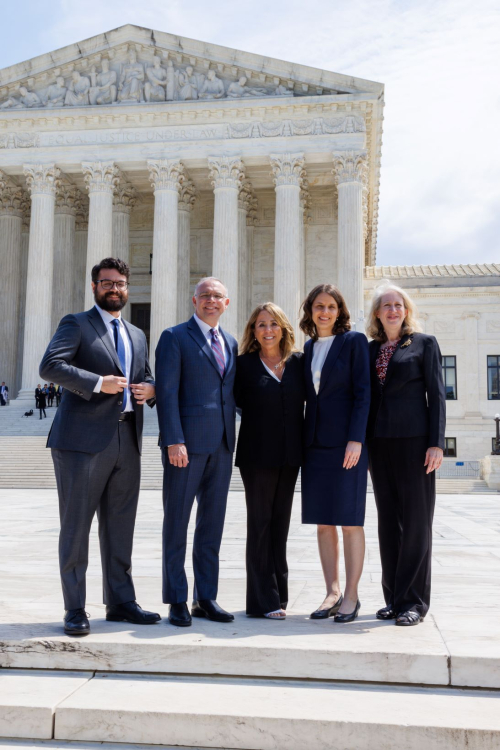
Our Pacific Legal Foundation Property Rights Litigation Tyler team,
and Counsel of Record Christina Martin (second from right)

Here are your links to the buzz about Tyler v. Hennepin County, No. 22-166, our law firm’s case which argues that Hennepin County’s seizure of Ms. Tyler’s condo and then keeping the excess equity over what she owed in property taxes and fees, is an uncompensated taking of private property, and also violates the Excessive Fines Clause.


Continue Reading Tyler SCOTUS Takings Argument Round-Up

Coffee
Coffee is for closers.
(Yes, we were up and at the desk at 4 a.m. local time

to listen live. We just needed a direct injection of coffee.)

Here is the transcript, and the audio recording of today’s U.S. Supreme Court arguments in Tyler v. Hennepin County, No. 22-166, our law firm’s case which argues that Hennepin County’s keeping the excess equity in Ms. Tyler’s home over what she owed in property taxes and fees, is an uncompensated taking of private property, and also violates the Excessive Fines Clause.

We will bring you the analysis of the arguments and the pundits’ predictions in a subsequent posts. But for the time being here these are in case you missed out listening live. Stay tuned.

Transcript, Tyler v. Hennepin County, No. 22-166 (U.S. Apr. 26, 2023)

Continue Reading Today’s Takings SCOTUS Oral Argument Transcript And Recording: Tyler v. Hennepin County

SCOTUS

Tomorrow, Wednesday, April 26, 2023, at 10:00 a.m. Eastern Time, the U.S. Supreme Court will be hearing oral arguments in Tyler v. Hennepin County, No. 22-166, our law firm’s case which argues that Hennepin County’s keeping the excess equity in Ms. Tyler’s home over what she owed in property taxes and fees, is an uncompensated taking of private property, and also violates the Excessive Fines Clause.

Listen to the arguments live, here.

We posted some preview links earlier this week here. But wait, there’s more!


Continue Reading More SCOTUS Takings Previews (Argument Tomorrow, 10am ET)