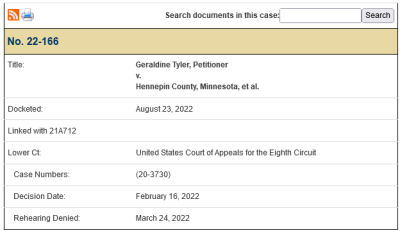
The Court has already started loading up next Term’s property rights docket, with last week’s grant of this cert petition.

Before we go further, a disclosure: our law firm colleague Deborah La Fetra filed an amicus brief urging the Court to grant review. Thus, we’re not going to be taking a deep dive into the issues, but will leave that to others. Luckily, lawprof Ilya Somin (as is often the case) beat us to the punch, analyzing the issues in “Supreme Court Decides to Hear Important Asset Forfeiture Procedural Property Rights Case” at the Volokh Conspiracy. Check it out.

Here’s the Question Presented:

In determining whether the Due Process Clause requires a state or local government to provide a post seizure probable cause hearing prior to a statutory judicial forfeiture proceeding and, if so, when such a hearing must take place, should district courts apply

Continue Reading SCOTUS To Weigh In On Due Process In Civil Forfeiture
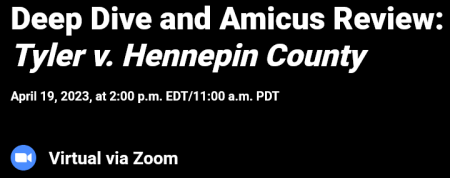
Take a deep dive into the arguments and amicus briefs

This Wednesday, April 26, 2023, the U.S. Supreme Court will hear oral arguments in Tyler v. Hennepin County, No. 22-166, our law firm’s case which argues that Hennepin County’s keeping the excess value in Ms. Tyler’s home over what she owed in property taxes and fees, is an uncompensated taking of private property, and also violates the Excessive Fines Clause.

Here are links to programs, summaries, and events to help you understand the arguments and issues, as well as registration for post-argument analysis:


Continue Reading Get Ready For SCOTUS Takings Arguments (Wednesday, April 26, 2023)

Screenshot 2023-04-11 at 20-42-01 Deep Dive and Amicus Review Tyler v. Hennepin County

Here at our law firm, we’re getting ready as one of our colleagues prepares to argue the Supreme Court’s next takings case in a couple of weeks. Yes, this is what we’ve alternatively called the “home equity theft” or the “keep the change” case where government seizes property to satisfy the owner’s tax debt, and after liquidation of the property and satisfaction of the debt, keeps any excess equity instead of returning the balance to the (former) homeowner.

The case is Tyler v. Hennepin County, No. 22-166, and it’s set for argument on the last day of this term’s argument calendar, Wednesday, April 26, 2023.

In the meantime you should check out the parties’ merits briefs and the beaucoup amici briefs (mostly filed in support of the property owner) on the Court’s docket.

But you should also see what others have to say, and how they are

Continue Reading Tyler v. Hennepin County Previews: Get Yourself Prepared For The Next SCOTUS Takings Arguments

LUI

Here are the opinions that we spoke about this afternoon at the Land Use Institute on “The Use of Eminent Domain for Redevelopment & Economic Development Projects.”

Thanks for joining in.Continue Reading Cases And Links From Today’s Land Use Institute Session: “The Use of Eminent Domain for Redevelopment & Economic Development Projects”

“But we had to eat.”

So begins the Washington Supreme Court’s opinion in Washington Food Industry Ass’n v. City of Seattle, No. 99771-3 (Feb. 9, 2023), wherein the court held that a takings challenge to Seattle’s ordinance requiring Co-19 combat pay for food delivery workers may proceed. 

There’s a lot in the opinion about the crisis and the early days of the response. And about the various claims brought by the WFIA challenging the city’s ordinance, including a statutory claim under Washington law (this is a prohibited tax or fee on groceries), equal protection, takings, contracts clause, section 1983, a “police power” claim, and a privileges and immunities claim.

The opinion is long (39 pages, plus concurring opinions and dissents, adding up to 67 pages), so here’s your scorecard:

I. The chapter 82.84 RCW claim is dismissed; we affirm.
II. The equal protection claim is dismissed; we reverse.
III.

Continue Reading Seattle’s Hazard Pay For Food Delivery Gig Workers Might Be A Penn Central Taking

40th ALI-CLE

We were eagerly anticipating 40th American Law Institute-CLE Eminent Domain and Land Valuation Litigation Conference. The 2022 Conference in Scottsdale was one of the first meetings where everyone was back in-person (and was a smashing success), but that conference was early in the game so not everyone could or would attend. But in the past year most of us got back to some semblance of “normal,” and the turnout promised to be good.

We had record registrations: with over 300 attendees, faculty, and staff signed up, things were shaping up.

Plus, we were headed to Austin, Texas. The last time we held the Conference there in 2016, we loved it so much it has been in-demand for a return visit. And this year is the debut Conference for some new planning co-chairs for both the main tracks as well as the “Condemnation 101” tracks, so the buzz for the

Continue Reading Ice Ice Baby: A Report From The 40th ALI-CLE Eminent Domain & Land Valuation Litigation Conference, Feb 1-4, 2023, Austin

If your first reaction to the Texas Court of Appeals (First District)’s decision in City of Houston v. The Commons of Lake Houston, Ltd., No. 01-21-00369-DV (Jan. 12, 2023) is scratching your head, then please come join us in bewilderment.

After all, the court held that a takings claim failed because the city is immune from inverse condemnation. Say what? We thought that the self-executing nature of the just compensation requirement of the U.S. Constitution (and the Texas Constitution) means that claims of sovereign immunity don’t hold water in inverse cases.

The Commons wants to develop “The Crossing,” one of those big master-planned communities. The usual development activities entailed: master plan, subdivision plats, city approvals for infrastructure, and even some actual site work. “By April 2018, The Commons had invested millions of dollars in planning and infrastructure for The Crossing.” Slip op. at 2.

But in

Continue Reading An Ordinance Isn’t A Taking Because It’s A Valid Exercise Of Police Power?: What The Heck Is Going On In The Texas Court Of Appeals (First District)?

We really want you there…

One (nearly) last reminder that there’s still time to register for your space at the 40th ALI-CLE Eminent Domain & Land Valuation Litigation Conference, February 1-4, 2023, in Austin. In the past several years, we have sold out due to the conference room capacity and the conference hotel block. But there’s still space, although we are nearly full. So register now – don’t delay any further! 

Here’s the brochure with the complete agenda, schedule, and faculty listing. But to tempt you, here are some of the highlights of the program:

  • Everything Old is New Again: Why Today’s Practitioners Need to Understand the Original Meaning of the Takings and Just Compensation Clauses
  • When the SWAT Team Comes (No) Knocking: Police Power Takings
  • Private Utility Takeovers – Lessons From a 67 Day Trial

  • “Contraband”: How Property Rights Helped Pave the Way for Civil Rights

  • Valuation


Continue Reading (Nearly) Last Call: There’s Still Time To Join Us For The 40th ALI-CLE Eminent Domain & Land Valuation Litigation Conference, Feb 1-4, Austin

Chop_park
Saturday in the park…I think it was the Fourth of July

Here’s the latest on a case we’ve been following, about the blocking off of a neighborhood in Seattle and making it a no-go zone for those whom the takeoverers wanted to keep out.

Yes, the CHOP/CHAZ case is still a thing. [And before we go on a disclosure: our law firm is participating as amicus curiae in the case.]

Business owners in the zone sued the City in federal court, alleging that the government actively aided or facilitated the takeover, or at minimum did nothing to end it. Claims asserted include Due Process, Takings, and state and local law claims. The takings claim was based on two theories: first, that the City facilitated a physical invasion by third parties of plaintiffs’ properties; second, that the City action or inaction resulted in a loss of access by plaintiffs and their

Continue Reading Federal Court: Seattle Facilitating Downtown Takeover Takings Claim Is Going To Trial

Screenshot 2023-01-13 at 14-15-26 Search - Supreme Court of the United States

Here at inversecondemnation.com, we were all set to call it a week and take a break from posting until Monday.

But SCOTUS had other ideas.

In this Order issued today, it agreed to review Tyler v. Hennepin County, No. 22-166, a case and an issue we’ve been following closely.

The Questions Presented by the petition:

Hennepin County confiscated 93-year-old Geraldine Tyler’s former home as payment for approximately $15,000 in property taxes, penalties, interest, and costs. The County sold the home for $40,000, and, consistent with a Minnesota forfeiture statute, kept all proceeds, including the $25,000 that exceeded Tyler’s debt as a windfall for the public. In all states, municipalities may take real property and sell it to collect payment for property tax debts. Most states allow the government to keep only as much as it is owed; any surplus proceeds after collecting the debt belong

Continue Reading Lucky Friday The Thirteenth: SCOTUS Grants New Takings And Excessive Fines Case