Be sure to check out this interview with a person we’re proud to call a friend and a colleague, Gideon Kanner, in the most recent edition of Right of Way magazine, a publication of the International Right of Way Association.

A Fierce Advocate for Just Compensation” is a sitdown with Professor Kanner, and covers a lot of ground, so to speak. The entire piece is worth reading, but here’s what a colleague pointed out as perhaps the best part:

If you represent a property owner in an eminent domain case, particularly an inverse condemnation one, you must understand that your client is persona non grata or the law’s “poor relation,” as U.S. Supreme Court Chief Justice William Rehnquist once said. The California Supreme Court once stated in an opinion that it was its duty to keep condemnation awards down, which is a hell of a hurdle to overcome when your task is to persuade the Justices that your client was undercompensated by the court below. So in those not-so-good ol’ days of the 1960s, when I walked into court, I had my job cut out for me. Sometimes, the hostility emanating from the bench was palpable. As Alex Kozinski, Chief Judge of the U.S. Court of Appeals for the 9th Circuit once noted, what property owners in this field often get from the bench is “thinly-disguised contempt.” This is not a line of work for the faint of heart.

We agree.
Continue Reading Why We Fight: An Interview With Gideon Kanner, “A Fierce Advocate for Just Compensation”

PICT1501

PICT1471

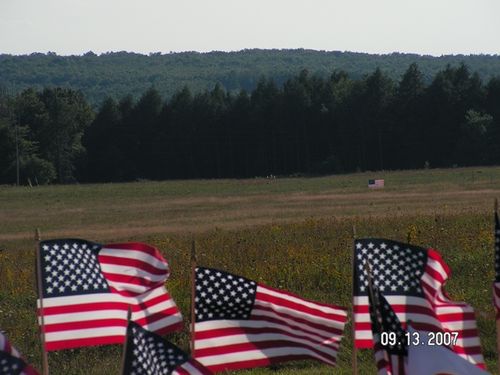
According to this story (“Eminent domain panel values Flight 93 crash site at $1.5 million“), a three-person panel of commissioners appointed by the U.S. District Court has settled on the amount of compensation owed the landowner for the taking of the site in middle Pennsylvania where United 93 crashed on September 11, 2001.

The above photos were taken during our visit a few years ago. The lower photo shows the impact site (the large solitary flag), in the middle of the field.Continue Reading PA Flight 93 Site Just Compensation – $1.5 Million

The latest front has opened in the ongoing (and spreading) issue about Mortgage Resolution Partners’ efforts to convince municipalities to use their powers of eminent domain to take underwater mortgages.

Here’s the Complaint, filed today in the U.S. District Court for the Nothern District of California, which seeks public disclosure by the Federal Housing Finance Agency of its relationship with banks. As reported in this story, “[t]he agency has threatened legal action against Richmond [California] and other cities planning to use the eminent domain tactic and may deny credit to locals seeking mortgages[.]”   

The article quotes the Executive Director of New Jersey’s ACLU:

Using money from private investors, Ofer said towns would pay the mortgage holders’ fair market value and then restructure mortgages into lower principal payments that are more favorable for homeowners. About 700 to 1,000 homes in Irvington could potentially benefit from eminent domain takeovers

Continue Reading New FOIA Complaint Seeks Information About Underwater Mortgage Eminent Domain Issue

No one contests that when it condemned property in Norfolk, Virginia to expand the Federal courthouse, the federal government made unreasonable pretrial offers to the property owner. The owner’s appraisals valued the property at $36.1 and $30.7 million, but the government valuation resulted in a $6.175 pretrial offer. After the pretrial dance, the final offers were $9.4 million from the government, compared to $15.4 million by the property owner.

Fortunately, the property owner had the good sense to seek advice from our good friends at Waldo & Lyle, and the jury returned a verdict for $13.4 million. As one of the prevailing parties, the property owner sought attorneys fees under the Equal Access to Justice Act. The government objected on the basis that its final offer was substantially justified, even though its pretrial offer may not have been, and thus “the position of the United States” as used

Continue Reading 4th Cir: Govt’s Reasonable Trial Position On Just Compensation Doesn’t Get It Off The Hook For Its Unreasonable Pretrial Position

Cornell lawprof Robert Hockett, the guy who by all accounts thought up of the idea of using eminent domain to take “blighted” (underwater, but mostly performing) mortgages, was interviewed on “Air Occupy” about the scheme yesterday. Here’s the podcast (we originally embedded the podcast below, but the darn thing was set to play automatically and it was just supremely irritating, so we deleted it and provided the link instead).

He goes into his thoughts on the motive of the opponents, among other things.

One thing we can’t figure: how an organization (although perhaps “decentralized, hacktivist collective” would be more acceptable to the group), can get within five feet of supporting a plan that was proposed, funded, and pushed by a bunch of the same “Wall Street” types who supposedly caused the problem. Anarchy breeds strange bedfellows?Continue Reading Cornell Lawprof Talks About His Plan To Take Underwater Mortgages

DSCF1269

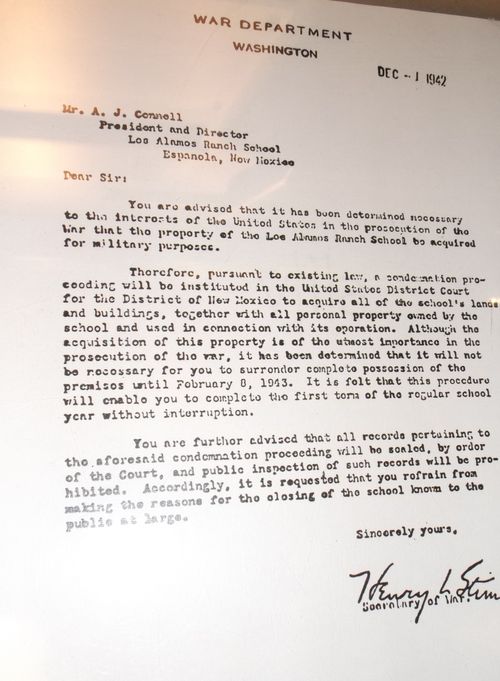
During a break at the recent ABA State and Local Government Law Fall meeting in Santa Fe, New Mexico, we took a short ride up to the town of Los Alamos for a little “nuclear tourism” at the site of the current National Lab, and, of course, the place where the first two atomic bombs were designed and build in World War II. Los Alamos was chosen as the site because it was remote, away from the prying eyes of foreign spies and the American public. That’s still probably true.

So we’re at the Bradbury Science Museum, when colleague Dwight Merriam pointed out the above letter, which tells us how the U.S. Government acquired the land it needed for the Manhattan Project. In case you can’t read the photo, here’s a transcription of the letter:

War Department

Washington

DEC — 1 1942

Mr. A.J. Connell
President and Director

Continue Reading The Eminent Domain Angle In Nuclear Tourism

The Honolulu City Council has proposed a charter amendment that asks the voters to approve eliminating the Mayor’s current veto power over the Council’s eminent domain resolutions.

The Resolution doesn’t directly say that, of course, but what it does command is that after the Council adopts a resolution to take property, the city administration must within 90 days start the condemnation action. In other words, no mayoral veto. Currently under the Charter, the Mayor may veto resolutions of taking:

Resolutions authorizing proceedings in eminent domain shall not be acted upon on the date of introduction, but shall be laid over for at least one week before adoption. Such resolutions shall be advertised once in a daily newspaper of general circulation and may be advertised, as deemed helpful, in other newspapers at least three days before adoption by the council. Not less than three copies of such resolutions shall be filed

Continue Reading Should The Honolulu Charter Eliminate The Already Minimal Check Of A Mayoral Veto On Eminent Domain Resolutions?

DSCF1078

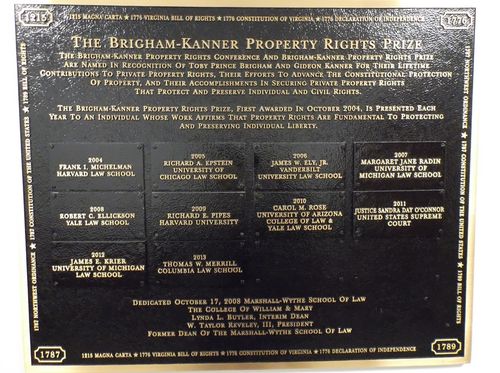
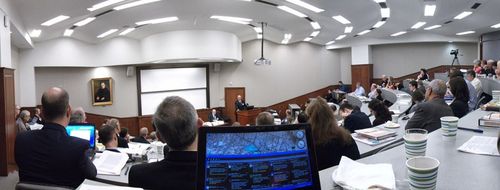
The last couple of days, we’ve returned to Williamsburg, Virginia to attend the annual Brigham-Kanner Property Rights Conference at the William and Mary Law School.

The Conference is the annual gathering of legal scholars and practitioners who focus on property law and property rights to celebrate the award the B-K Prize to “an individual whose scholarly work and accomplishments affirm that property rights are fundamental to protecting individual and civil rights.” The list of past winners is a who’s who of property scholars and includues James Ely, Richard Epstein, Carol Rose, and Frank Michelman.

This year’s prizewinner is Columbia Law’s Thomas Merrill. The Conference panelists have thus far focused on his scholarship, including his landmark article on the right to exclude, titled, not surprisingly, Property and the Right To Exclude, 77 Neb. L. Rev. 730 (1998).

DSCF1087

Our Owners’ Counsel colleage Mark Savin speaking about “Defining the Essence of

Continue Reading 10th Annual Brigham-Kanner Property Rights Conference And Prize – Thomas Merrill

DHM_IMLA

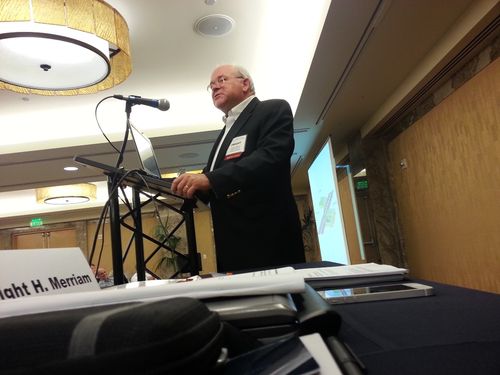
A big thanks to my Owners Counsel of America and ABA State and Local Government Law Section colleague Dwight Merriam for emceeing today’s well-attended double session on land use and takings law at the International Municipal Lawyers Association’s 2013 annual meeting in San Francisco. Dwight and I were joined by land use expert Cecily Barclay, who presented sessions on Harvey Cedars, while I covered Koontz and Dwight did the relevant parcel/Lost Tree sessions. Continue Reading IMLA Conference Session On Koontz, Harvey Cedars, Relevant Parcel