Check out the opinion of the Indiana Supreme Court in Utility Center, Inc. v. City of Fort Wayne, No. 90S04-1208-PL-450 (Apr. 11, 2013. The issue is what the term “rehear … de novo” means in Indiana’s eminent domain code relating to condemnations by cities and towns, which provides for such review by trial courts on administrative appeal from a valuation assessment by a municipal works board. The city had the option to condemn the property either under that provision, or under the general eminent domain statute in which the landowner would be entitled to demand a jury.

The landowner objected to the board’s valuation, and demanded a jury trial. The trial court granted the city’s motion to strike the jury demand, concluding that “de novo” only required a limited review of the administrative record to insure that the valuation decision was made “in conformity with proper legal procedure.”

The
Continue Reading Indiana S Ct: Meaning Of “De Novo” Rehearing In Eminent Domain Code Not Quite A “No Brainer”

Here’s a quick one from the Texas Supreme Court. Texas, Dep’t of Transportation v. A.P.I. Pipe and Supply, LLC , No. 10-1020 (Apr. 5, 2013) is an inverse condemnationut the issue isn’t really one of inverse condemnation, but who owns the property. If the City of Edinburg does, then TxDOT didn’t inversely condemn API’s property when it undertook a drainage project and removed soil from the parcel. If, as API claimed, it had title to the land, then TxDot was on the hook.

The issue was one of competing (and conflicting) recorded judgments from the same court, one year apart. The city condemned the parcel in 2003 from White, and the court entered a judgment vesting ownership of the parcel in “fee” to the city. The following year, however, the same court entered a “Judgment Nunc Pro Tunc” which “purported to render the 2003 Judgment ‘null and void,'” and

Continue Reading Texas: Which Judgment Rules In An Inverse Case?

Film critic Roger Ebert, whose death was announced yesterday, was a huge fan of our favorite eminent domain movie, Australia’s The Castle. Not so much a fan in the four-star-auteur-director-Fellini-Malick-Herzog mode, but a fan in the sense that when it came time for programming for his personal film festival and others, he selected it more than once and dubbed it “the funniest film in the history of Ebertfest.”

And so life spins along at 3 Highview Crescent in Melbourne, where the Kerrigan home sits surrounded by its built-on rooms, screened-in porch, greyhound kennel, big-dish satellite and carport. For Darryl, it is not so much a house as a shrine to one of the best darn families in the universe, and he proudly points out the plastic Victorian gingerbread trim and the fake chimney to an inspector–who is there, as it turns out, to condemn the property under

Continue Reading Ebert On “The Castle”

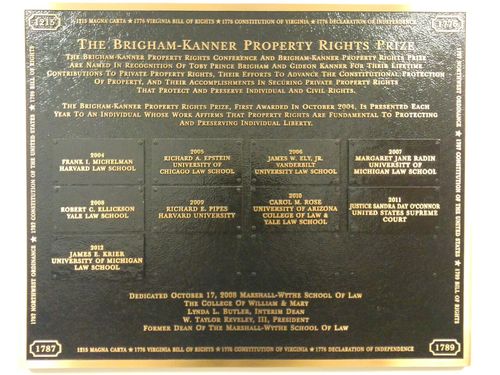
IMG_20121012_135714

William & Mary Law School, host of the annual Brigham-Kanner Property Rights Conference, has announced that Columbia Law School Professor Thomas W. Merrill will receive the 2013 B-K Prize at the conference (October 17-18, 2013, Williamsburg, Virginia). The photo above is of the plaque on the wall at the William & Mary Law School listing B-K Prize winners.

The Conference agenda and speakers have yet to be finalized, but here’s the tentative list of topics:

  • The Impact of a Leading Property Scholar: Defining the Essence of Property
  • Promoting Government Forbearance
  • The Implications of the Court’s Recent Takings Cases
  • Property Rights in Times of Transition

We spoke at the 2012 Conference in Williamsburg, and attended the 2011 Conference in Beijing. The 2013 lineup sounds pretty good, so mark your calendars. Continue Reading 2013 Brigham-Kanner Property Rights Prize: Professor Thomas Merrill

Here’s what’s on our reading list today:

  • Here’s the latest chapter in the saga of one Fane Lozman, whose titling at windmills got some Supreme Court love recently when the Court held that his floating home was not a “vessel” under admiralty law, and a Florida city was wrong to seize it. My Damon Key colleague Mark Murakami reports on the 11th Circuit’s recent ruling in Lozman’s related federalcivil rights case. Houseboat Redux – Eleventh Circuit Reinstates Lawsuit (via Hawaiioceanlaw.com). 


Continue Reading Wednesday Round-Up: Houseboat Redux, Backtracking Post-Kelo, Arkansas Game Remand, Big Gulps

Here’s a quick one from the Indiana Court of Appeals, about when a party must object to an appraiser’s report, and the reaction to that objection by the condemnor.

In Clark County Bd of Aviation Commissioners v. Dreyer, No. 10A01-1206-PL-288 (Mar. 21, 2013), the property owner did not object to the report of three court-appointed appraisers valuing its property at $201,000 within the 21 days allowed under Indiana eminent domain procedures, but the condemor did not object, so the trial went forward. The jury awarded $865,000 as compensation, and the court awarded the owner $24,000 in attorney fees.

The condemnor appealed, arguing that the trial court should not have admitted evidence of the highest and best use of the property that the condemnor alleged was inconsistent with the property’s current use. The Court of Appeals rejected the argument and even though it noted that the property owner had not

Continue Reading Indiana App: Timing Of Objection To Appraiser’s Report Is Not A “Real” Jurisdictional Problem

Cle-logoThose of you on the east coast (or, who wouldn’t mind a visit to a very beautiful part of Virginia), mark your calendars: on April 25 and 26, 2013, CLE International is presenting the 7th Annual Virginia Eminent Domain Conference – Local, State, and National Trends at the Tides Inn in Irvington, Virginia.

My Owner’s Counsel of America colleague Joe Waldo, the Planning Chair for the conference, has kindly asked me to deliver the Keynote Presentation to speak about “Virginia’s Place in National Eminent Domain Trends.” The following day, I’ll also be presenting a one-hour session on “Tough Takings Questions: Regulatory Takings, Zoning Issues and Judicial Takings” featuring the latest updates in those areas.

Joe and colleagues have assembled a talented and varied faculty, so please join us for two days worth of great CLE. Download the full brochure or the short version postcard, or, for complete

Continue Reading 7th Annual Virginia Eminent Domain Conference (April 25-26, 2013)

Our colleague Mark M. Murakami has published the first in a series of posts on his blog about legal issues surrounding the multi-billion dollar Honolulu rail project, “Honolulu Rail and the Uniform Relocation Act.”

Because the HART rail project will involve federal funds, federal laws and regulations provide property owners (and their tenants) with additional statutory and regulatory protections above what is required by the Fifth Amendment, the Hawaii Constitution or Hawaii Revised Statutes Chapter 101.  This is the first post in a series about Honolulu Rail.

Title 42, Chapter 61 of the U.S. Code is entitled:  “The Uniform Relocation Assistance and Real Property Acquisition Policies for Federal and Federally Asssisted Programs” and provides the statutory authority for the regulations which provide the details of the various benefits of the Uniform Relocation Act program.  

Yes, his blog is Hawaiioceanlaw.com, but maritime and admiralty law is just one

Continue Reading Honolulu Rail And Federal Relocation Benefits

If this article — Christie tells beachfront owners to sign easement for dunes or face ridicule — accurately relays the entire context of the situation, then something is seriously off here.

The article quotes New Jersey Governor Chris Christie as declaring that if shoreline property owners do not voluntarily surrender easements and allow the construction of sand dunes on their land (presumably without compensation) very soon, then he’s going to “call them out” and publicly name them:

“We’re going to start calling these folks out in the next few weeks if they haven’t signed the easements to let us build the dunes because they need to be called out and they need to be told that there is something more important than their own self interests,” he said during a town hall-style event in Middlesex Borough.

He followed that up with his reasoning:

“I’m not going to put up with

Continue Reading Tail Gunner Christie: What’s Next, The Pillory And The Stock?

Here’s the Reply Brief in Ilagan v. Ungacta, No. 12-723 (cert. petition filed Dec. 7, 2012), the case in which the Court is considering whether to review the Guam Supreme Court’s opinion applying Kelo v. City of New London, 545 U.S. 469 (2005) to reverse a trial court decision invalidating a taking. 

The reply brief responds to the Brief in Opposition‘s argument that the taking of the Ilagan property did not violate the Public Use Clause because it was accomplished under the auspices of the Agana Plan:

Most notably, the Opposition does not dispute the evidence showing the private character of the transfer of the Petitioners’ (Ilagans) land to their neighbors, the Ungactas. To be precise, the Opposition does not deny: (1) that the taking of the Ilagans’ land was initiated and funded by the Ungactas; (2) that the Unguctas are politically connected, with Respondent Felix Ungacta

Continue Reading Reply Brief In Eminent Domain Pretext Case: If The Government Won’t Even Defend The Taking … It Might Be A Private Condemnation