
yyryrContinue Reading Brigham-Kanner Property Rights Conference Report


Here are my remarks from last week’s Brigham-Kanner Property Rights Conference at the William & Mary Law School in Williamsburg, Virginia. Our panel spoke on “Property Rights in Times of Economic Crisis,” and included lawprofs James W. Ely (Vanderbilt), William Fischel, (Dartmouth), and Eric Kades (William & Mary). See the complete faculty list and agenda here.
+++++++++++++++++++++++++++++++++++++++
Aloha, I bring you greetings from the land of Midkiff, the land of Lingle.
I practice in the jurisdiction that believed it would cure our economic ills to use eminent domain to bust up the legacy land trusts, and make sure that everyone who owns a home could also own the fee simple interest.
Which they may now do, provided they can afford our median price for a single-family residence, $637,000.
I practice in the jurisdiction that believed that it would be a good idea to try and bring
Continue Reading Professor Ely, You Magnificent Bastard, I Read Your Book!
Ever since the U.S. Supreme Court’s infamous decision in Kelo v. City of New London, 545 U.S. 469 (2005), the focus of eminent domain scholarship and the public have been on the public use side of the condemnation equation.
However interesting those issues are (and they truly are), practitioners of eminent domain law understand that a vast majority of the issues in litigation still revolve around just compensation and valuation. The Supreme Court has even shown an interest, with the Justices asking questions about compensation in at least two oral arguments where the issue was not directly presented (here and here for example). While the ABA has recently published books about eminent domain generally (see here and here), it has not produced one devoted to just compensation.
But it soon will. The section on State and Local Government Law has decided to publish a book on current
Continue Reading Call For Authors: American Bar Association Book On Just Compensation Issues
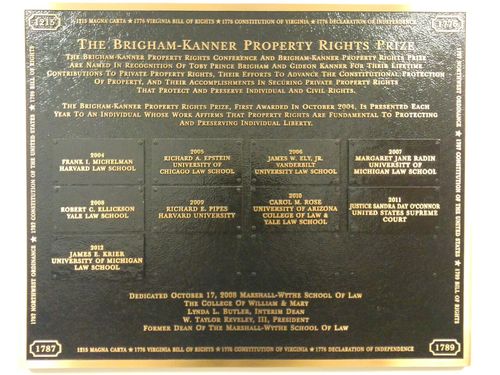
There’s still time to join us later this week at William & Mary Law School in Williamsburg, Virginia for the 2012 Brigham-Kanner Property Rights Conference, and the award of the B-K Prize to University of Michigan lawprof James Krier for his lifetime contributions to property law scholarship.
The Conference includes a day-long series of discussions on property rights, featuring leading scholars and practitioners. Topics include “The Impact of a Leading Property Scholar,” “The Judiciary’s Role in Shaping Constitutionally Protected Property,” “Property Rights in Times of Economic Crisis,” and “Property’s Moral Dimension.” The day will wrap with a roundtable discussion, “How Fundamental are Property Rights?” The complete agenda is available here.
I will be speaking on the panel about “Property Rights in Times of Economic Crisis,” discussing why property rights are even more important when times are tight.
Register on-line here. If you can’t join us, I will
Continue Reading 2012 Brigham-Kanner Property Rights Conference
The New York Times editorial page has weighed in on Arkansas Game & Fish Comm’n v. United States, No. 11-597 (cert. granted Apr. 2, 2012), the takings case argued earlier this week in the U.S. Supreme Court.
And, no surprise, in When Flooding Is Not a Taking, the great beneficiary of eminent domain abuse comes out on the “no compensation” side when the government purposefully floods property because — get this — the floodwaters eventually recede:
The takings clause of the Constitution’s Fifth Amendment ensures that private property cannot be taken for public use without fair compensation. A classic example is the government’s exercise of eminent domain power to build a highway; if the road cuts through private land, the government owes the owners payment equal to fair market value. That principle applies when the government builds a dam, and water and silt overflow land, permanently destroying or
Continue Reading Does The NY Times Know That Most Floodwaters Eventually Recede (Or Might?)
Here’s the transcript of Wednesday’s argument in Arkansas Game & Fish Comm’n v. United States, No. 11-597 (cert. granted Apr. 2, 2012).
BLUF (Bottom Line Up Front): we’re predicting the property owner win with a minimum six-Justice majority (perhaps more), with a narrowly drawn opinion vacating the Federal Circuit’s conclusion that temporary flooding can never be a taking. Whether the Court adopts a new test to determine whether a taking occured when the government purposefully floods land, however, is up in the air.
The petitioner was represented by James Goodheart, who led off the argument by attacking the Federal Circuit’s conclusion, arguing for a rule that a taking occurs whenever a “direct physical invasion” results in a “substantial intrusion” on a property interest, and that the duration of the invasion is not relevant. That’s a restatement of the existing per se rule that any physical invasion that
Continue Reading SG Doubles Down: Transcript Of Arguments In SCOTUS Flood Takings Case, Part II
Here are links to worthwhile reads, all with a takings flavor:
In or near Sacramento this week? You may want to attend this free program, sponsored by the American Action Forum:
The American Action Forum will host a panel discussion at the Hyatt Regency in Sacramento on the devastating downturn of the housing market and painful recovery currently facing our nation. There’s no question California’s housing markets and greater economy have been among the hardest hit, yet a comeback seems to be underway. What can California’s story teach the rest of us? Is using eminent domain really a solution to our housing woes?
Join us for a complimentary breakfast as we hear from an exciting group of experts including Douglas Holtz-Eakin, former Director of the Congressional Budget Office, Daren Blomquist, Vice President of RealtyTrac, Richard Green, Director and Chair of the USC Lusk Center for Real Estate, Jed Kolko, Chief Economist at Trulia, Paul Herrera, Government Affairs and Communications Director, Inland
Continue Reading Upcoming Program – The U.S. Housing Recovery: Lessons From California
In the op-ed piece “Eminently reasonable,” Brooklyn lawprof David Reiss writes that “using the power of eminent domain to restructure underwater mortgages is constitutional, beneficial and administratively feasible.”
Local governments across the country are considering an innovative use of eminent domain. They propose to condemn underwater mortgages (those that exceed the fair-market value of the home) in their communities and restructure them so that homeowners can afford their payments and so that the new mortgage is for less than the fair market value of the property. If this proposal is implemented, the local government will pay the owner of mortgages of “underwater” homes the fair market value for the mortgages. The local government will then restructure each mortgage by reducing the principal amount owed to be in line with a mortgage that would be appropriate for the fair market value of the home. This will result in lower
Continue Reading “Eminently Reasonable,” Or Desperate Times Breed Desperate Measures?
You’ve seen those shirts, the ones that have “Hollister” emblazoned on the front (“So Cal inspired clothing for Dudes and Bettys”). But here’s a case about the real Hollister (the town in Northern California), and a condemnation action directed at the Hollister Inn, a roadside hostelry near that town.
In Council of San Benity County Govt’s v. Hollister Inn, Inc., No. H036629 (Sep. 19, 2012), the Court of Appeal (6th District) held:
On appeal from the final judgment in condemnation, COG challenges (1) the trial court’s order of conditional dismissal that dismissed the action unless COG cured what the court found to be a gross abuse of discretion in adopting resolutions of necessity and (2) the trial court’s associated order awarding reasonable litigation expenses in the amount of $233,750 to respondent Hollister Inn. Both orders were incorporated into the final judgment, which recognized that COG
Continue Reading Cal App: Necessity And Attorneys Fees In Eminent Domain