In the nearly eight years since the Supreme Court’s infamous decision in Kelo v. City of New London, the Court has yet to provide any clarification about what it meant when it said that a taking will not survive public use analysis when the proffered justification is a pretext to private benefit. Despite massive uncertainty and conflicting rulings from the lower courts about how to apply this standard and more than a few requests for guidance (including our own), the Court has not taken up a case.

Here’s the latest, a cert petition out of Guam, that we think stands a pretty decent chance to grabbing the Court’s attention. The Question Presented sets out the facts well, so we won’t go into the details of the case, but let’s just say that this condemnation doesn’t just seem to lack a public purpose, or appear that it was for

Continue Reading New Cert Petition: Private Purpose Pretext In Economic Development Takings

Here’s what we’re reading today:

  • We know you probably read Professor Gideon Kanner’s blog daily, but in case you missed his thoughts about the U.S. Supreme Court’s opinion in Arkansas Game and Fish Comm’n v. United States, No. 11-597 (Dec. 4, 2012), please read them here. Today’s must-read.
  • Today is Pearl Harbor day, so we are linking to our in-person report from last year’s remembrance ceremony.
  • Check out the cert petition in Johnson v. Paynesville Farmers Union Cooperative Oil Co., No. 12678 (Nov. 29, 2012). The question presented is somewhat opaque and we don’t think there’s much chance that it will grab the Court’s attention, but it does involve an interesting issue about pesticide drift and organic certification. The petition challenges the Minnesota Supreme Court’s dismissal of an organic farmer’s nuisance and negligence per se claims because federal regulations do not regulate pesticide drift. Here’s the Court’s


Continue Reading Friday Round-Up: Flood Takings, Pearl Harbor, Organic Farming

chinagrave

China again. And this time, the holdout is not going to die (what we fear happens to those who dare object there), but is already gone. According to this story (more photos inlcuded), “Developers bought a cemetery and paid villagers to relocate the remains of their loved ones. All except one. The grave has not been moved as the family is waiting for an auspicious date to do so and a reason from the developer for choosing this site, according to the owner of the tomb. The developers are now offering to pay nearly $160,000 to have it moved. The building is scheduled to be completed by April 2013, but for now, construction continues around the gravesite.”

Life imitates art from the Clancy Brothers. But it’s not just in China that these things happen. See these examples from Chicago and Honolulu. Continue Reading They Really Are Moving Father’s Grave To Build

Gideon Kanner recently asked “Whatever Happened to Condemnation of Underwater Mortgages?

Watch this November 23, 2012 interview with the chairman of Mortgage Resolution Partners for the views from the outfit that proposed the idea of using eminent domain to take underwater mortgages. He says the idea is “not dead at all … but it’s a fair characterization to say it’s moving slowly.” When asked whether there is any jurisdiction in which it will defintely happen, he responded that there are places where MRP is “actively working” with government, and he is “highly confident” that it will happen.

In a classic case of burying the lede, be sure to pay attention at the 5:15 mark where he notes that “this is about economics … they own a piece of paper, it has a value. You might argue about what that value is or isn’t, but they [the bondholders]

Continue Reading Condemnation Of Underwater Mortgages Not Off The Table Yet

In California, a property owner whose business suffers when the land is taken is entitled to goodwill under the state’s eminent domain code, and has the right to have a jury determine the amount of goodwill. But who makes the call when there’s a dispute about whether there’s any goodwill at all?

According to the Court of Appeal in People ex rel. Dep’t of Transportation v. Dry Canyon Enterprises, No. B234198 (Nov. 28, 2012), it’s the judge’s decision, not the jury’s. According to the opinion, “no court has squarely addressed this question.” Slip op. at 1. Now one has. The court based its conclusion on the language of the statute, and because “it makes no sense to hold a jury trial on the amount of goodwill lost if there was no goodwill to lose.” Slip op. at 5 (emphasis original).

The court also held that the trial court had

Continue Reading Cal App: Jury Determines The Amount Of Goodwill, Not Whether There Is Goodwill

Here’s a short one from the Ohio Supreme Court. In City of Girard v. Youngstown Belt Railway Co., No. 2012 Ohio 5370 (Nov. 21, 2012), the court held:

In this case, we are called upon to determine the extent to which the Interstate Commerce Commission Termination Act (“ICCTA”), 49 U.S.C. 10101 et seq., preempts a state’s eminent-domain action over a parcel of property owned by a railway company. Based on our interpretation of the legislation at issue and its application to the unique facts of this case, we find no preemption, and we therefore reverse the judgment of the court of appeals.

Slip op. at 1-2. Not really an eminent domain heavy issue, and if federal preemption is your thing, check it out. More here from the local newspaper.

City of Girard v. Youngstown Belt Railway Co., No 2012 Ohio 5370 (Nov. 21, 2012)Continue Reading Ohio: Federal Law Does Not Preempt City’s Condemnation

nailhouseThis photo of a “nail house” in Wenling, People’s Republic of China is making the rounds on the internet. The reports (see also here for higher res photos) say that the homeowners refused to take the offers to sell, so the developer built the road around their house. “They are called “nail houses” because the homeowners refuse to be hammered down.”

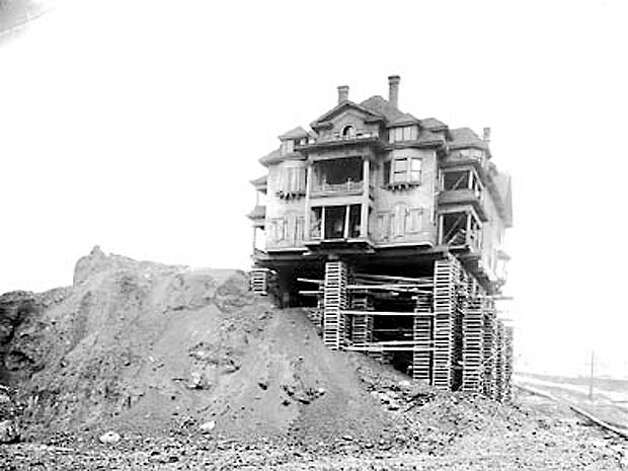
We’ve covered similar circumstances before (here, the “calvacade of homeowner holdouts,” and famous nail houses for example). Indeed, this is not a recent  phenomenon. See Seattle’s Denny regrade, for example. More photos from the Seattle Post-Intelligencer.

dennyregrade

Homeowners who didn’t go along with the Denny regrade project had the hill dug out around them. Photo: Seattlepi.com File / Seattle Post-Intelligencer

Reminds us of the Warner Bros. classic “Homeless Hare,” where Bugs Bunny objects to a developer’s efforts to evict him from his

Continue Reading When All You Have Is A Hammer, Everything Looks Like A Nail House

text

Download LA COA Monteleone

case that originated with a taking in 1987 by the DOT.  In State of Louisiana, et al v. Monteleone, et al, the Court of Appeals affirmed an award of $1,631,000.50 ($214,534.14 as just compensation for the taking + $1,416,466.40 in severance damages) + $1,584,442.54 in interest + $173,030.00 and legal interest in costs +  $900,000.00 and legal interest in attorneys fees and remanded for further determination of attorneys fees due to the landowner for the appeal.  Including all interest calculations, the award totals approximately $6 Million and represents an increase 129 times greater than the initial deposit of $46,558.00

Congratulations to OCA colleague Randy Smith for this win.

Louisiana v. Monteleone, No. 11-CA-1013 (Nov. 13, 2012)Continue Reading La App:

Check out “Property rights take center stage in disputes over wetlands, flooding,” by Greenwire‘s Lawrence Hurley, asking whether the U.S. Supreme Court’s recent “flurry of activity” in property cases augurs a renewed interest in these issues by the Court, or is, as lawprof John Echeverria is quoted as suggesting, “serendipity.”

So far this Term, the Court has agreed to review two major property rights cases, Arkansas Game & Fish Comm’n (is government-caused flooding a taking) and Koontz (do the Nollan/Dolan limitations for land exactions apply to government demands for cash), and could grant cert in others. Lawprof Jonathan Adler suggesting this might not be a new trend, but simply “a return to the norm.”

One of the views noted in the article is ours:

In analyzing why property rights is making a comeback at the high court, some court-watchers point to an active and ideologically driven

Continue Reading Supreme Court Again Focused On Property Cases?