


Save the date: on Thursday, December 1, 2011 (1:00pm-2:30pm EST, 10:00am-11:30am PST) we’ll be presenting the on-line seminar “Eminent Domain: Redevelopment Challenges for Local Governnment – Navigating Federal Funding Requirements, Challenges for Public Utilities in Right-of-Way Projects, and Objections to Taking for Public Use.

Joining me are colleagues Anthony Della Pelle (McKirdy & Riskin – New Jersey), J. Casey Pipes (Helmsing, Leach, Herlong, Newman & Rose – Alabama), Rick E. Rayl and Bradford Kuhn (Nossaman – California), and Mark M. Murakami (Damon Key Leong Kupchak Hastert – Hawaii).

Each member of the faculty should be well-known to our readers: Tony publishes the New Jersey Condemnation Law blog and is a frequent speaker at the annual ALI-ABA eminent domain program. Casey is with the Owners’ Counsel member firm from Alabama and Co-Chair of the ABA Litigation Section’s Condemnation, Land Use, and Zoning Law Committee. Rick and Brad produce
Continue Reading Upcoming National Webinar – Eminent Domain: Redevelopment Challenges for Local Government

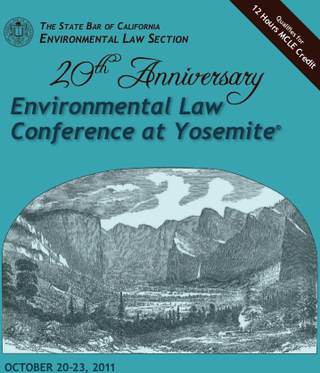
Yosemite_conference One conference down, one to go.

We’re on the way back from the Brigham-Kanner Property Rights Conference in Beijing, and on our way to the California State Bar Environmental Law Section’s annual conference at Yosemite N.P., which begins later this week. More information about the conference here.

Along with U.C. Berkeley law professor Joseph Sax and Deputy California Attorney General Daniel L. Siegel, I will be speaking about “Regulatory Takings: Looking Back and Looking Forward.” E. Clement Shute will moderate the panel discussion.

We will be discussing the seminal regulatory takings cases from the past 20 years. “The panelists, who have been involved in several of the most significant takings cases since even before the founding of the annual Yosemite Environmental Law Conference twenty years ago, will highlight key decisions, offer their views on the evolution of takings law, and discuss cutting-edge issues raised by more recent

Continue Reading California Bar’s Yosemite Conference: “Regulatory Takings: Looking Back and Looking Forward”

Most interesting comments at tonight’s event awarding the Brigham-Kanner prize to Justice (Ret.) Sandra Day O’Connor were the remarks by the Dean of Tsinghua Law School.

“When you amended your Constitution for the first time,” he noted, “you protected things such as speech. When China amended its Constitution for the first time, we protected property.”Continue Reading Brigham-Kanner Conference: In China, Property Rights Are In The First Amendment

At a conference and awarding of a prize named in part in his honor, we lead off with the thoughts on Professor Gideon Kanner from his Gideon’s Trumpet blog on how the People’s Republic of China is dealing (or not) with the whole “property rights” thing:

Now, it would not be a Gideon Kanner commentary without some provocative thoughts:

And so it goes. Still, be all that as it may, we experience a feeling of revulsion whenever we come across this sort of thing, where American law that is said to be of the people’s government that is the embodiment of due process, fairness and equity, turns out in some ways to be not all that much different than the

Continue Reading Brigham-Kanner Conference: Professor Kanner’s (First) Thoughts

Next week, power adapters and internet connectivity permitting, we’ll be blogging from the Brigham-Kanner Property Rights Conference at the Tsinghua University School of Law in Beijing, People’s Republic of China.

Admin note: We’ve added “Brigham-Kanner Conference” as a separate category to catalog the posts related to the Conference. In order to read all of the posts under this topic, go here.

A property rights conference in the PRC? Should be interesting.

Here‘s the agenda and the list of sessions.

The honoree this year is Justice Sandra Day O’Connor. The speakers include the past winners of the B-K prize, Frank Michelman, Richard Epstein, James Ely, Margaret Jane Radin, Robert Ellickson, Richard Pipes, and Carol Rose. In addition to these luminaries in the property law and property rights field, the speakers include the top property law scholars and practitioners in the U.S. (Alan Ackerman, Andy Brigham, Jim Burling, David Callies

Continue Reading Blogging From Beijing: The Brigham-Kanner Property Rights Conference

Some day, the Court will grant cert in another eminent domain case.

But today is not that day.

The Court declined to review C & J Coupe Family Ltd. P’ship v. County of Hawaii, No. 11-75, the petition that asked, after Kelo, when is eminent domain pretextual? We represent the petitioner, and after the case did not show up on last week’s grant list the handwriting was on the wall. But today’s order list made it official.

This makes at least the third pretext petition denied by the Court, meaning the lower courts will continue to flounder about searching for clues in the Kelo majority opinion’s language for the correct standard to assess whether a condemnor’s asserted reason for a taking is a pretext to private benefit, and ask whether Justice Kennedy’s concurring opinion means much of anything. Until the Court establishes a standard, any hope of

Continue Reading Cert Denied In Pretext Case

Under Florida eminent domain law the property owner whose property is taken is entitled to attorney’s fees “based solely on the benefits achieved for the client.” The statute defines what “benefits” means:

As used in this section, the term “benefits” means the difference, exclusive of interest, between the final judgment or settlement and the last written offer made by the condemning authority before the defendant hires an attorney. If no written offer is made by the condemning authority before the defendant hires an attorney, benefits must be measured from the first written offer after the attorney is hired.

Fla. Stat. § 73.092.

In Pompano Beach Community Redevelopment Agency v. Holland, No. 4D10-291 (Sep. 14, 2011), the District Court of Appeal (Fourth District) interpreted the phrase “first written offer” to exclude an unexecuted contract in which the condemnor offered to pay $31,250 for the property. However, “[t]he contract contained

Continue Reading Fla App: What Is The “First Written Offer?”

Update: More thoughts on the apology from Gideon Kanner , the Queens, NY-based property owners’ blog Willits Point United, and from eminent domain scholar lawprof Ilya Somin.

++++++++++++++++++++++++++++++++++++++++++++++++++++++++++++++++++

Comes word from Jeff Benedict, author of the Kelo book Little Pink House, via his blog and a story in the Hartford Courant, that one of the Connecticut Supreme Court justices who voted in favor of the government approached Mrs. Kelo last year at an event and apologized for ruling against her. 

After she told her story, he came up and said, “[h]ad I known all of what you just told us, I would have voted differently.”

Recall that the Connecticut Supreme Court ruled 5-4 that the “economic development” taking of the homes of Mrs. Kelo and her neighbors passed muster under the Connecticut and U.S. Constitutions, overturning the trial court’s post-trial judgment that the takings were invalid

Continue Reading Too Soon Old And Too Late Smart: A Jurist Offers His Kelo Mea Culpa

Not hardly. Just check out the amici supporting her (NAACP, Jane Jacobs, et al.).

To drive the point home that many of the property owners on the business end of eminent domain are those who lack political power and influence, check out this brief filed on behalf of New York state Senator Bill Perkins in the Columbia/Tuck-it-Away case, where he argues that “blight removal” and “economic development” takings “disproportionately impact already marginalized groups, including tenants, the elderly, persons of low-income, and racial and ethnic minorities.” Br. at 7.

A post on a blog at Forbes, Liberals Should Be Upset by the Kelo Case makes the point well.Continue Reading Is Kelo A “Conservative” Issue?