Thanks to the Rocky Mountain Appellate Blog for pointing out the Colorado Supreme Court’s recent opinion in The Glenelk Ass’n, Inc. v. Lewis, No. 10SC275 (Sep. 12, 2011), an important decision about the standard of proof in private-way-of-necessity condemnations. The court concluded that a property owner who claimed to be “landlocked” could not condemn a private access corridor over a neighbor’s land without proof of a “concrete development proposal” showing that the access corridor is necessary.

Lewis owned a 334 acre ag-zoned parcel, and had the right to build one dwelling per 10 acres. Other access options were apparently not feasible, so Lewis and his neighbor Glenelk negotiated for purchase of an easement but failed to reach an agreement. Under Colorado law (like the law of many other jurisdictions) one private landowner may institute a condemnation action against a neighbor if necessary to gain access to a landlocked parcel

Continue Reading Colorado: Private Condemnor Must Prove Present Necessity

Little-pink-house

As we noted earlier, Little Pink House, Jeff Benedict’s book about the Kelo v. City of New London case, looks like it is going to become a TV movie. Mr. Benedict writes:

On Monday my publisher will officially announce that Lifetime is making a movie based on Little Pink House, and Brooke Shields, who is currently on Broadway playing Morticia in The Adams Family, will star in the film as Susette Kelo.

Congratulations, Jeff … but come on Hollywood: even though you disregarded our choice for the lead role, there’s still time to cast the supporting players!

Discover more of the backstory on how he came to write the book, and how Ms. Kelo’s story will transition from the page to the screen here. Continue Reading The Kelo Story Coming Soon To The Screen

“Property rights” often are portrayed as belonging only to the rich and powerful and protecting only the politically connected. But as we recently were reminded, this is a very inaccurate picture because property rights — as the “guardian of every other right” — form the foundation on which all other rights rest, and are “civil rights” that benefit everyone.

If we needed any more reminding, the U.S. Department of Justice recently filed a complaint in the Northern District of Ilinois against the City of Joliet under the Fair Housing Act after the City condemned an apartment complex in which 96% of the residents are African-American. The City claims it needed to take the property for “redevelopment” to alleviate blight. According to the DOJ’s press release:

The complaint, filed today in the U.S. District Court for the Northern District of Illinois, alleges that the city of Joliet

Continue Reading The “Bad Old Days” – Feds Sue City For Eminent Domain Abuse

Worth reading: “Six Years of Separation: Life After Kelo” by Ethan Friedman, posted on Miller Starr’s web site. Mr. Friedman writes about the state of affairs in eminent domain at the macro level, noting the reactions in state legislatures and the US House of Representatives’ current consideration of the “Private Property Rights Protection Act of 2011.” (You might think that having express protection for private property rights in both the Fifth and Fourteenth Amendments might be sufficient, but apparently Congress thinks we need a statute.)

The article also references our pending cert petition in County of Hawaii v. C&J Coupe Family Ltd. P’ship, No. 11-75 (filed July 14, 2011):

However, the Supreme Court had a vastly different makeup in 2005 than it does today. The new Supreme Court, with Justices Alito, Roberts and Sotomayor, and without Justices Stevens, Breyer and O’Connor, was recently asked to consider a

Continue Reading “Life After Kelo” – A Summary Of the Current State Of Eminent Domain Policy

Thanks to the good folks at Volokh and Gideon’s Trumpet for alerting us to the Texas Supreme Court’s opinion in a case we’ve been following, but somehow slipped by, Texas Rice Land Partners, Ltd. v. Denbury Green Pipeline-Texas, LLC, No. 09-0901 (April 19, 2011).

Texas, like many other states, delegates the power of eminent domain to certain utlilities (Hawaii even delegates the power to “irrigation corporations”). Under a Texas statute, Tex. Nat. Res. Code § 111.002, a pipline company may take property to transport carbon dioxide “to or for the public for hire.” A dispute arose between a property owner and a pipeline company when the owner objected to the taking of its property for a pipeline, claiming that there was no evidence that the pipeline would be used by the public to transport CO2. The pipeline company asserted it met the definition of “common carrier”

Continue Reading Texas: “Common Carrier” Claim Subject To Actual Judicial Review

Today, we filed the Reply Brief (also available below) in the case that asks: after Kelo, when is eminent domain pretextual? 

Last month, we filed a cert petition asking the Supreme Court to review the Hawaii Supreme Court’s decision in County of Hawaii v. C&J Coupe Family Ltd. P’ship, 242 P.3d 1136 (Haw. 2010). In that case, the Hawaii court upheld the taking of land on the Big Island, holding that the asserted public use was not a pretext to the overwhelming private benefit to the developer of the luxury Hokulia project.

On August 17, 2011, the developer and the County filed their joint brief in opposition. Our brief responds:

After reviewing the Oceanside/County brief, it would be easy to forget why this case is here: they argue the Hawaii Supreme Court correctly applied the rational basis standard for pretext established in Kelo v. City of

Continue Reading Final Cert Brief In Eminent Domain Pretext Case

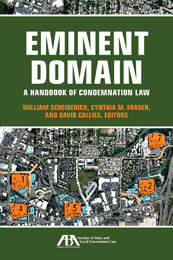
5330215_big The American Bar Association’s Section of State & Local Government Law has just published a new book on eminent domain fundamentals: Eminent Domain – A Handbook of Condemnation Law (available for preorder here).

I was privileged to author two chapters (Prelitigation Process and Flooding & Erosion), and my Damon Key colleagues Mark Murakami and Christi-Anne Kudo Chock co-authored the chapter Damages Resulting from a Taking: An Overview.   

The price is $89.95 with the price of $69.95 for members of the Section of State and Local Government Law (discounts on books and CLE: another good reason to join the Section). There are also discounts for purchase of multiple copies. More details here.

Here’s what the book offers, from the Introduction by my colleague Dan Dalton:

Eminent domain has a long and distinguished legal history, dating from the first limits on sovereign power in the Magna

Continue Reading New Book: Eminent Domain – A Handbook of Condemnation Law (ABA 2011)

Last week the developer and the County of Hawaii filed their joint Brief in Opposition in C & J Coupe Family Limited Partnership v. County of Hawaii, No. 11-75 (cert. petition filed July 14, 2011), responding to the cert petition we filed earlier, that poses this Question Presented:

The Hawaii Supreme Court held that a one-to-one transfer of property to a private developer by eminent domain, instituted outside the confines of an integrated development plan, and while the condemnor was threatened by breach of a contract in which it promised to condemn the land for the developer, was not subject to a presumption of invalidity or even heightened scrutiny under the Fifth Amendment’s Public Use Clause. The court concluded that even when “a contract that delegates a county’s eminent domain powers raises well founded concerns that a private purpose is afoot” under Kelo v. City of New London,

Continue Reading Developer & County’s BIO In Eminent Domain Pretext Case

Yosemite_conference

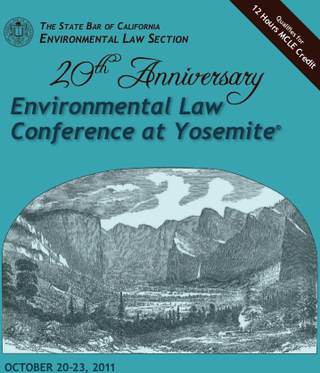
Mark your calendars for October 20 – 23, 2011. That’s when the State Bar of California will present its 20th Anniversary Environmental Law Conference at Yosemite® (yes, it is trademarked), at the Tenaya Lodge in Fish Camp, California.

Along with U.C. Berkeley law professor Joseph Sax and Deputy California Attorney General Daniel L. Siegel, I will be speaking about “Regulatory Takings: Looking Back and Looking Forward.”

We will be discussing the seminal regulatory takings cases from the past 20 years. “The panelists, who have been involved in several of the most significant takings cases since even before the founding of the annual Yosemite Environmental Law Conference twenty years ago, will highlight key decisions, offer their views on the evolution of takings law, and discuss cutting-edge issues raised by more recent court decisions.”  E. Clement Shute will moderate the panel discussion.

The Yosemite program, sponsored by the CSB’s

Continue Reading “Regulatory Takings: Looking Back and Looking Forward” At The Cal Bar’s Yosemite Conference

Many of the cases we cover on this blog present unusual fact patterns and cutting-edge legal claims. But they may not present an accurate view of the typical cases that cross the desk of lawyers who have chosen this line of work, as much of the work of eminent domain and property lawyers involves issues such as access, street widening, parking, and the like.

For an example of that, look no further than today’s short opinion by the South Carolina Supreme Court holding that the loss of left turn access to the plaintiff’s property as a result of the State’s widening of a highway did not result in an inverse condemnation of property. Hilton Head Automotive LLC v. S.C. Dep’t of Transportation, No. 27026 (Aug. 15, 2011). The property owner claimed a physical take of its access easement.

The court concluded:

The gravamen of HHA’s claim is that its

Continue Reading South Carolina: No Taking By Cutting Off Left Turns, Because Property Is Still Accessible By Right Turns And U Turns