Here’s one that’s holding over from 2022, but we wanted to make sure to post because it’s a good reminder that when you settle a case, you settle the case.

Wyoming is one of those jurisdictions that has one of those “I want it back” provisions, where if property is not actually used for X years after it is acquired by the government, the owner may ask for it to be returned. In Wyoming, the term is 10 years:

If a public entity acquires property in fee simple title under this chapter but fails to make substantial use of the property for a period of ten (10) years, there is a presumption that the property is no longer needed for a public purpose and the previous owner or his successor may apply to the court to request that the property be returned to the previous owner or his successor upon

Continue Reading Wyoming: When You Settle An Eminent Domain Fight By Waiving All Future Claims, You Can’t Take Advantage Of A Reclaim Statute

Thanks to a colleague giving us a heads-up, we’re starting 2023 with a neat case.

In Ohio Power Co. v. Burns, No. 2021-1168 (Dec. 29, 2022), the Ohio Supreme Court declined to apply a statutory presumption of necessity to the power company’s efforts to use eminent domain to expand the scope of several existing utility easements to upgrade electric transmission lines. Although the case turned on the interpretation of the term “appropriation” in the Ohio statute, it has some lessons for those of us not in the Buckeye State.

In the absence of three statutory presumptions that a taking is necessary, the general rule in Ohio is that the condemnor bears the burden of proving necessity by a preponderance of the evidence. Here, “[t]he landowners opposed the easements in general, alleging that the appropriations were overly broad and unnecessary, and they challenged the need for several of the easement

Continue Reading Ohio: Necessity Is Judged By The Property Taken, Not The Overall Project

A classically short opinion from the New York Supreme Court (Appellate Division, Fourth District) in HBC Victor LLC v. Town of Victor, No. 683 (Dec. 23, 2022). (So short that we were tempted to simply post the opinion and let you read it, because it will probably take you just as long to read our summary; but we’re up to the challenge of making our summary even shorter than the opinion, so here goes.)

The town wants to take property “connected to an enclosed regional shopping center known as Eastview Mall[.]” Slip op. at 1. Until Co-19, the property was occupied by a retail department store, but the store closed permanently in February 2021. The owner tried to get a new tenant, but unsurprisingly, that came up short.

Perhaps sensing an opportunity, the Town sought to condemn for redevelopment. But its resolution of taking did not specify what it

Continue Reading You Can’t Just Say “Redevelopment” – Take Now, Decide Later Isn’t A Public Use

Check this out, a decision upholding a necessity challenge to a taking.

Necessity, you say? What’s this? Aren’t necessity challenges subject to an even more deferential judicial standard of review than the rational basis test applied to declarations of public use? Didn’t the U.S. Supreme Court in Adirondack Ry. Co. v. New York, 176 U.S. 335, 349 (1900) say that “[t]he general rule is that the necessity or expediency of appropriating particular property for public use is not a matter of judicial cognizance but one for the determination of the legislative branch of the government….”? What gives?

In Lafayette City-Parish Consolidated Gov’t v. Bendel, No. 22-0432 (Dec. 23, 2022), the local government brought an expropriation action (that’s eminent domain or condemnation to you non-Louisiana chappies), seeking to take property to construct four detention pods to improve drainage. The owner objected, challenging the public use and necessity of the

Continue Reading No Necessity: Landowner Met Burden – Condemnor Did Not Consider Other Sites

Here’s another one from the Ninth Circuit, argued on what one advocate called “land use day at the Ninth Circuit” (except, unlike the other two cases argued that day, the decision in this one gets published). 

In Gearing v. City of Half Moon Bay, No. 21-16688 (Dec. 8, 2022), the panel upheld the dismissal of a takings case, holding that federal courts should abstain from considering regulatory takings cases in favor of pending state court eminent domain actions, even when the condemnor instituted the state court action in response to the federal takings claim (and even though, unlike the other two cases argued that day, the federal takings claim is ripe).

This one started in federal court, where the property owner asserted the city’s rejection of its development application worked a taking. In response, the city ran to state court and filed an eminent domain action

Continue Reading CA9: Land Use Is A “Sensitive Area Of Social Policy” So We’re Gonna Let A Local Govt Bleed The Property Owner Out

Check out the Ohio Supreme Court’s 6-1 opinion in State ex rel. Ohio History Connection v. Moundbuilders Country Club Co., No. 2020-0191 (Dec. 7, 2022), in which the court held held that the taking of the Country Club’s lease for the property served a public use.

Court News Ohio beat us to the punch is summarizing the case and the dissent, so instead of us repeating, we suggest you go check it out:

The Ohio History Connection can proceed with its efforts to transform the Octagon Earthworks of Newark into a public park by extinguishing the Moundbuilders Country Club lease on the land, the Supreme Court of Ohio ruled today.

A Supreme Court majority affirmed a Fifth District Court of Appeals decision allowing the History Connection to take the land through eminent domain. The state agency wants to convert the Octagon Earthworks into a public park so that it

Continue Reading Ohio: Property Got Nominated Real Good – Saying You Want To Put Up Site For UNESCO Designation Is Enough To Support Taking

Syllabus

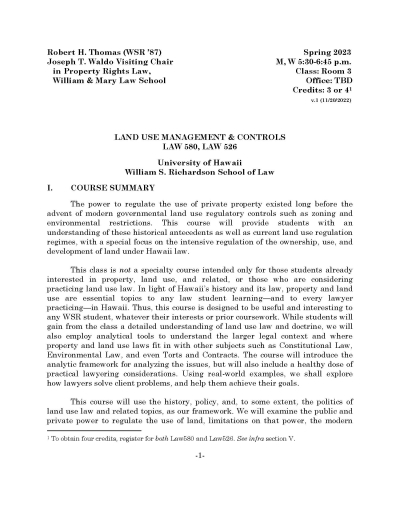
Starting in January, we’ll be teaching the venerated, and oh-so-important Land Use course (Law 580) at the University of Hawaii’s Law School.

We’re at least temporarily stepping into some mighty big slippers (this is Hawaii, so we don’t always wear shoes), as this is the course that our mentor Professor David Callies taught for decades. And is there a better venue in which to teach and study land use law and regulation, and its limits? After all, Hawaii may be the most heavily-regulated land on the planet, and is a focal point for every issue you can think of, from zoning to environmental restrictions to takings to public trust to subdivision to admin law to … well, you get the drift.

We’ll cover those topics, as well as the fundamentals. And we have a few surprises up our sleeve – some impressive guest lecturers, explorations of dirt law careers

Continue Reading Hawaii 5-80: Land Use Law At The University Of Hawaii

Here it is, the official agenda and program for the 40th ALI-CLE Eminent Domain & Land Valuation Litigation Conference, February 2-4, 2023 (with a special event the evening of Wednesday, February 1, 2023 to entice you to arrive early).

Screenshot 2022-11-18 at 13-35-13 ALI CLE PA NY VA TX FL Continuing Legal Education

Here’s the brochure with the complete agenda, schedule, and faculty listing. But to tempt you, here are some of the highlights of the program:

  • Everything Old is New Again: Why Today’s Practitioners Need to Understand the Original Meaning of the Takings and Just Compensation Clauses
  • Private Utility Takeovers – Lessons From a 67 Day Trial

  • Valuation Issues When Billboards and Signs are Condemned

  • Setting Client Expectations and Identifying Red Flags

  • Developing Property Right Issues in Texas – Questions and Answers from the Bench: A View From the Bench (with Texas Supreme Court Justice Jimmy Blacklock)

  • Eminent Domain and Regulatory Takings Updates: Important Decisions You Need to Know

  • Ethics:


Continue Reading Here’s The Program For The 40th ALI-CLE Eminent Domain & Land Valuation Litigation Conference, Feb 1-4, 2023, Austin

Ideker Farms, Inc. v. United States, No. 21-1849

As written up in the FedCircuitBlog (a must-follow for all you federal takings mavens):

It concerns the federal government’s liability for taking private property. Specifically, in this case, the Federal Circuit will review the conclusion of the Court of Federal Claims that the government’s action was the cause-in-fact of flooding damage and that, as a result, a taking-by-flooding occurred. The government appeals the CFC’s judgment, while Ideker Farms cross-appeals.

Behrens v. United States, No. 22-1277

Also from the FedCircuitBlog:

Behrens v. United States, which concerns a claim the federal government was liable for taking land for public use through the National Trails System Act. Specifically, in this case, the Federal Circuit will review the determination by the Court of Federal Claims that the plaintiffs were not entitled to compensation because the scope of the easement in question was broad

Continue Reading CAFED Hears Arguments In Two Takings Cases

Takingspanel

For the last week, the blog has been a bit idle. That hasn’t been because we’re slowing down, but was mostly the result of our blog platform being worked on behind-the-scenes, which knocked a lot of the hosted blogs offline, this one included. But things look good now, so here we are.

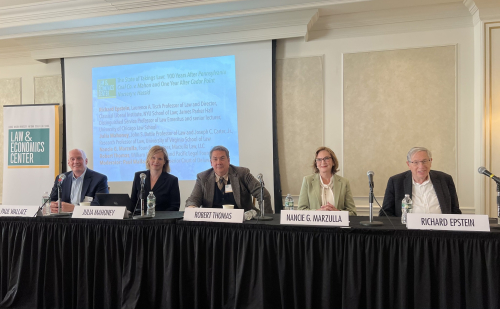
We were also on the road, traveling to New York for the Seventeenth Meeting of the American College of Business Court Judges, where we were able to join an august panel of takings mavens (pictured above, L-to-R: Judge Paul Wallace, Professor Julia Mahoney, some guy, Nancie Marzulla, and Professor Richard Epstein) to talk about the state of takings law.

The title of our program was “The State of Takings Law: 100 Years After Pennsylvania Coal Co. v. Mahon and One Year After Cedar Point Nursery v. Hassid,” and we spent our time discussing and debating

Continue Reading What’s “The State of Takings Law: 100 Years After Pennsylvania Coal Co. v. Mahon and One Year After Cedar Point Nursery v. Hassid”? Incoherent (But Getting Better)