Here’s a recently-filed cert petition in a pipeline case. This one asks whether an agency — here, FERC — has primary administrative jurisdiction over a facial challenge to Congress’ delegation of federal eminent domain authority to a private party. 

Here are the Questions Presented:

Whether a facial challenge to Congress’s delegation of eminent domain power to private parties is properly filed in district court, as this Court held in PennEast Pipeline Co. v. New Jersey, 141 S. Ct. 2244 (2021), or with FERC, which has admitted it has no jurisdiction to adjudicate the constitutionality of this delegation.

Whether a facial challenge to Congress’s overly broad delegation of legislative power to FERC is properly filed in district court or with FERC, which has admitted it has no jurisdiction to adjudicate the constitutionality of this delegation.

Whether a facial challenge to Congress’s delegation of eminent domain power to FERC is properly
Continue Reading New Takings Cert Petition: Can An Agency Decide Constitutionality Of Delegation Of Federal Eminent Domain Power?

PXL_20220927_164202969

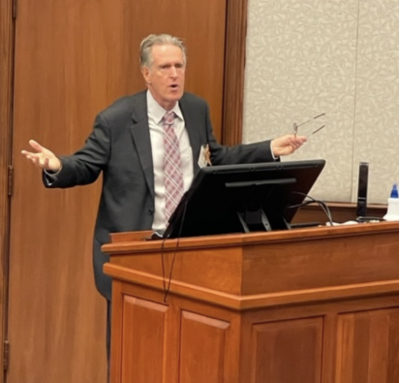
We spoke on the second panel of the day at the 2022 Brigham-Kanner Property Rights Conference at the William and Mary Law School. The subject of our panel — which included Professors David Callies, Tim Mulvaney, and Dave Owen — was “Reshaping the Framework Protecting Property Under the Roberts Court.

Here’s a rough transcript of my remarks.

————————————–

President Reveley, Professor Butler, distinguished Brigham-Kanner Prizewinners (present and future), mentors, colleagues, family and friends: thank you for the opportunity to speak today.

The story goes that when asked what it was like to be a part of the “Rat Pack,*” that Dean Martin responded “It’s Frank’s world, we just live in it.”

Fd5_62PUoAEo-y8

When I first heard the title of this portion of the program and the discussion of how and if the Roberts Court is reshaping property, my first reaction was a paraphrase of Dean

Continue Reading Brigham-Kanner Property Rights Conference 2022 Report: It’s Chief Justice Roberts’ Property World, We Just Live In It

Screenshot 2022-09-13 at 14-12-11 Feed LinkedIn

One last reminder that there’ still time to register for the upcoming Brigham-Kanner Property Rights Conference at the William and Mary Law School in Williamsburg, Virginia, September 29-30, 2022. If you can’t make it to the historic campus, there’s an option to attend remotely.

In our opinion, the Conference is the best of its kind because it brings together legal scholars and the practicing bar to talk dirt law theory and practice. We also a have a full supplemental program for law students, that covers property law and careers in eminent domain law, a recruiting session, a program on international property rights, and a program on land use law.

Registration for the Conference is ongoing, and you can sign up here.

Here is the full agenda. (We’ll be speaking on Panel #2, “Reshaping the Framework Protecting Property Under the Roberts Court.”)

Come on, join us!

Continue Reading Still Time To Join Us (In-Person Or Remote) For The 19th Annual Brigham-Kanner Property Rights Conference

Be sure to check out Anthony Alderman (MRICS, SR/WA, CRE, Senior Managing Director at Cushman & Wakefield), who guests on Episode 98 of Clint Schumacher’s Eminent Domain Podcast, “Eminent Domain in Pop Culture.”

You know we are going to really appreciate an episode “about depictions of eminent domain in popular culture – often a juror’s only prior exposure to condemnation law.” Whether it’s the vibe of contitution, or how eminent domain can show up in novels, Netflix, Russian and Australian movies, memes (and meme briefs), or nerding out on Star Trek metaphors. We love this topic.

But it’s not all distractions, because the episode also covers “what makes appraising for eminent domain acquisitions different from other appraisal projects as well as current issues of interest in the appraisal field.”

What a fun episode. Don’t miss it. Continue Reading It’s The Vibe! – Eminent Domain In Pop Culture

Here’s the latest in a controversy we’ve been following.

In 624 Broadway LLC v. Gary Housing Authority, No. 22S-CT-140 (Aug. 29, 2022), the Indiana Supreme Court held that the Authority failed to provide the property owner adequate notice that it would be taking its property as part of a redevelopment project.

The Gary Housing Authority wanted to redevelop 624 Broadway’s commercial property in downtown Gary into mixed-use residential. The Authority instituted an “administrative taking” under Indiana law, which is “an alternative to the ‘traditional’ lawsuit route” that “occurs when an authorized governmental body condemns property and awards damages through resolutions.” Slip op. at 2.

The administrative taking statute only requires notice to the property owner by publication. And that’s exactly the notice the Authority gave 624 Broadway. “It twice published notice of the resolution and upcoming meeting in two area newspapers of general circulation.” Id. Broadway’s agent found

Continue Reading Indiana: Before Taking Property, Condemnor Must Provide Notice Reasonably Calculated To Put The Owner On Actual Notice

BK 2022

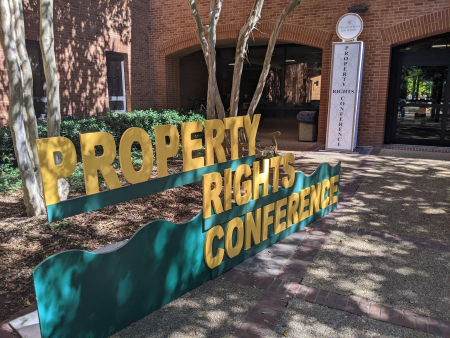
There’s still space for you to join us — preferably in-person, but remotely if that is not possible for you — at the 19th Annual Brigham-Kanner Property Rights Conference, September 29-30, 2022, at the William and Mary Law School in Williamsburg.

The American Law Institute was kind enough to post a notice about the Conference and the ALI members who are on the speaking faculty here.

Registration for the Conference is ongoing, and you can sign up here. Here is the full agenda. (We’ll be speaking on Panel #2, “Reshaping the Framework Protecting Property Under the Roberts Court.”

In our opinion, the Conference is the best of its kind, and brings together legal scholars and the practicing bar to talk dirt law. So please come join us.Continue Reading Registration Underway – 19th Annual Brigham-Kanner Property Rights Conference (Sep 29-30, 2022)

Here’s the latest in a case we’ve been following. The U.S. Court of Appeals recently heard oral arguments in a case where a private Natural Gas Act condemnor (the Sabal Trail pipeline) exercised the delegated federal power of eminent domain to take the property of a Florida owner.

As we reported here, the issue is whether federal or state law applies in these cases. The big reason why the question of whose law applies is that under the Fifth Amendment, “just compensation” does not include attorneys’ and other fees, while under the Florida Constitution’s “full compensation” provision (which we noted here), a property owner may recover fees and costs. The District Court held that Florida law, not federal, applied, and Sabal Trail appealed to the Eleventh Circuit.

The arguments are worth listening to. Is this a question of “choice of law?” Or does it go

Continue Reading CA11 Oral Arguments In Pipeline Taking: If Florida Law Says The Owner Gets Compensation Plus A Car, Does A Federal Court Have To Recognize That?

Is there a more appropriate place at which to study property rights and dirt law than William and Mary Law School? After all, it is a stone’s throw from Jamestown, the place where there’s a good argument the concept of property law and property rights first took hold in the New World. As noted by author David Price in “Love and Hate in Jamestown – John Smith, Pocahontas, and the Start of a New Nation” –

The introduction of private property for the common citizen had a salubrious effect on the owners’ sense of initiative, as John Rolfe would observe. By the end of 1619, he reported, the “ancient” (or longtime) colonists had chosen their allotments, “which giveth all great content, for now knowing their owne lande, they strive and are prepared to build houses and to cleare their grounds ready to plant, which giveth …

Continue Reading Ye Olde Law 608: Eminent Domain & Property Rights, S5E1 @ William & Mary Law

IRWA

The International Right of Way Association‘s Real Estate Law Committee produces twice-a-year reports “which contain summaries of eminent domain decisions and legislation within the United States.”

And what is really nice is that they make the report available

We’re posting it here because we’re one of the co-authors. Hat tip to our co-authors Brad Kuhn, Jillian Friess Leivas, and Ajay Gajaria.

The report is short, and doesn’t contain a lot of fluff. Just what you wanted.Continue Reading IRWA’s Summary Of Major Eminent Domain Cases & Legislation (Jan-May 2022)

Last week, along with my colleagues Deborah La Fetra and Kady Valois, we filed this cert petition in a case we’ve been following (even before we joined as counsel).

The petition seeks review of the Fifth Circuit’s opinion holding that there’s nothing a federal court can do if a local government does not pay a state-court just compensation judgment for an unreasonably long time. Because we are counsel in the case we won’t go into further detail, but will leave it to you.

Here’s the Question Presented:

A fundamental element of just compensation is “certain payment of the compensation without unreasonable delay.” Bragg v. Weaver, 251 U.S. 57, 62 (1919). In 2013, the Sewerage & Water Board of New Orleans inversely condemned the properties of 70 home and business owners for a flood control project. The property owners obtained state court judgments starting in 2018. Louisiana law

Continue Reading New Cert Petition (Ours): Can Condemnor Delay Actually Paying Compensation Indefinitely?