Here’s how the Pennsylvania Supreme Court stated the issue in Hughes v. UGI Storage Co., No.J-69A-2021 (Nov. 29, 2021):

In these consolidated appeals, we consider the Commonwealth Court’s holding that, to be held liable for damages under Pennsylvania’s inverse condemnation statute, an entity must be clothed with the power of eminent domain – not only in a general sense, in that it must be a governmental or quasi-public entity to which condemnation powers may be delegated – but also, the entity must be invested with eminent domain authority specific to the property in issue.

Slip op. at 1.

If all you need to know is “what did the court answer?” you can stop right here: the court held that UGI Storage did not need to have been delegated the power of eminent domain, nor must it be delegated the power to take the property at issue, in order to
Continue Reading Pennsylvania: To Be Liable For Inverse Condemnation, Taker Need Not Have Eminent Domain Power

Like a lot of things in Gary, Indiana, the Housing Authority was “troubled.” So troubled, the feds took it over. The Housing Authority received big money from the feds, and was required to agree to an annual contribution agreement, by which the Authority ok’d a HUD takeover in the even of the Authority’s substantial default.

Next up, default. The city dissolved the Housing Authority’s Board of Commissioners, and HUD appointed one of its employees to be the administrator of the Authority and to serve as the Board of Commissioners. Back in business.

Part of the administrator’s … ahem … “Authority’s” business was redevelopment. The Authority decided to take 624 Broadway’s property (which, not surprisingly, included 624 Broadway) to do some mixed-use and affordable housing. The taking was undertaken under Indiana’s eminent domain procedures. Attempts to purchase the property were not successful, so the Authority instituted an administrative taking.

Continue Reading Indiana App: Even When Federal Agency Steps Into The Shoes Of A Local Redevelopment Agency, It Has To Follow Local Rules

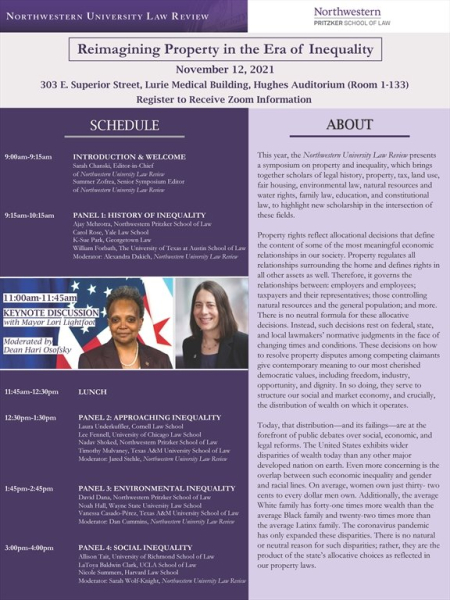
“This year, the Northwestern University Law Review presents a symposium on property and inequality, which brings together scholars of legal history, property, tax, land use, fair housing, environmental law, natural resources and water rights, family law, education, and constitutional law, to highlight new scholarship at the intersection of these fields.”

More information, as well as registration to attend remotely, here.

Nulr_symposium_posterContinue Reading Still Time To Sign Up For Northwestern L. Rev.’s Symposium: “Reimagining Property Rights in the Era of Inequality” (Friday, Nov. 12, 2021)

21a0226p-06

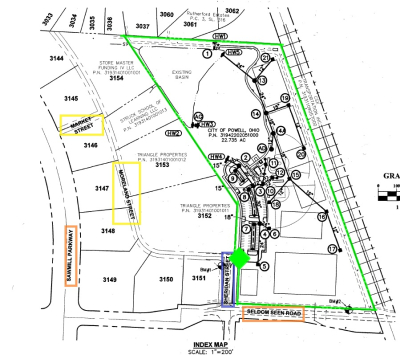
We thought we posted the U.S. Court of Appeals for the Sixth Circuit’s recent opinion in a takings case,  Golf Village North, LLC v. City of Powell, No. 20-4177 (Sep. 23, 2021), earlier, but a search of the blog reveals we did not, so here we go.

The City built a new 23-acre public park (highlighted in green on the map above), which had been dedicated by the developer, Golf Village North, as a condition of subdivision. A road that led to the one of the park entrances was to be made a public road (blue highlighted). The City’s plans noted that approval of the park construction and opening the blue road to the public were contingent on the City securing easements from Golf Village for public access to the private streets.

The city tried to obtain these easements but Golf Village declined. Notwithstanding the city’s plans required

Continue Reading CA6: City Park Causing Public To Use Private Roads Not A Taking Because Owner Can Erect Roadblock

FCetK11XoAASxO2

Please plan on joining us next Wednesday, November 3, 2021, at 8pm ET for the next gathering of the Eminent Domain and Right of Way Club, a social media gathering spot “geared toward right of way professionals as well as anyone interested in the acquisition of land rights for infrastructure projects.” Register for the (free) Clubhouse App here.

I must say that I’m intrigued by this newfangled “clubhouse” thing, and from what I gather it is a place for those who share interest in a topic to talk a bit of shop in a friendly and informal environment. What’s nice about this group is that it isn’t necessarily geared only towards condemnation lawyers (who are welcome, but not the center of gravity), but includes all of the other professionals involved in the industry. 

The topic of the day for this meeting is something near and dear to my

Continue Reading Join Us – Wed, Nov 3, 2021 (8pm ET) – Eminent Domain & Right-of-Way Club

FrankLUI Co-Chair Prof. Frank Schnidman introducing the faculty
Here are the links to the cases and issues that we just finished speaking about at the 35th Annual Land Use Institute (more information on the LUI here). Today was day 1 of a multi-day remote program and the sessions are available ala carte, so there’s still time to join in and learn.

Supreme Court

  • Cedar Point Nursery: the Supreme Court affirms the “keep out” vibe in property law. Yes, there are three “exceptions” to the presumption that any physical intrusion into property is a taking (torts, entries allowed under “background principles,” and legal exactions), but overall a very strong affirmation of property rights.
  • Pakdel v. San Francisco: the “final decision” ripeness requirement in takings cases is “relatively modest” and turns on “de facto” readiness. Yes, it’s a technical requirement, but let’s not get too technical about it.
  • PennEast Pipeline


Continue Reading Links And Materials From Today’s Land Use Institute Takings/Eminent Domain Session

PXL_20211001_131054682Joe Waldo leading off the Conference with a remembrance of
Toby Prince Brigham, for the eminent property rights practitioner
for whom the Conference is named.

I was honored to speak today at the 2021 Brigham-Kanner Property Rights Conference, and here’s a rough transcript of my remarks.

Seeking Justice Through Just Compensation

Dean Spencer, Professor Been, Professor Butler, and colleagues.

The title of our session is “The Relationship between Eminent Domain and Social and Racial Injustice,” and my colleagues have ably covered the ways in which limitations on the power to take can move us towards justice. And there is little I might add to their contributions, except to note this, a quote from a commentator in a recent story about historical “slum clearance” in the Tampa, Florida, area:

“If you want to know where historic Black neighborhoods were once located, look for a sports arena or

Continue Reading Seeking Justice Through Just Compensation: 2021 Brigham-Kanner Property Rights Conference

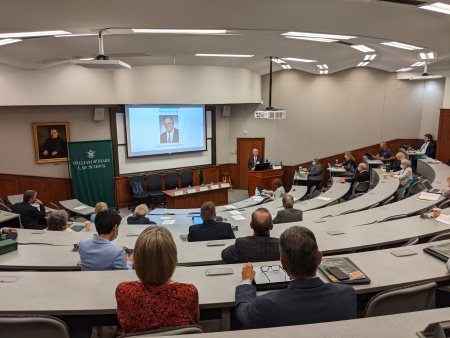
PXL_20210920_195630876

There’s still plenty of time to register and join us for the 18th Annual Brigham-Kanner Property Rights Conference at the William and Mary Law School, Thursday and Friday, September 30 and October 1, 2021.

Yes, you may attend in-person, or remotely. The registration fees are very reasonable, ranging from $0 (yes, free!) to $200 (go here, and click “Tickets” for the details).

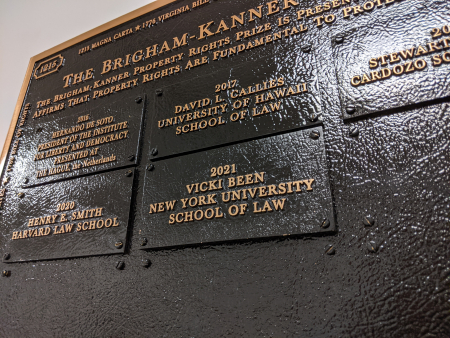
This year’s Brigham-Kanner Property Rights Prize winner is Professor Vicki Been (NYU Law). The Conference includes presentations on:

  • Remembering Toby Brigham
  • The Role of Empirical Research in Defining the Scope of Constitutionally Protected Property Rights: A Tribute to Been
  • The Relationship between Eminent Domain and Social and Racial Injustice (this is the panel on which we’ll be presenting)
  • Just Compensation Issues, Changing Public Uses, and Other Recent Developments
  • The Interdependence of Property and First Amendment Rights
  • The Distributional Implications of Land Use Regulation

Details on

Continue Reading 2021 Brigham-Kanner Property Rights Conference (Sep. 30 – Oct. 1, 2021) – Still Time To Join Us

DqyzrckX0AIhgpM

Check this out, the latest from lawprof Lee Anne Fennell, her thoughts on the Supreme Court’s Cedar Point decision, “Escape Room: Implicit Takings After Cedar Point,” forthcoming in the Duke Journal of Constitutional Law & Public Policy.

Here’s the abstract:

In the June 2021 case of Cedar Point Nursery v. Hassid, the Supreme Court held that a California regulation that gave union organizers limited access to agricultural worksites (three hours a day, 120 days a year) amounted to a per se taking. The Court further opined that any governmental grant of physical access, no matter how time-limited or functionally constrained, similarly works a per se taking—unless one of the Court’s exceptions applies. This essay argues that Cedar Point is best understood as part of an ongoing campaign by the Court to selectively apply heightened scrutiny to property-facing governmental acts in ways that broadly entrench the status quo.

Continue Reading New Article: Lawprof Lee Anne Fennell – “Escape Room: Implicit Takings After Cedar Point”

All the topics you want to know about, presented by top-notch faculty from across the nation. Sessions include:

  • Keynote: Do Animals Have Property Rights?
  • Did the Supreme Court Signal a New Direction in Property Rights in Cedar Point Nursery?
  • Maximizing Relocation Benefits: Understanding the Law and Regulations to Ensure Fairness
  • Challenging Public Use: Lessons From a 67-Day Trial
  • COVID Takings
  • Property Rights as Civil Rights
  • Eminent Domain National Update
  • Federal Court and the Daubert Challenge: How to Prepare
  • How to Position Your Client for the Fallout When Projects Don’t Get Built
  • Rural Broadband and the Emerging Constitutional Challenges
  • Are Precondemnation Entry Statutes Still Valid After Cedar Point Nursery?
  • How Condemnor and Property Owners’ Counsel Prepare the Battlefield
  • How Will the Trillion Dollar Infrastructure Bill Impact Your Practice?
  • Ethics
  • …and more, including a full slate of networking and social events!

We’ve sold out the last few years, so don’t Continue Reading Registration Open Now: ALI-CLE Eminent Domain & Land Valuation Litigation Conference, Jan 26-29, 2022, Scottsdale