Here’s an issue that we’ve been following for a while. What will a court do when a condemnor is ordered to pay (the property owner has a judgment in hand), but the condemnor says “no thanks”?

The latest incarnation is the U.S. Court of Appeals’ opinion in Ariyan, Inc. v. Sewerage & Water Board of New Orleans, No. 21-30335 (Mar. 21, 2022). There, a group of property owners successfully brought Louisiana law takings claims against the Board after its flood control project caused “property damage and economic loss.” In the various cases, verdicts were rendered, and judgments were issued from 2018 through 2020.

Well, you know what is supposed to happen next. Judgment debtors are supposed to pay up, or else the judgment creditor may satisfy the judgment by other means.

But when the government is the judgment debtor, the creditor can’t just put a lien on City

Continue Reading What Can A Property Owner Do When A Condemnor Doesn’t Pay? (Fifth Circuit: Nothing)


When you are building a sewer, grading is important. Otherwise, the stuff might not “flow” correctly, if you get our drift. Okay Public Works Authority built a sewer, and guess what? “The work performed by OPWA caused extensive damage” to private property, and the “lines installed by OPWA had not been properly graded.”

Not good. The jury in the inverse condemnation lawsuit that followed awarded $73k in compensation. The court of appeals, however, tossed the verdict because OPWA did not possess the power of eminent domain to take property for sewage lines. And to be liable for inverse in Oklahoma, the defendant must possess the eminent domain power.

In Barnett v. Okay Public Works Authority, No. 117792 (Mar. 8, 2022), the Oklahoma Supreme Court concluded that the utility possesses the eminent domain power to take property for sewer lines. The decision turned on the language in the statute delegating

Continue Reading OK: Inverse Is A Two-Way Street – Utility Has Eminent Domain Power, So Is On The Hook For Inverse

CedarpointPRELcoverpage

Thank you to the editors over at The Practical Real Estate Lawyer for publishing my missive on Cedar Point Nursery v. Hassid, the U.S. Supreme Court’s recent blockbuster regulatory takings decision (and for letting me post a copy of the article here so it is available even if you are not a PREL subscriber). And you know this, but I’m going to disclose it again: my law firm represented the property owner in that case, so yes, I do have a viewpoint; take that into account while reading. 

By the way, you might consider becoming a subscriber. The journal publishes just what the title suggests it does – practice-oriented articles about dirt lawyering. Good stuff.

Thomas, Common Sense and Common Law: Defining “Property” in Cedar Point v. Hassid, 38 Prac. Real Estate Law…

Continue Reading New Article: Common Sense and Common Law: Defining “Property” in Cedar Point v. Hassid

Screenshot 2022-02-15 at 07-42-11 Eminent Domain Reports - Publications IRWA

Check this out: the International Right of Way Association’s Real Estate Law Committee produces twice-a-year reports “which contain summaries of eminent domain decisions and legislation within the United States.” (This is the “international” right of way association, so that last qualifier is important.)

And what is really nice is that they make the report available

We’re posting it here because we’re one of the co-authors. The laboring oars on this are really Brad Kuhn and Jullian Friess Leivas (both from the Nossaman firm), but they were kind enough to ask me for some input.

Brad and Jillian wrote up more at the California Eminent Domain Report.

The report is short, and doesn’t have a lot of fluff. Just what you wanted.Continue Reading IRWA’s Summary Of Major Eminent Domain Cases & Legislation (June-Dec 2021)

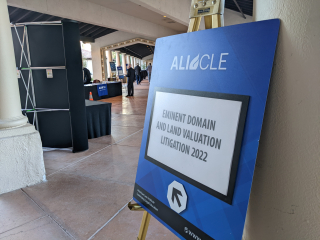
PXL_20220127_144224442

After a two-year absence in which we went remote, in the last week of last month (our usual spot on the calendar, between the playoffs and Super Bowl), we once again met in-person for the American Law Institute-CLE Eminent Domain and Land Valuation Litigation Conference.

Approximately 200 lawyers, judges, legal scholars, appraisers, law students, right-of-way agents, relocation experts, property owners, and other related professionals gathered in-person–yes, in-person–at the Scottsdale (Arizona) Resort at McCormick Ranch, to get reacquainted, learn stuff, and renew ties last made in-person in Nashville in 2020. In addition to the live attendance, we also welcomed about 50 remote colleagues, who joined the live webstream.

This was the 39th edition of the Conference, one of the most-established and successful conferences in the ALI-CLE stable of programs.

To those who joined us – thank you. This conference reminded us of why this program is so

Continue Reading 2022 ALI-CLE Eminent Domain And Land Valuation Litigation Conference, Scottsdale: You Should Have Been There!

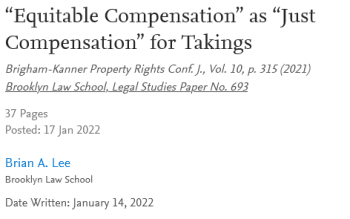
Screenshot 2022-01-24 at 11-03-28 “Equitable Compensation” as “Just Compensation” for Takings

An article, from the just-published issue of the Brigham-Kanner Property Rights Journal, about a rarely-covered academic topic, just compensation.

Brian A. Lee (Brooklyn), “Equitable Compensation” as “Just Compensation” for Takings, 10 Brigham-Kanner Prop. Rts. J. 315 (2021).

Here’s the Abstract:

The Fifth Amendment’s requirement that the government pay “just compensation” to owners of taken property is typically assumed to mean “full” compensation, equivalent to the taken property’s fair market value. In this symposium contribution to the Brigham-Kanner Property Rights Journal, I explore an often overlooked alternative understanding of “just compensation” for takings, one freed from automatic equation with full, fair-market-value compensation. Rooted in traditional equity, this “equitable compensation” alternative has significant historical roots, starting with the Fifth Amendment’s drafters’ striking choice not to follow the Northwest Ordinance of 1787’s requirement of “full” compensation, and running through a line of cases and commentary that has emphasized takings compensation’s equitable

Continue Reading New Article: “‘Equitable Compensation’ as ‘Just Compensation’ for Takings” (Brigham-Kanner Property Rights Journal)

If you ever get the opportunity to teach in a law school — either as a full-time legal scholar, or part-time as an expert adjunct practitioner — take it if you can. You might think you know a lot about a particular subject, but there’s nothing like spending time at the lectern in a law classroom in front of sharp and eager lawyers-in-training to sharpen your thoughts, and get you to truly understand a subject.

And folks calling you “professor” can evoke a smile.

Sensei

But if there’s one downside to the law school experience from the teacher’s side of the lectern, it’s grading. Especially at a law school like William and Mary that has a pretty strict mandatory curve. In upper-division courses that we handle like Eminent Domain and Property Rights Law and Land Use — where we’re dealing with some very high-level stuff and the quality of the

Continue Reading The Circle Is Now Complete: A Sampling Of Final Paper Topics From William and Mary Law’s Eminent Domain & Property Rights, And Land Use Courses

The latest episode of Clint Schumacher’s Eminent Domain Podcast has dropped.

A Holiday Special in which Dave Arnold, Kristen Bennett, Ivy Cadle, Anthony DellaPelle, Carolyn Elefant, Clint Harbour, Justin Hodge, Patrick McCallister, Richard Rothfelder, and Adam Sanders share their seasonal traditions.

We also visit with Clint for a preview of the upcoming ALI-CLE Eminent Domain & Land Valuation Litigation Conference, Jan 26-29, 2022, Scottsdale, Arizona.

As always, check it out!Continue Reading Episode 80, Eminent Domain Podcast: Holiday Special (And ALI-CLE Conference Preview)

You probably already know our Toronto friend and colleague Shane Rayman. He’s the lawyer responsible for the fascinating Supreme Court (Canada, naturally) decision in Antrim Truck Centre, wherein the Court recognized that under the Expropriation Act, Ontario had an obligation to compensate a property owner for “injurious affection” even though the highway project did not formally expropriate any part of the owner’s truck stop.

Shane is also a regular guest lecturer at our William and Mary Law School Eminent Domain and Property Rights class (where he speaks on comparative property rights), and has been a faculty member at the ALI-CLE Eminent Domain and Land Valuation Litigation Conference. He also recommended we visit Montreal’s Mirabel Airport (a trip only a true dirt lawyer could love).

To catch up on the latest from Shane, check out this Canadian Lawyer story, “Expropriation expands with more infrastructure projects,” in

Continue Reading Shane Rayman On Expropriation And Compensation In Canada

If you knew nothing about a case except that it was public use challenge to a redevelopment condemnation in New York, you’d be on firm footing if you guessed the outcome was not going to be favorable to the property owner. New York, after all, is what one colleague called the worst in the nation at protecting property owners, and has produced such stinkers are the Atlantic Yards decision, and the Columbia-takes-Manhattanville case. 

The facts in PSC, LLC v. City of Albany Indus. Dev. Agency, No. 432952 (Dec. 9, 2021), might not be as dramatic as those two cases, but the result is the same: the New York Supreme Court Appellate Division upheld a redevelopment taking of a holdout owner, concluding that the agency’s decision to take a public parking lot was not subject to any serious judicial questioning. Same as it ever was.   

The court

Continue Reading NY App Div: Taking In Albany’s “Parking Lot District” Meets Low Redevelopment Standards, Even Though No One Seems To Want To Redevelop