Like a lot of jurisdictions, Kentucky allows (or requires upon demand) the jury to view property being taken by eminent domain. In Kentucky, it’s a matter of statute, which requires the court to allow a jury view upon the demand of any party, unless “unusual or extreme circumstances” are present.

In Comm’w of Kentucky v. PTL Warehousing, LLC, No. 2019-CA-388-MR (Apr. 2, 2021), the trial court did not approve of the condemnor’s request that the jury view the site and the warehouse taken. The court concluded that a view would not be helpful to the jurors because “the jurors had likely eaten at an Arby’s which was located across the street from the subject property.” Slip op. at 3. The court asked the jurors whether they indeed had eaten at Arby’s. The court concluded they were already familiar enough with the property (the condemned property, not the Arby’s).

Trial

Continue Reading Google Maps And Arby’s Visit Aren’t Enough To Overcome Jury View

Here are the amici briefs supporting the property owner’s cert petition in a case we’ve been following for a long time, Eychaner v. City of Chicago, No. 20-1214.

This is the one in which the Illinois courts concluded that Chicago’s desire to prevent “future blight” is enough of a public use to support the taking of private property. Yes, you read that right: future blight.


Continue Reading SCOTUS Amici: Preventing Future Blight Is Not Public Use

IMG_4261
Come at me!
(Bolick, J., dissenting)

We have a Wexis alert for “Kelo,” because that’s one of the ways we keep up on the latest developments in this area. That alert doesn’t ping all that often, so we were all excited when yesterday, we received an alert notifying us of the Arizona Supreme Court’s opinion in State of Arizona v. City of Tucson, No. CV-20-0244-SA (Apr. 14, 2021)? Was it a case of government-to-government takings? Prior public use? 

So imagine our disappointment when in reading the opinion, it turns out to be a question of municipal home rule, and election law. Now don’t get us wrong: we are muni law nerds as well as takings nerds, so we dig any opinion in which a court is looking at a local government’s power to frame its own “constitution” and how (or whether) it conflicts with state law. But

Continue Reading What Is A Kelo Reference Doing In An Opinion About Elections And Municipal Home Rule?

If you’re wondering what to do if, during the course of an eminent domain lawsuit or project, a condemnor (or anyone else with the power of eminent domain) invades, occupies, or affects more property than it acknowledges, check out the Indiana Court of Appeals’ opinion in Lake County v. House, No. 20A-PL-1675 (Apr. 14, 2021).

Short story: a part of a larger project, the county brought an eminent domain action seeking a partial take of the owners’ property, and offered to pay compensation and relocate a septic system that would be affected to somewhere else on the property. The owners claimed that because they could not relocate the septic system anywhere on property, the court should treat this as a total take of entire property. The trial court agreed.

So the county made new plans, which (it argued) avoided taking any of the owners’ property, and would therefore not

Continue Reading Indiana: Owner’s Remedy For Condemnor’s Trespass After Dismissal Of Eminent Domain Lawsuit Is Inverse Claim, Not Reopening The Condemnation

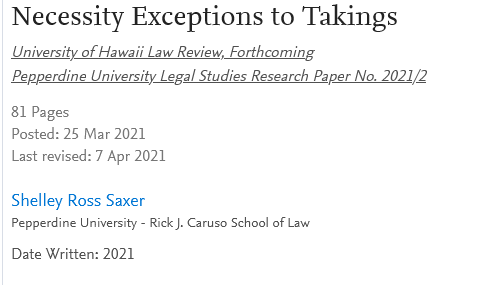
Screenshot_2021-04-12 Necessity Exceptions to Takings by Shelley Ross Saxer SSRN

Takings! Armstrong! Emergencies! Mahon! Jacobson!

Add lawprof Shelley Ross Saxer’s latest article (forthcoming in the University of Hawaii Law Review), “Necessity Exceptions to Takings” to your reading list.

Get it at SSRN here.

Rather than summarize it for you, we’ll just post the abstract:

The doctrine of necessity has strong roots in the common law of tort and property going back hundreds of years. In the United States the doctrine has been applied in various situations to negate judicial review of constitutional challenges to government action, most recently in some of the wildfire and flood claims resulting from disasters. But now, the states’ responses to the COVID-19 pandemic have brought one of these necessity doctrines—the public health necessity relying on Jacobson v. Massachusetts—to the forefront as courts across the country review constitutional challenges to state public health measures. With such intense review of Jacobson’s public health necessity

Continue Reading Must Read: “Necessity Exceptions to Takings” (Shelley Ross Saxer)

TPBToby Prince Brigham
November 24, 1934 – March 19, 2021

We haven’t posted in a few days, because we’ve been busy with a sad but important task – traveling to Miami to pay our respects to a true giant in the field of property rights and eminent domain, Toby Prince Brigham.

After a long and legendary life and career, Toby left us last month.

The accolades you know: constitutional lawyer, founder of Owners’ Counsel of America, one of the namesakes of William and Mary Law School’s Brigham-Kanner Property Rights Project, the essential man in the Brigham three-generation property rights “dynasty,” the person who boosted and promoted others around him, a committed advocate for his clients who never lost sight of the lawyer’s essential role as a champion, and a mentor who treated you like a valued colleague.

But maybe you didn’t know the “other” Toby: a gentleman in every sense

Continue Reading Farewell, Toby Brigham (1934-2021)

Here’s the Wisconsin Supreme Court’s 4-3 opinion in a case we’ve been following, Christus Lutheran Church of Appleton v. Wis. Dep’t of Trans., No. 2018AP 1114 (Apr. 1, 2021). Even though it was close, after oral arguments, we were hoping for a more positive result.

This is the case in which the Court of Appeals concluded that DOT’s jurisdictional offer was not based on the “full narrative appraisal” required by the statute. The offer was for $403k, but the appraisal on which it was based valued the compensation at $133k.

Wait, you ask, how so? True, the DOT offer was more than its appraisal, but it didn’t back up the increase with any appraisal other than its $133k appraisal. The increase was the result of DOT’s internal administrative review. Read that again: no appraisal supported the $403k offer.

Follow along: DOT’s appraiser opined that the owner incurred

Continue Reading Wisconsin Shrugs: Appraisal Omitting Severance Damages Qualifies As “Full Narrative Appraisal” Because DOT’s Valuation Later Went Up

Check out the North Dakota Supreme Court’s opinion in Cass County Joint Water Resource District v. Aaland, No. 20200171 (Mar. 24, 2021). It’s a quick read, and worth your time.

North Dakota has one of those “precondemnation entry” statutes allowing a (potential) condemnor to enter private property to check it out to see if this property is suitable for the anticipated public use. Indeed, North Dakota’s statute is modeled on California’s pre-1963 entry statute (the one analyzed by the California Supreme Court in the somewhat-recent decision in Property Reserve):

In all cases when land is required for public use, the person or corporation, or the person’s or corporation’s agents, in charge of such use may survey and locate the same, but it must be located in the manner which will be compatible with the greatest public benefit and the least private injury and subject to the provisions of

Continue Reading N. Dakota: We Understand The Right To Exclude – Non-Permanent Precondemnation Entries Went Too Far

Pop quiz: in eminent domain valuation proceedings, may an owner who is not qualified as an expert witness testify about the value of her or his own property?

If you said “yes,” most courts would agree with you, either as percipient witness testimony or as lay expert testimony. As would the U.S. Court of Appeals for the Fourth Circuit in most circumstances. As the court noted, “federal courts routinely permit landowners to testify as to the value of their real property in eminent domain cases.”

But as shown in the court’s (unpublished) per curiam opinion in Mountain Valley Pipeline, LLC v. 0.47 Acres of Land, No. 20-1306 (Mar. 23, 2021), there are limitations.

There, the owner opposed the pipeline condemnor’s motion for summary judgment on valuation by submitting his counter-declaration in which he testified about the value of his own property. Did that create a triable issue of

Continue Reading CA4 (unpub): Owner Can Testify About Valuation Of Own Property, Unless He Also Testifies About Other Stuff

You listened live. Or you missed that, and listened to the recording. Or, you preferred to review what others thought of the arguments. Now you can read it yourself.

Here’s the transcript of Monday’s oral arguments in Cedar Point Nursery v. Hassid, No. 20-107, the case in which the Supreme Court is considering whether California’s forbidding of agricultural property owners from keeping union organizers off their land is a taking.

Some highlights, in our opinion:

  • Several of the Justices wanted to know whether it was important that the property owners called the access required by the regulation an “easement,” even though it is not formally an easement (you know, the thing where the dominant and servient estate owners agree that one can use the land of another, that is recorded, that runs with the land, and the like. Lawprof Josh Blackman writes about that here (“


Continue Reading Read And Listen To The Oral Arguments In SCOTUS’ Latest Takings Case