Charlie Brown got a bag of rocks for Halloween.

But you aren’t so cruel, and want to give better gifts this holiday season to the dirt lawyer in your life, no? Here are our 2020 suggestions for stocking stuffers that will make property mavens celebrate the season. 

Start with this one, Professor Bart Wilson’s newly-published “The Property Species – Mine, Yours, and Human Mind.” As describe in the book blurb: “Arguing that neither the sciences nor the humanities synthesizes a full account of property, the book offers a cross-disciplinary compromise that is sure to be controversial: Property is a universal and uniquely human custom. Integrating cognitive linguistics with philosophy of property and a fresh look at property disputes in the common law, the book makes the case that symbolic-thinking humans locate the meaning of property within a thing.”

Property book cover image

We are so confident that the book is sure


Continue Reading Holiday Suggestions For The Dirt Lawyer On Your List (2020 Edition)
Before it condemned a parcel of land in Bastrop County, the State of Texas made a bona fide offer to purchase to the owners of the fee as mandated by Texas law, which requires that a condemnor make an offer to the “property owner,” and provide a statement “to the landowner[.]”

But in In re Texas, No. 03-20-00447 (Dec. 2, 2020), the land being taken was also subject to an easement. And Texas didn’t make any kind of offer to the owners of the easement, whose parcel would otherwise be landlocked. The trial court abated (dismissed), and Texas sought mandamus review, arguing that the owners of the easement are not “property owners” as contemplated in the statute.

The court of appeals agreed. The statute does not expressly define “property owner.” After noting that the plain meaning controls, the court glossed over the plain meaning of “property owner” (under which

Continue Reading Tex App: Term “Property Owner” In Statute Requiring Bona Fide Offer Does Not Include Owner Of Easement

Often, the dispositive question in many takings cases tuns on whether the plaintiff owns “property,” and if so, what rights does that recognize. If you define the property in such a way that ipse dixit excludes the “stick” the owner claims was taken, then the answer is always going to be no property, no taking. To us, this is largely a question of definitions and policy: is this interest, in a judge’s view, worthy of constitutional protection?

And that’s the wrong approach, because this analysis often seems more like a semantic exercise, undertaken by the wrong party. Instead of concluding, for example, that the property in a case is a lease (a recognized property interest) and then going on to ask whether there’s been a sufficient interference with an owner’s distinct investment-backed expectations, the question shifts from what we think is the proper focus (a fact question of the impact

Continue Reading Surf And Turf (Our Beef With The Virginia Oyster Takings Case): Although Leases Are “Property,” They Don’t Confer A Right To Exclude Government Sewage

You know what SCOTUS nerds want for Christmas? These words, in a federal court of appeals opinion:

We are aware that our decision conflicts with the Ninth Circuit’s recent holding in Sierra Club v. Trump. That case involved a parallel challenge to the Government’s use of § 2808 funds to build the border wall. Nine states “alleged that the Section 2808 diversion of funds will result in economic losses, including lost tax revenues.” Addressing Wyoming, the Ninth Circuit acknowledged that “[i]t may be appropriate to deny standing where a state claims only that ‘actions taken by United States Government agencies . . . injured a State’s economy and thereby caused a decline in general tax revenues.’” Nevertheless, the court concluded that the states’ alleged tax-loss injuries were “analogous to those in Wyoming v. Oklahoma.” The court held that the “injuries in the form of lost tax revenues resulting from

Continue Reading Border Wall Funding Case Headed To SCOTUS? CA5: “We are aware that our decision conflicts with the Ninth Circuit’s recent holding in Sierra Club v. Trump.”

Go on, read the facts in the California Court of Appeal’s (unpublished) opinion in San Joaquin Regional Transit District v. Superior Court, No. C084755 (Dec. 1, 2020). It’s worth your time, believe us.

After chasing from California a long-standing manufacturing and service business (to Illinois) by instituting condemnation proceedings on the property on which its Stockton plant was located and then obtaining immediate possession, the District changed its mind and abandoned the taking. The owner sought damages under a statute (Cal. Code of Civ. P. § 1386.620).

The District argued that it was not liable for all damages proximately caused by the proceeding, because the owner had not “moved from the property.”

Wait, you say, I thought you just told me that the condemnor obtained possession of the property? Yes, it did, in two phases. First, the District and the owner stipulated to possession of the property subject

Continue Reading After Telling Owner To Beat It, Condemnor Acts Surprised That It Did. Cal Ct App: “Moving” From Property Does Not Mean “Completely Physically Dispossessed”

PXL_20201118_163528916 (1)

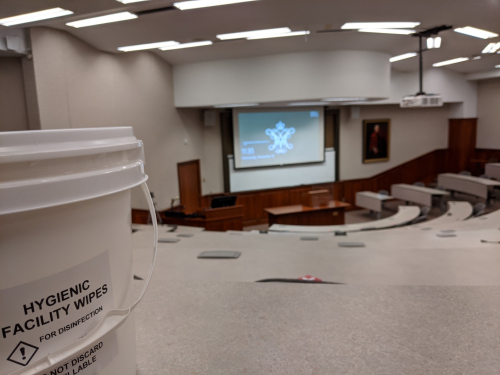
We have now wrapped up the coursework portion of the Fall semester at William and Mary Law School, so here’s an after-action report from the two full courses which I taught in a “hybrid” style (some students live, in the classroom; others attending via Zoom live; and still others with the option to attend via the Zoom recording). The two courses: (1) Land UseEminent Domain & Property Rights

Overall, it went much better than I think nearly everyone else expected. When I say “everyone else,” that is because when I posted photos of the “distanced” classroom that the law school set up in the adjacent indoor Tennis Center, the reactions were mostly dubious, or even scornful. I had much less doubt about teaching and learning in a non-typical environment. The in-person option, I believed, was essential, and anything less would likely be … less.

So off

Continue Reading Wrapping Up A Semester In A “Hybrid” Law Classroom (Never Go “Full Remote”)

Check this out, the latest episode of the Pendulum Land Podcast, in which we briefly return to chat about what’s on the Thanksgiving menu (hint: Spam® and oysters).

Spam® because we 808 people like that stuff, and oysters because the Virginia Supreme Court recently heard oral arguments in an important inverse condemnation case involving…oysters. More on that case here, including the briefs.

Stream the episode above, or download it here.

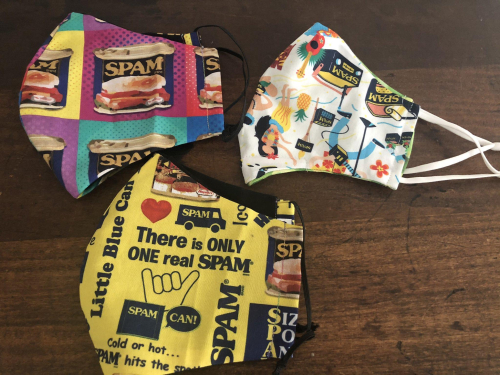
SPAM masks

Haiku was also on the menu. (We apologize in advance.)

Tabasco Spam® is
the best Spam® – no demurrer.
Exceptions overruled!

Darling, what is on
the court’s Thanksgiving menu?
Dare I say oysters?

Condemnor’s cocktail –
Care to imbibe a highball?
Regrets: lowballs only.

Kelo: very wrong.
With Barrett now in D.C.,
time to revisit?

Been relocated?
Right-of-way bumming your trip?
Pendulum swoops in.

Clint and Pendulum:
Podcasts together, in Continue Reading Spam® For Thanksgiving? Mais Oui!

Check this out, the Complaint we filed a couple of weeks ago in the U.S. District Court for the Western District of Virginia, in Grano v. Rappahannock Elec. Coop., No. 3:20-cv-00065-NKM (W.D. Va. Oct. 28, 2020).

It’s not a true “takings” case because the claims for relief are limited to due process and Contract Clause and the plaintiffs are not seeking just compensation, but there’s a takings flavor, because the due process problem alleged is failure to condemn and also provide for compensation.

We’re not going to comment in depth because it’s our case, and we’d rather just let the complaint speak for itself at this point. But the short story is that recently, the Virginia General Assembly adopted a statute directing that all existing easements in which the servient estate owner granted a right to use property for electrical distribution now include the right of the dominant estate

Continue Reading Is Virginia’s Legislative Rewriting Of Existing Electric Easements To Permit Fiber Optic Use Unconstitutional?

DSCF3357

Today, Friday, November 13, 2020, is the day that the Supreme Court is scheduled to decide whether to decide a case we’ve been following for a long time (and one in which we filed an amicus brief urging the Court to take up the case).

In Cedar Point Nursery v. Shiroma, 923 F.3d 524 (May 8, 2019), a 2-1 panel of the Ninth Circuit affirmed the dismissal of a complaint for failure to plausibly state a takings claim under Twombly/Iqbal. At issue was a regulation adopted by California’s Agricultural Labor Relations Board which requires agricultural employees to open their land to labor union organizers. The regulation is framed as protecting the rights of ag employees to “access by union organizers to the premises of an agricultural employer for the purpose of meeting and talking with employees and soliciting their support.”

The Ninth Circuit panel

Continue Reading It’s Conference Day For Case Asking How “Permanent” A Loretto Permanent Physical Invasion Taking Must Be