Goofus-gallant

Yes, it starts tomorrow, Thursday, January 28, 2021, but we’re “remote” this year, so it is not too late to register to join us for the 38th Annual ALI-CLE Eminent Domain & Land Valuation Litigation Conference. This is the “big one” where the nation’s best practitioners, scholars, jurists, and other industry professionals gather to talk shop about the subjects we know and love.

Details here (ALI-CLE’s page with faculty, agenda, and times), or here (a recent episode of Clint Schumacher’s Eminent Domain Podcast, where we preview the Conference). Here’s your chance to be a part of what is the best conference on these topics.

We have set it up to take advantage of the remote format, and tuition has been reduced (thank you to ALI-CLE for recognizing this, and for our sponsors for being so generous). We’re seeing a lot of first-time registrations, and this is a great opportunity
Continue Reading Still Time To Join Us: ALI-CLE Eminent Domain & Land Valuation Litigation Conference (Online!) This Thursday & Friday. Tuition Deals! #EminentDomain2021

25 Years of PASH_Schedule

Mention the term “PASH” to any dirt lawyer in the 50th State, and they’ll nod in understanding. It’s an 808 shibboleth — a kind of local property password — that signals that you’ve been around the block and know your stuff.

On one hand, it is simply an acronym for Public Access Shoreline Hawaii, the plaintiff/petitioner in the (in)famous case Public Access Shoreline Hawaii v. Hawaii Cnty. Planning Comm’n, 903 P.2d 1246 (Haw. 1995). On the other, however, it has evolved into shorthand for a number of things: from the technically accurate – native Hawaiian customary and traditional rights and practices under the Hawaii Constitution (“I was chasing a pua’a on private property, so I cannot be convicted of trespass because I was exercising my PASH rights”); to generically and cheekily – the ability to access the beach and shoreline (“Surf’s up today, let’s go practice some PASH rights!”)

Continue Reading PASH Bash: U. Hawaii Law Review Symposium – “25 Years of PASH” (Feb. 5, 2021)

ALI-CLE 2021 Bingo card

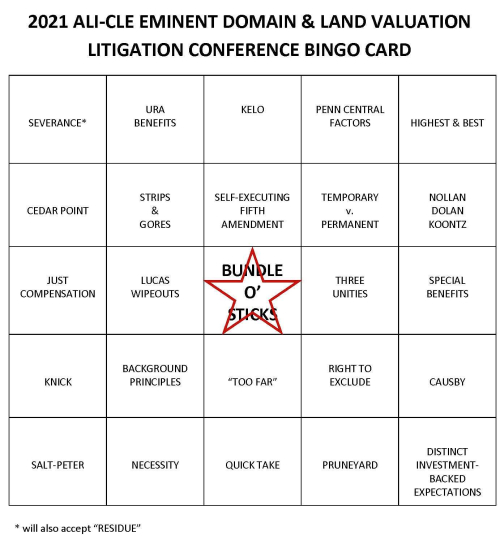
If you “get” this, you should be registered for the 38th Annual Eminent Domain & Land Valuation Litigation Conference, to be held remotely on Thursday and Friday, January 28-29, 2021.

The list is growing rapidly, and you need to join us!

This is the “big one” where the nation’s best practitioners, scholars, jurists, and other industry professionals gather to talk shop about the subjects we know and love. We’re having programs with intriguing subjects such as “Planning to Win: Practical Strategies for a Successful Inverse Condemnation Case,” “How Do I Keep My Firm’s Doors Open When the Courthouse Doors Are Closed? Making Your Practice More Efficient When You Can’t Try Cases,” “Where Is the Supreme Court Headed on Takings Cases? Regulatory Takings Update and Cedar Point Preview,” “No Show and All Tell: Breaking News in Property Rights and Takings,” “More Than the Fifth Amendment: Other Tools for Upholding

Continue Reading Your 2021 ALI-CLE Eminent Domain & Land Valuation Litigation Conference (Jan 28-29, Remote) BINGO Card

1o 11 ALI-CLE

Are you a law student interested in takings, eminent domain, land use, environmental, and other dirt-lawyering related topics? If so, good news: thanks to the generosity of ALI-CLE, you can register gratis (free!) for the upcoming 38th Annual Eminent Domain & Land Valuation Litigation Conference, to be held remotely on Thursday and Friday, January 28-29, 2021.

This is the “big one” where the nation’s best practitioners, scholars, jurists, and other industry professionals gather to talk shop about the subjects we know and love. We’re having programs with intriguing subjects such as “Planning to Win: Practical Strategies for a Successful Inverse Condemnation Case,” “How Do I Keep My Firm’s Doors Open When the Courthouse Doors Are Closed? Making Your Practice More Efficient When You Can’t Try Cases,” “Where Is the Supreme Court Headed on Takings Cases? Regulatory Takings Update and Cedar Point Preview,” “No Show and All Tell:

Continue Reading Law Students: Register Free For The 38th Annual ALI-CLE Eminent Domain & Land Valuation Litigation Conference (Jan 28-29, 2021)

Our thanks to Clint Schumacher for having us on his program to talk about the upcoming Conference. We’re “remote” this year, but that means a different approach to our presentations (and a very modest tuition!).

We’re having programs with intriguing subjects such as “Planning to Win: Practical Strategies for a Successful Inverse Condemnation Case,” “How Do I Keep My Firm’s Doors Open When the Courthouse Doors Are Closed? Making Your Practice More Efficient When You Can’t Try Cases,” “Where Is the Supreme Court Headed on Takings Cases? Regulatory Takings Update and Cedar Point Preview,” “No Show and All Tell: Breaking News in Property Rights and Takings,” “More Than the Fifth Amendment: Other Tools for Upholding Property Rights,” “Evaluating Lockdown, Moratorium, and Emergency Claims,” and more (including Ethics for those of you in MCLE jurisdictions). We’ll have a post with more details. 

Register now!Continue Reading Eminent Domain Podcast’s Preview Of The Upcoming ALI-CLE Eminent Domain & Land Valuation Litigation Conference

A short but mildly interesting one from the Arizona Court of Appeals, Maricopa County v. Rovey, No. 1 CA-CV 190659 (Dec. 29, 2020).

The County sought to condemn portions of the Rovey land for the expansion of existing roads. The roads had been used “as public roadways for decades,” slip op. at 2, and ownership of the land on which the roads sat was disputed. The Roveys asserted they owned it in fee and the County had to pay compensation for the taking, while the County claimed it already owned an easement. All of the cases — the County’s condemnation, the Roveys’ quiet title, trespass, and inverse condemnation counterclaims, and their stand-alone claims for trespass and inverse — were consolidated. 

The owners argued that application of the rule of “strips and gores” (a presumption that unless expressly otherwise noted, a conveyance of a lot adjacent to a road conveys

Continue Reading Ariz App: “Strip And Gore” Rule Guts Inverse Condemnation Claim

In New Hampshire v. Beattie, No. 2019-0460 (Nov. 19, 2020), the New Hampshire Supreme Court was presented with two alternatives about how to review a property owner’s objection to the state commission’s approval of the quick-take of land for a state highway. The owner “challenged the necessity and net-public benefit of the taking,” slip op. at 2, but did not allege fraud or gross mistake. The question the Supreme Court considered was whether such allegations are the only way to challenge public use or necessity.

One possibility, argued by the state, was that the statute authorizing the commission to determine the laying out of highways governed. This statute provides that the only appeals from the commission’s determination must be based on a claim of fraud or gross mistake. The property owner had a different take. He pointed out that the statute also noted that all acquisitions must be made “in

Continue Reading New Hampshire: All Public Use And Necessity Challenges Are Reviewed De Novo, Not Only For Fraud Or Gross Mistake

A short one from the Virginia Supreme Court. In Palmyra Associates, LLC v. Comm’r of Highways, No. 191680 (Dec. 17, 2020), the court upheld the exclusion of evidence about a property’s “before” condition in a partial take case, concluding that the proffered evidence of the property’s development potential was too speculative. Or, more accurately, that the trial court did not stray beyond its wide discretion to keep the evidence out.

VDOT needed a portion of Palmyra’s property for a roundabout. The big question was the damage to the remainder (or “residue”) property and its highest and best use. Owner said commercial development; VDOT said existing use.

The owner offered testimony that it intended to develop the property (consistent with the County’s general plan), and had drawn up site plans years ago. But it had not secured entitlements, and further government approvals were needed before those plans could come to

Continue Reading Trial Court Had Discretion To Exclude Unapproved, Conditional, 10-Year-Old Site Plans From “Before” Condition

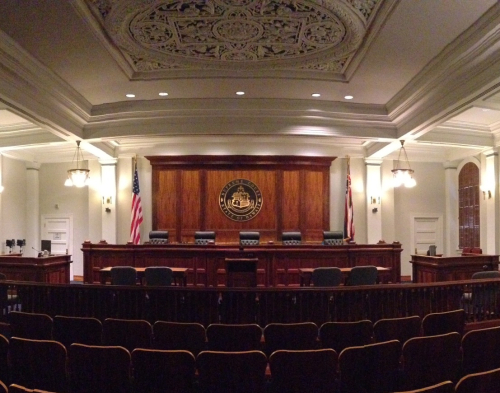
Photo

Here’s a big development in a case we’ve been following for a while (and in which we filed an amicus brief in support of the prevailing property owner).

In DW Aina Lea Dev., LLC v. State of Hawaii Land Use Comm’n, No. SCCQ-19-156 (Dec. 17, 2020), the unanimous Hawaii Supreme Court held that the statute of limitations governing a regulatory takings claim under the Hawaii Constitution’s “takings or damagings” clause is six years.

The case started out in a Hawaii state court, and was removed to the U.S. District Court by the State Land Use Commission. The district court dismissed the state takings claim for missing the limitations cut-off. Hawaii has not adopted a statute of limitations expressly for takings or inverse condemnation claims. Thus, the question is what is the closest analogue claim. If there isn’t one, Hawaii has a “catch all” statute (six years) for civil claims.

Continue Reading Hawaii: State Takings Are “Self-Executing” Constitutional Violations (Not Torts Or Breaches Of Contract), Subject To A Six-Year Statute Of Limitations