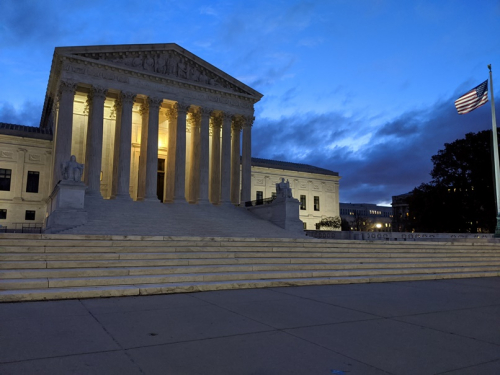
Here’s the recording of this morning’s oral arguments in an important eminent domain case being considered by the Wisconsin Supreme Court. (We had some trouble with the stream, so if the above video doesn’t work, try this link instead.)

This is a case we’ve been following (court of appeals’ opinion in favor of the property owner here), in which the issue is whether Wisconsin’s eminent domain statute — which requires that a condemnor’s “jurisdictional offer” be “based” upon a “full narrative appraisal” of “all property proposed to be acquired” — allows the Wisconsin DOT to provide an appraisal that omits severance, and then later introduce a new appraisal that includes severance. See Wis. Stat. §§ 32.05(3)(e), 32.05(2)(a)-(b). The property owner successfully argued that allowing the DOT to do this skirts the text of the statute, and its purpose. The jurisdictional offer’s primary function is to
Continue Reading Wisconsin Supreme Court Oral Argument: Can Condemnor Omit Severance From The “Full Narrative Appraisal” Required For The Jurisdictional Offer?

We were honored to be a guest on an episode of the Pendulum Land Podcast. Here’s the description from the show notes:

Hawaii inverse condemnation lawyer and William and Mary Law School adjunct professor Rob Thomas joins your hosts to discuss recording his classic single “Smooth” with Carlos Santana, whether the COVID moratoriums on evictions constitute a taking, and his favorite flavor of SPAM! (Don’t act like you don’t love SPAM.) This is the first of two episodes with the publisher of the popular eminent domain blog inversecondemnation.com.

We had to bring our “A game” because the hosts were full of rapid-fire questions, wit, and nerd trivia. It was hard to keep up at times. But we did our best (and yes, we did talk about our favorite flavors of SPAM). We also chatted about the coronavirus related takings claims, and an interesting takings case working its way up

Continue Reading In Which We Go Over To The Dark Side: Our Guest Appearance On The Pendulum Land Podcast (SPAM, Takings, Star Trek/Wars, and More!)

IMG_20190925_175845

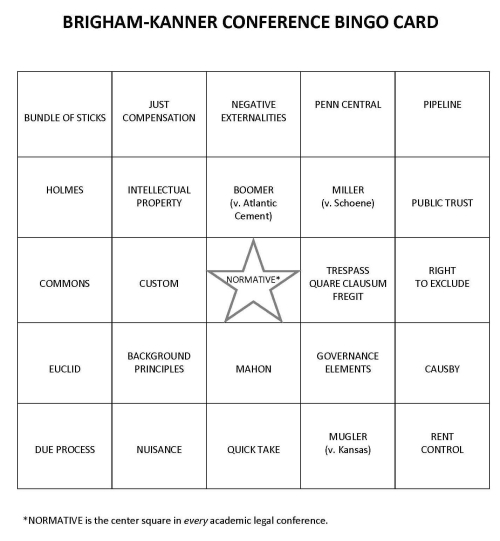
Although it is set to launch this Friday, October 2, 2020, there’s still more than enough time to register (and room at the inn) for you to join us for the 17th Annual Brigham-Kanner Property Rights Conference at the William and Mary Law School.

Like everything else this season, the Conference is online (register here), and although we would have preferred to gather in-person of course, the online format has some advantages: the number of attendees isn’t limited by the classroom size (this year’s registrations are at record levels), you don’t need to travel to Williamsburg, and the Conference is free if you don’t want Virginia CLE credit for attending. What a deal.

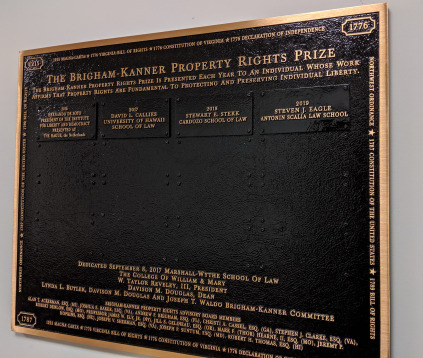
In our opinion, this is the best legal academy/practicing bar conference on property law. This year, the Conference honors the Brigham-Kanner Prizewinner, Harvard Law School Professor Henry Smith.

Here are the panel topics

Continue Reading There’s Still Room: Join Us For The 17th Annual Brigham-Kanner Property Rights Conference (Online, Free!)

IMG_20191203_064308

Today, the U.S. Supreme Court is considering our cert petition during the Court’s “long conference.”

This is the case focusing on the interplay between Williamson County‘s “final decision” ripeness rule and the “case and controversy” injury-in-fact standing requirement, and asks: if the government makes its final decision, but the plaintiff isn’t injured until later, has there been an actionable taking? 

Often, the date on which the government ripens a takings claim by making the final decision to apply the regulation to the plaintiff’s property, and the date on which the plaintiff’s property rights are actually affected are the same. But here, the two key events happened on different dates. The feds allege they made their final decision to jettison in the GM bankruptcy the plaintiffs’ tort and related claims on July 1, 2009. The Federal Circuit accepted the government’s assertion that final decision occurred when it uploaded its

Continue Reading Considered In Today’s SCOTUS Conference: What Triggers The Takings Statute Of Limitations?

What place do you think of when you hear the word “earthquake? Most likely California, we’re betting.

And it’s also very likely that you didn’t think “Ohio.”

Well, that’s probably what everyone involved in the Ohio Supreme Court case State ex rel. AWMS Water Solutions, LLC v. Mertz, No. 2019-0493 (Sep. 23, 2020) thought too. Until AWMS sought salt-water injection well permits from the State of Ohio, and “[t]he next day, a 2.7-magnitude earthquake was recorded in Youngstown, Ohio, about seven miles from AWMS’s Weathersfield Township site and about one mile from an injection well known as “Northstar #1” that was not related to AWMS’s wells.” Slip op. at 3. Earthquakes? In Ohio?

A week later, the State determined that Northstar #1 should be taken out of operation, and the very next day, a 4.0 earthquake “was recorded within one mile of Northstar #1. Slip op. at 3. [That

Continue Reading Earthquake In Ohio: The Jury Should Decide Lucas And Penn Central Takings After State Shut Down Injection Wells For Causing Earthquakes

A very quick one today from the North Dakota Supreme Court. In Cass County Joint Water Resource District v. Aaland, No. 20200272 (Sep. 15, 2020), the court rejected a property owner’s request for a stay pending appeal of a trial court’s order allowing the district to enter the owner’s property “to conduct examinations, surveys, and mapping, including geomorphic examinations requiring installation of survey monuments.” The District had tried to negotiate an easement, but the owner didn’t want to play.

The Supreme Court rejected the request, concluding that the owner didn’t show irreparable injury because he could always bring an after-the-fact inverse condemnation claim to remedy whatever injuries the entries caused. The court also concluded that a stay would harm the District, because it would delay the project, even though actual construction of the project has already been enjoined by a federal court. While the district might not be able

Continue Reading No Injunction To Halt Precondemnation Entry, Since Owner Can Sue Later For Inverse

News just in: we’ve just received confirmation that the Conference will not be in-person in Scottsdale in January 2021, and we’re going online.

Not a big surprise, but still a bit disappointing, and it’s a shame that the circumstances won’t allow us to meet in-person to talk shop and to renew our friendships like we do every year. 

But rest assured we’re making lemonade out of these lemons, and we’d appreciate everyone holding the dates on your calendars to join your colleagues from across the nation for the online Conference. And no, we’re not going to do two-and-a-half-days remotely, we’re paring down the agenda and will be focusing on hot topics, and great presenters. The remote format has some advantages, and we’re taking advantage of the circumstances to plan a conference more interactive and a bit different than usual.

This will also be a great program for first-time Conference participants.

Continue Reading Breaking: News About The 2021 ALI-CLE Eminent Domain & Land Valuation Litigation Conference (Jan. 28-29, 2021)

Tiffany Lashment’s “Ag Law in the Field” podcast is one of those you really should follow. Every episode is worthwhile in our opinion. The latest episode is a chat with Texas property owner lawyer Jim Spivey. From the show notes:

Eminent domain is one of the most popular topics we cover. Today, we are focusing on the important issue of compensation when property is being condemned. San Antonio-based attorney, Jim Spivey, joins us to talk us through many helpful concepts related to compensation, and offers important tips to Texas landowners dealing with eminent domain.

Check it out.
Continue Reading New Ag Law In The Field Podcast Ep: Jim Spivey On Eminent Domain & Just Compensation

Ainalea

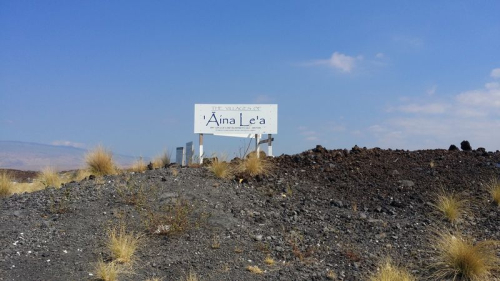
A short while ago, we featured the cert petition in a case from the Big Island that we’ve been following as various pieces of it went up and down through both the state and federal court systems. See “New (Mike Berger) Cert Petition: ‘This case is the proverbial ‘Exhibit A’ of much that is wrong [with takings law].

Now, after the State of Hawaii waived its right to file a BIO, five briefs of amici curiae (including one in which we played a small part) have been filed in support of the petition, urging the Court to review the Ninth Circuit’s opinion. We wrote about the case in a recent issue of the American Planning Association’s magazine. The short story is that a federal jury concluded that the State of Hawaii Land Use Commission took the owner’s property under both a Lucas and a

Continue Reading No Shortage Of Amicus Support For Takings Cert Petition (Lucas and Penn Central!)