In Utah Dep’t of Transportation v. Coalt, Inc., No. 20161063 (Aug. 17, 2020), the Utah Supreme Court dealt with a public use and a just comp issue.

The first is perhaps the more interesting. After a federal court upheld environmentalists’ challenge to the Environmental Impact Statement prepared by UDOT for its Legacy Parkway Project and enjoined highway construction, UDOT and the enviros settled. The settlement called for “additional measures to protect the wetlands and its wildlife inhabitants from the effects of the Parkway.” Slip op. at 6.

One of those measures? Get additional land for the Legacy Nature Preserve. Guess whose property was, as a consequence, now slated for eminent domain? You guessed it: Coalt’s. It objected to the taking, “arguing that UDOT did not have the authority to condemn Parcel 84 because it was not doing so for a transportation purpose or a public use, but to settle
Continue Reading Utah: As Long As A Taking Is For The Birds, Not The Enviro Plaintiffs, It’s A Public Use

IMG_20200817_104808

We’re done with our first day of class for the upper-level students at William and Mary. We’re teaching two courses this semester, the usual Eminent Domain and Property Rights, but also Land Use Law. We were set to begin a semester of “hybrid” instruction (some students in the classroom, with distancing in place, while others attend remotely). But late last week, due to some administrative difficulties unrelated to the law school, we had to postpone the in-person part until next week.

So we did our first two classes today via Zoom. It went as well as you might expect. We’ve had to make some adjustments to the usual law classroom, but so far, everyone is taking it in stride and adapting well. We expect to do the same and adjust and readjust as the semester progresses.

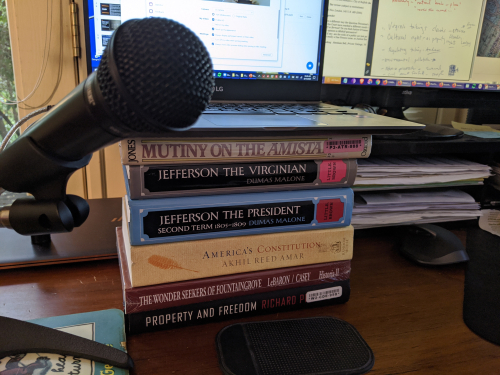
What you’re looking at above is our set-up, a remote “podium” on which we

Continue Reading What Books Do You Use For Your Remote Podium?

A short one from the U.S. Court of Appeals for the Eleventh Circuit. In Sabal Trail Transmission, LLC v. 18.27 Acres, No. 19-10705 (Aug. 3, 2020) (unpub.), the court concluded that the trial court did not abuse its discretion when it allowed the property owner to testify about the value of his property. 

This is a ruling that should not be a surprise, given the same court’s earlier published opinion holding the same thing in a case by the same pipeline condemnor against different property owners. Here, the court noted the “low bar” an owner must satisfy to testify (having “some basis” for the testimony).

One owner had some training as an appraiser. The other had experience buying and selling property in the relevant market:

Lee and Ryan Thomas satisfied the low bar of providing some basis for their valuation testimony. Lee trained as a land appraiser early in

Continue Reading CA11: In Eminent Domain, There’s A “Low Bar” For An Owner To Testify About The Value Of His Own Property

PENDULUMPODCAST

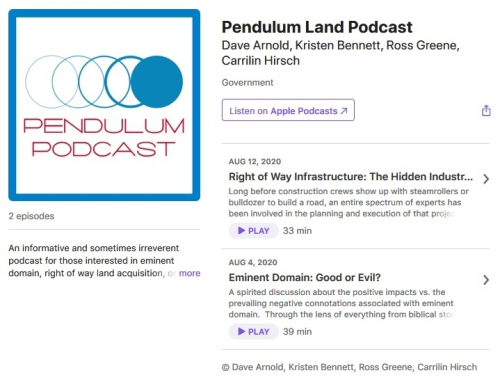
Check this out, a new podcast for your dirt lawyer types to follow, Pendulum Podcast. As it describes itself:

An informative and sometimes irreverent podcast for those interested in eminent domain, right of way land acquisition, or infrastructure development. Topics for discussion frequently include condemnation of real property for public use, just compensation, the Uniform Relocation Act, as well as your hosts’ hot takes on popular culture.

Uniform Relocation Act? Right of way and eminent domain? Be still our hearts.

Two eps are posted so far, “Eminent Domain: Good or Evil?” (embedded above), and “Right of Way Infrastructure: The Hidden Industry. From the Uniform Relocation Act to Eminent Domain.” We’ve listened to the first one, and will soon do so with the second.

Count us as subscribers. Highly recommended you become one as well. Continue Reading New Property/Eminent Domainey Podcast: Pendulum Land Podcast

Here’s the latest in a case we posted about last year. There, the North Dakota Supreme Court noted an open issue, but declined to resolve it. Now, in Fargo v. Wieland, No. 20200100 (July 22, 2020), the court addressed it head-on. 

Here’s how the noted the issue:

whether a landowner who appeals an award in eminent domain proceedings, without accepting or withdrawing deposited funds, is entitled to the payment of post-judgment interest subsequent to the deposit of the full amount of the judgment

Slip op. at 2.

After a just comp judgment, the city deposited the funds to cover the verdict, plus money for the court’s award of attorneys’ fees. The property owner appealed. Even though she could have, she didn’t withdraw the money because doing so would have waived her right to appeal on all issues except a claim for more compensation. Her appeal asserted the taking

Continue Reading Time Isn’t Money: Landowner Not Entitled To Interest On Deposited Funds Satisfying Just Comp Verdict, Even If That Forces Property Owners Into A Bad Choice

Here’s the latest in a case we posted about last year. There, the North Dakota Supreme Court noted an open issue, but declined to resolve it. Now, in Fargo v. Wieland, No. 20200100 (July 22, 2020), the court addressed it head-on. 

Here’s how the noted the issue:

whether a landowner who appeals an award in eminent domain proceedings, without accepting or withdrawing deposited funds, is entitled to the payment of post-judgment interest subsequent to the deposit of the full amount of the judgment

Slip op. at 2.

After a just comp judgment, the city deposited the funds plus money covering the court’s award of attorneys’ fees. The property owner appealed. Even though she could have, she didn’t withdraw the money because doing so would have waived her right to appeal on all issues except a claim for more compensation. Her appeal asserted the taking was invalid, so pulling

Continue Reading Interesting Just Comp Ruling: Landowner Not Entitled To Interest On Deposited Funds Even If That Forces Property Owners Into A Bad Choice

We can’t pretend that we understand everything that is going on in the Supreme Court of India’s recent opinion in Hari Krishna Mandir Trust v. State of Maharashtra, No. 2013-6156 (Aug. 7, 2020) (but when has that ever stopped us before?), but after reviewing the decision, we thought we would post it because of the court’s holding:

96. The right to property may not be a fundamental right any longer, but it is still a constitutional right under Article 300A and a human right as observed by this Court in Vimlaben Ajitbhai Patel v. Vatslaben Ashokbhai Patel and Others. In view of the mandate of Article 300A of the Constitution of India, no person is to be deprived of his property save by the authority of law. The appellant trust cannot be deprived of its property save in accordance with law.

97. Article 300A of the Constitution of

Continue Reading Supreme Court Of India Channels Magna Carta: Although Compensation Is Not Expressly Required By Constitution, When Govt Takes Property, It Has Obligation To Pay

20181003_180531_HDR

Registration is up and online. Join us (online) for the 2020 Brigham-Kanner Property Rights Conference. Tuition: free, unless you want CLE credit (in which case it is a very modest $100). Because this conference has gone virtual, the usual Wren Building awards banquet to honor this year’s B-K Prize winner, lawprof Henry Smith, obviously won’t happen, but the speaking panels are a “go.” 

Sign up now and hold the date on your calendar. This is, in our opinion, the best one-day Academy-Bar-Bench conference about property rights that there is. And at such a great deal this year makes this one a “can’t miss.”

Here are the panel topics:

  • Where Theory Meets Practice: A Tribute to Professor Henry E. Smith Recipient, 2020 Brigham-Kanner Property Rights Prize
  • The Housing Crisis
  • Roundtable: Emerging Issues in Takings and Eminent Domain Law
  • The Reach of Government’s Confiscatory Powers Over Exigencies and Emergencies
  • The


Continue Reading Register Now: William and Mary Law’s Brigham-Kanner Property Rights Conference – Oct 1, 2020 (Virtual)

California eminent domain law requires that if property taken isn’t used for the intended public use “within 10 years” of the adoption of the resolution of necessity, then the condemnor must offer to sell the property back to the (former) owner. Unless, that is, the condemnor adopts a new resolution “reauthorizing the existing stated public use.” In Rutgard v. City of Los Angeles, No. B297655 (July 30, 2020), the California Court of Appeal put some meat on the bones of the statute.

We suspect that this situation doesn’t arise all that often. Thus, from the eminent domain perspective, this one seems more interesting than important. But we also think that muni law mavens may find this important, because the court’s analysis focuses on local law:

This appeal presents four cascading questions:

First, does a public entity desiring to retain condemned property under section 1245.245 have to “adopt” its initial

Continue Reading Cal App: When Condemnor Doesn’t Fish Within 10 Years Under Anti-Land Banking Statute, It Better Cut Bait Correctly

How much can a condemnor alter the scope of the taking before the good faith offer required by state law also needs to be re-done?

That’s the question the Wyoming Supreme Court resolved in EOG Resources, Inc. v. Floyd C. Reno & Sons, Inc., No. S-20-0013 (July 23, 2020).

There, the condemnor’s original good-faith offer to the property owner was for a take of rights-of-way, easements, and surface use rights on 2,100 acres. Later, however, it amended the complaint to take only 70 acres. The owner objected to the amended take, arguing that the condemnor had not complied with the statute’s good faith offer requirement. The condemnor responded that the 70 acres it now wanted was within the 2,100 acres its original offer covered, so what’s the big deal?

It is a big deal in this case, held the court. The point of the good faith offer requirement

Continue Reading If A Condemnor Alters The Scope Of The Take, A Good-Faith Offer Carries Over Only If The Amended Taking “Significantly Resembles” The Original Offer