Front page

Here’s one for our Hawaii folks, in case you all are curious about the origins of the analytical framework which courts use to review the legality of measures taken by the authorities in the name of “public health” that have an impact on the uses of private property.  

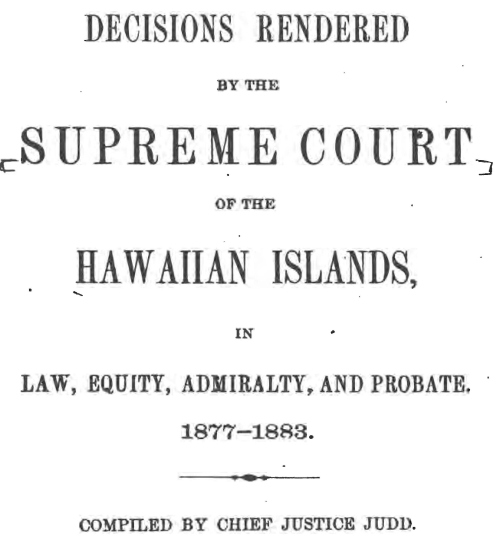
As far as we can tell, The King v Tong Lee, 4 Haw. 335 (Kingdom 1880) (in banco), is the first Hawaii case which uses the term “police power,” and which upheld the broad – and nearly unreviewable – authority of the government to limit the uses of property, as long as there’s a colorable argument that the property’s use is contrary to the public health.

There, the Kingdom’s legislature (one of the joys of practicing law in Hawaii is that you get to deal with cases involving the Kingdom; things like Privy Council, the royal prerogative, and the like) prohibited

Continue Reading The Royal Origins Of “Police Power” Hawaii-Style: The King v. Tong Lee (1880)
Torromeo Industries owned a 12-acre parcel zoned “Industrial.” Two buildings — one a home, the other a 4,000 square foot industrial building — were on the land. Sole access to the property way by a private driveway along the 149 foot frontage of the parcel. Industrial zoning has a minimum lot size of 80,000 square feet, and frontage of 150 feet. Yes, Torromeo’s parcel was one precious foot short of conformity with the frontage requirement.

But land use mavens know what this means: a nonconforming use. So back in 1989, the town’s planning board affirmed that status and that it considered the uses a permitted preexisting use. 

Flash forward to 2015, when the State condemned 2 acres of the land for a service road, along with 30k square feet for easements. This had the effect of subdividing Torreomeo’s formerly single parcel into three lots: (1) a 1/3 acre lot on

Continue Reading NH: Subdivision Of Nonconforming Lot Was Not Reasonably Likely – Availability Of A Variance Is A Factual, Not Legal, Question

The current headlines — and a couple of inquiries from colleagues and clients — got us to thinking about government power in times of crisis and the tension between that power and property and other individual rights. 

On one hand, court decisions going back over the centuries have told us that courts are reluctant to interfere with government power that the government asserts further the public “health, safety, and welfare” (what we in the U.S. call the “police power”). But at what point do such exercises of government power require compensation to a property owner who as a consequence of the limitation on their rights suffers a loss?

So we dusted off our law books and assembled a primer of what we thought were some of the more interesting and important decisions over the centuries on the question. This is not a comprehensive list, of course, and if you think

Continue Reading Emergencies, Police Power, Commandeering, And Compensation: Essential Readings

Missed out on the 2021 ALI-CLE Eminent Domain and Land Valuation Litigation Conference swag?

Well fear not: here’s your chance to get your high-class reminder — a kit of road warrior essentials — to save the Conference date on your calendar. We’re already underway with planning the agenda and faculty, so it’s never too soon to block it off (January 28-30, 2021, at the 4-Diamond DoubleTree Resort, Scottsdale, Arizona). 

If you were not able to get your swag in Nashville, send us a note (rht@hawaiilawyer.com) and we shall gladly drop one or two in the mail to you.

While supplies last!  Continue Reading Unboxing The 2021 (Scottsdale) ALI-CLE Eminent Domain Conference Swag: Get Yours Today!

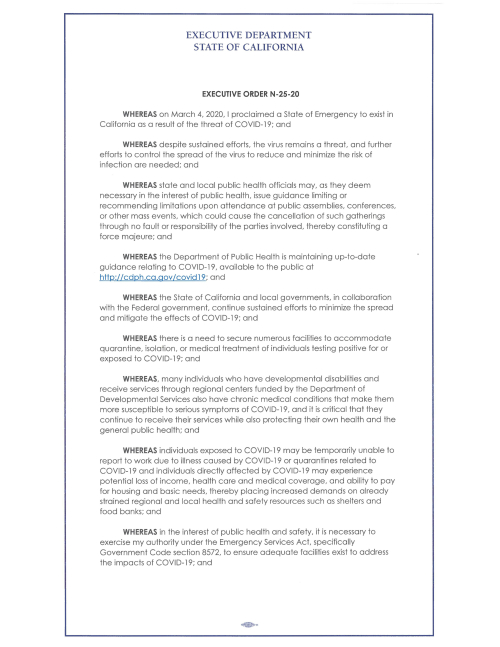
Cal Emergency EO

You remember the TV trope where Starsky, Hutch, or some other police officer is in hot pursuit of a dangerous criminal and flags down a motorist and “commandeers” their private vehicle and drives off?

We thought of that when we were reading the news reports about various governments invoking their emergency powers to respond to the coronavirus crisis. 

So while we were on the telephone on hold (bailing out of every conference, event, and travel arrangement in the foreseeable future), we thought we would take a look at the recent Executive Order, issued by California Governor Gavin Newsom, which expressly mentioned the “power to commandeer [private] property” such as hotels and medical facilities and press them into public service, as needed:

The California Health and Human Services Agency and the Office of Emergency Services shall identify, and shall otherwise be prepared to make available-including through the execution of any

Continue Reading #CoronavirusLaw: Is There A Difference Between “Commandeering” Property In An Emergency, And “Taking” It?

EX A

Here’s the cert petition that we’ve been eagerly waiting to drop in a case we’ve been following (and which gathered a lot of public — and academic — attention and outrage). 

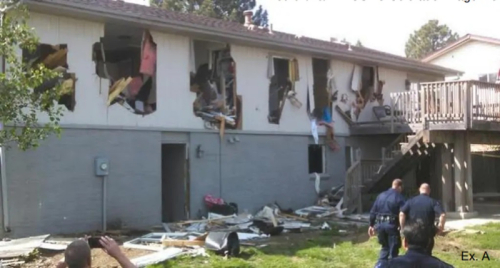
Yes, this is the case where the Village police pretty much destroyed a family home in the course of their efforts to dislodge a shoplifter who had taken refuge there while fleeing. Homeowner sought compensation for a taking. The Tenth Circuit, however, concluded “no taking” because the police were exercising the police power. And you can’t have a taking where the government is exercising the police power.

We were not terribly surprised by the ruling as grossly unfair as it is, because it is pretty typical: customs agents inspect and seize your laptop at the border to check it out but destroy the data on the hard drive? no taking; DEA holds your legal prescription drugs as evidence against

Continue Reading New IJ Cert Petition: Purposely Destroying Your House Could Be A Taking, Even If Govt Was Exercising Its Police Power

ALICLE-tagline-250x90

At the recent ALI-CLE Eminent Domain and Land Valuation Litigation Conference in Nashville, our colleagues, New York’s Jon Houghton and Hawaii’s Dave Day presented a very informative program on litigating regulatory takings cases. Jon is a property owner-side lawyer, while Dave is a Deputy Attorney General who represents the State of Hawaii in such cases. So it was a practical and balanced presentation.

Well, Jon and Dave are taking (pun intended) it to the next level. On Friday, April 24, 2020 at 2-3pm Eastern Time, they will be presenting “Strategies for Litigating Regulatory Taking Cases” in a webinar produced by ALI-CLE. This isn’t simply a repeat of their Nashville program, but they will be exploring in more detail the practicalities of building and defending these difficult cases. 

Here’s the description of the program:

The U.S. Constitution provides that private property may not be taken for public use


Continue Reading Mark Your Calendars (Friday, Apr 24, 2020): ALI-CLE Webinar – Strategies for Litigating Regulatory Taking Cases

IMG_20200303_191820

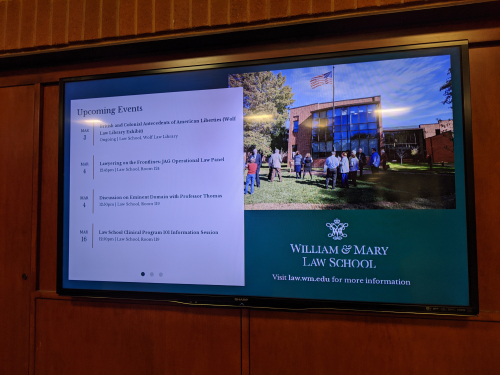
We just completed a fun hour-long talk with the students in the William and Mary Law School’s American Constitution Society, the Native American Law Society, and the Society on Environmental and Animal Law about the various pipeline cases that are ongoing nationwide. (If our tech worked, we shall post the audio recording in a future post.)

The theme of our talk was that these cases are an excellent illustration of the need for lawyers to think outside their usual lanes when it comes to addressing and solving their clients’ problems, because they present a smorgasbord of legal issues that range from property and eminent domain law, to administrative law, constitutional law, state and local government law, environmental law, federal courts, and civil procedure. 

The lawyers who are litigating these cases have done a good job of not being bound by convention and thinking creatively. They are thankfully analyzing the cases

Continue Reading Cases And Materials From Today’s WM Law ACS Talk: “Pipelines at the Intersection of Environmental, Administrative, and Property Law: How Divergent Interests Joined Forces To Challenge Big Energy”

IMG_20200220_054717

Update: here’s a report (video included!) about our spring “field trip” to what arguably is the birthplace of a “more perfect union” (which just happens to be right down the road from William and Mary Law School).

********

This semester, we’re teaching a short course at William and Mary Law School (and yes, thanks to a willing administration and student body, we will be back in the fall for the “big” Eminent Domain and Property Rights course). 

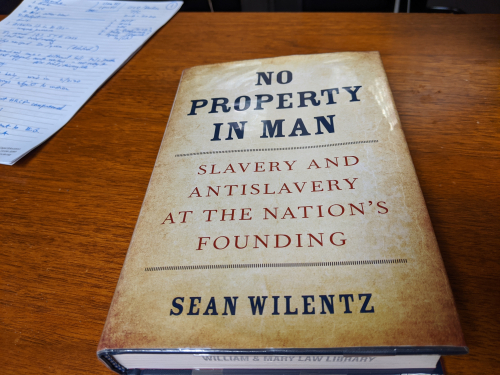
The title of the spring class is “No Property in Man: Slavery and Antislavery at the Nation’s Founding,” and the focus of the course is the book by Princeton historian Sean Wilentz from which we filched our title. Professor Wilentz’s book is a recounting of the debates surrounding the ratification of the U.S. Constitution and the political atmosphere from the founding until the Civil War.

When we read it last year

Continue Reading William & Mary Spring Course: “No Property in Man” – Slavery And Property Rights