Here’s the latest episode of Clint Schumacher’s Eminent Domain Podcast. Featuring an interview with the Institute for Justice’s Robert McNamara about an eminent domain case we’ve been following, Woodcrest Homes, Inc. v. Carousel Farms Metro. Dist., No. 19-607 (cert. petition filed  Nov. 7, 2019). Also included, a short talk with Delia Root, a William and Mary Law student who attended the Nashville ALI-CLE Eminent Domain conference

Check it out. Continue Reading Latest Ep. Eminent Domain Podcast: Carousel Farms Cert Petition, William & Mary Law
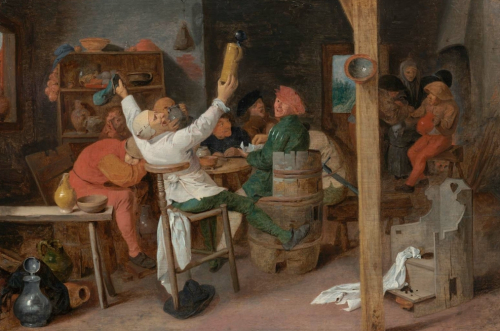
Peasants carousing

The last two cert-stage briefs have been filed in a case we’ve been following for a while (since it was decided by the Colorado Court of Appeals). 

In Carousel Farms Metro. Dist. v. Woodcrest Homes, Inc., 444 P.3d 802 (Colo. App. 2017), the appeals court invalidated an attempt to exercise eminent domain to take property which the owner had refused to sell to developer Carousel Farms. Although the Carousel Farms Metropolitan District couldn’t point to a present public use or benefit from the taking, it asserted that in the future the public would benefit from the condemnation because if Carousel Farms were allowed to develop its property in accordance with its agreement with the town, the public would receive new infrastructure such as roads and sewers. The trial court upheld the taking, but the court of appeals reversed. The real purpose of the taking was to facilitate the developer’s

Continue Reading Carousing at Carousel Farms: Final SCOTUS Cert-Stage Briefs In Colorado Eminent Domain Abuse Case

20180805_155740_HDR
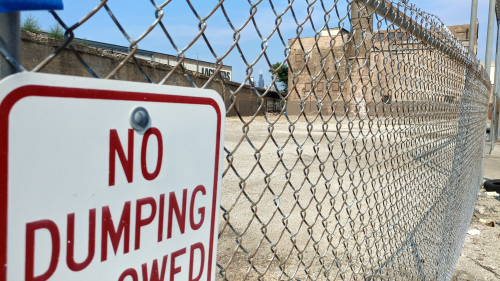
Where is this? The clues are all in the picture. 

You’ve seen the citation so many times, your eyes probably gloss over it. After all, Westlaw lists it with 4,507 “Citing References.” That’s a heckuva lot of citations to a single case. 

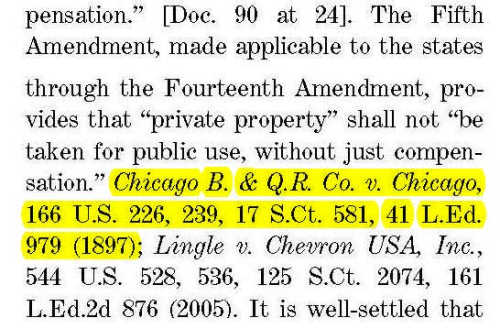
Like this one, pulled from a recent random federal district court opinion: 

Chcago cite

And we admit that we’ve done it: cited (but didn’t read) Chicago B. & Q.R. Co. v. Chicago, 166 U.S. 226 (1897) for the proposition that the rights in the Bill of Rights (in that case, the Fifth Amendment right to Just Compensation) have been selectively incorporated against states and local governments under the Due Process Clause of the Fourteenth Amendment. You’ve done it. We’ve all done it. 

To cure that shortcoming, we read and analyzed the case in our William and Mary class. And before we included it in the syllabus, we had

Continue Reading Just Compensation Site Visit: The First Right “Incorporated” Against States, And Local Govts

We were all set to take a deeper dive into the Court of Federal Claims’s recent opinion in the “downstream” Harvey flooding cases (we could not do so at the time the opinion was issued last week because we were tied up doing real lawyer stuff), when our Reno, Nevada colleague Steve Silva (who most recently was on the faculty at the ALI-CLE Conference in Nashville) beat us to the punch.

On his Taking Nevada blog, Steve has posted “Major flood decision in Texas turns on Divine Intervention” —

Analyzing and comparing tort to taking is difficult. A tort is generally seen as something wrongful. A private injury committed by one person against another. A classic “taking” by exercising the power of eminent domain in direct condemnation to acquire land and pay compensation is not a wrongful act. It merely is.

Further complicating things, the clearest

Continue Reading Steve Silva (Taking Nevada) On Flood Takings, Torts, And Tortes

Check out the latest (and final) episode of the Institute for Justice’s “Bound by Oath” podcast. IJ’s John K. Ross was kind enough to ask us to be a guest on the show titled “Excessive Fines,” and our friend and colleague Bob McNamara and I sat down in Nashville to record our sound bytes. 

The series (not simply a podcast, but more like an audio documentary) is about the Fourteenth Amendment, and covers (inter alia) how and why the rights in the Bill of Rights have, over time, been applied by the Supreme Court to state and local governments under the Due Process “selective incorporation” doctrine.

So why was a takings guy a guest on a show about the Excessive Fines Clause of the Eighth Amendment?  Because last year in Timbs v. Indiana, the Supreme Court held, in a civil forfeiture case, that the Excessive

Continue Reading IJ’s “Bound by Oath” Podcast, Ep. 9: Excessive Fines, 14th Amendment Incorporation (And The Just Compensation Clause)

NashvilleALICLEposter

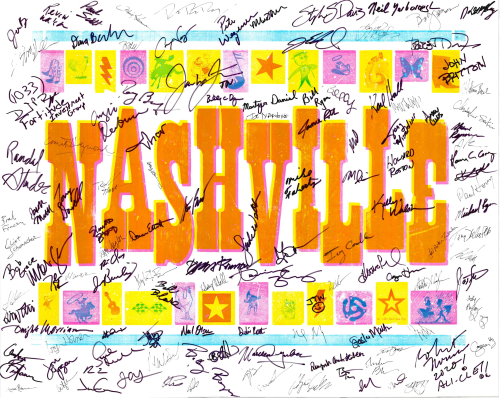
Each of the three big presentation rooms was full at our recent ALI-CLE Eminent Domain & Land Valuation Litigation Conference in Nashville. Nearly 300 lawyers, judges, appraisers, professors, students, relocation experts, and others eminent domain professionals coming together for 3 days of programming and fellowship. I have uploaded all of the photos that I took during the conference here

To celebrate another successful and enjoyable conference, we also signed the above commemorative poster from the famous Hatch Show Print shop which was just down the street.  

Can you locate your signature? (high-res pdf here) If you missed out, you’ll have a chance to join us in January 2021 in Scottsdale

Nashville 2020 ALI-CLE Commemorative Poster (signed) 

Continue Reading Thank You To All Who Joined Us In Nashville For The 37th Annual ALI-CLE Eminent Domain Conference!

6a00d83451707369e20240a4699139200c-800wi

Check out these two amici briefs, just filed in a case we’ve been following, about what a property owner who is awarded just compensation in a state court eminent domain lawsuit is supposed to do if the local government that is ordered to pay the just compensation judgment … doesn’t. 

The property owner sued the local government — a Louisiana Port District — in U.S. District Court, alleging a violation of 42 U.S.C. § 1983. That court dismissed for failure to state a claim. The property owner appealed to the Fifth Circuit. 

Several amici have joined together to file two briefs in support of the property owner: 

The IJ brief focuses on the long-standing requirement that just

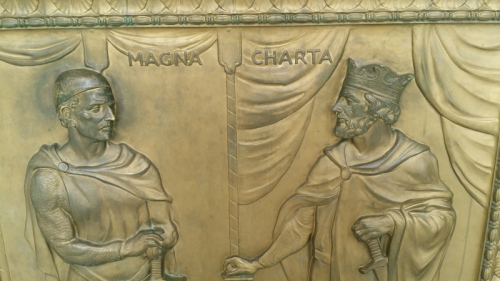
Continue Reading Amici Briefs: What Do You Do With A Recalcitrant Condemnor Who Won’t Pay The Judgment? Magna Carta ‘Em!

W Su cover page

Be sure to download and read this article, recently published in the Virginia Law Review by legal scholar Wanling Su with the deceptively simple title, “What is Just Compensation?

The article delves into the history of ad quod damnum and concludes that “just” compensation means a jury must determine compensation. That’s an issue that we’ve addressed here before, but the Supreme Court has declined to decide

Here’s the abstract:

The Supreme Court has held that “[t]he word ‘just’ in [‘just compensation’] . . . evokes ideas of ‘fairness.’” But the Court has not been able to discern how it ensures fairness. Scholars have responded with a number of novel policy proposals designed to assess a fairer compensation in takings.

This Article approaches the ambiguity as a problem of history. It traces the history of the “just compensation” clause to the English writ of ad quod

Continue Reading New Must-Read Article: “What is Just Compensation?” (Wanling Su, Virginia L. Rev.)

IMG_20200123_170539

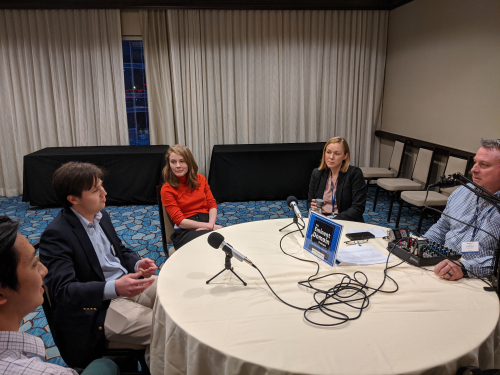
L to R: Benming Zhang, Andrew Parslow, Kelsey Abell,
Kacie Couch, Clint Schumacher

At the recent ALI-CLE Eminent Domain and Land Valuation Litigation Conference in Nashville, our colleague Clint Schumacher set up his portable studio and recorded future episodes of his Eminent Domain Podcast. (Barista’s note: Clint was also one of the three featured presenters for Friday’s Ethics panel, and the feedback we’ve been receiving on that program is uniformly excellent.)

Eight of my William and Mary Law School students took several days out of their busy Spring semester schedule to travel to Nashville and participate in-person in the Conference, applying the theories and concepts we learned in the fall semester’s class (Eminent Domain and Property Rights) to the real world of lawyering. (More on their Conference participation in a future post.)

Between sessions, they had a chance to sit down individually and in groups

Continue Reading Eminent Domain Podcast Interviews William & Mary Law Students

Recall that recent Third Circuit decision which held that a private condemnor exercising federal eminent domain authority pursuant to the Natural Gas Act could not sue the State of New Jersey in federal court to take the state’s property for a pipeline? The court based its conclusion on the Eleventh Amendment immunity states enjoy. 

That ruling, however, was no impediment to this recent Order by FERC (Federal Energy Regulatory Commission) which — at least on its face — seems to address the very same question. In the Order, a 2-1 FERC majority concluded that the NGA permits a private condemnor to sue a state in federal court to take its property. For more details on the FERC Order, see “Divided FERC Finds Pipeline Companies Can Seize State-Owned Interests,” by Addisah Sherwood

And what about the earlier ruling by the Third Circuit? Not a problem, according to a majority

Continue Reading Less Meaningful Than The Iowa Caucuses: FERC Invokes Chevron Deference, Rules That Under NGA, Private Condemnors May Take State-Owned Land