A short one from the U.S. Court of Appeals for the Eighth Circuit.

In Couser v. Shelby County, No. 23-3758 (June 5, 2025), the court held that local ordinances which were adopted after a pipeline company announced plans to build a project to move carbon dioxide across several states (and presumably designed to make it harder, or impossible, to build the pipeline), were preempted by federal and state statutes. 

That’s it. You preemption/home rule mavens can read the opinion for the details which we won’t go into, except to point out what we think is the heart of the matter: 

This court holds that the Counties’ setbacks are safety standards. They apply alike to economically developed and remote areas. This blanket application undercuts aesthetic, land-use, and development rationales. It suggests the effect on safety is not incidental, but rather the “primary motivation.” Texas Midstream, 608 F.3d at 211.
Continue Reading CA8: Local Ordinances Regulating Pipelines Are Preempted By State And Federal Pipeline Law

Misusingheader

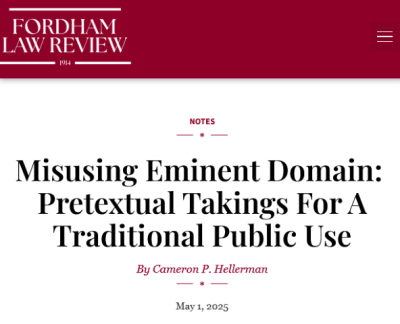
Check out this recently-published student note: Cameron P. Hellerman, Misusing Eminent Domain: Pretextual Takings For A Traditional Public Use, 93 Fordham L. Rev. 2229 (2025).

The article considers the Second Circuit’s decision in Brinkmann v. Town of Southhold, about what we call “spite takings” — those in which the government’s stated public purpose supporting the taking is not the actual reason. That issue is now being considered by another court in Rhode Island.

Here’s the summary:

Eminent domain is a powerful tool at the disposal of local, state and federal governments.  The Fifth Amendment to the U.S. Constitution imposes two conditions on this sovereign power:  the taking must be for “public use,” and the condemner must pay “just compensation” to the property owner.  There are minimal guardrails in place to police potential misuse of the eminent domain power in the courts.  The U.S. Supreme Court equates “public use”


Continue Reading New “Spite Takings” Article: “Misusing Eminent Domain: Pretextual Takings for a Traditional Public Use” (Fordham L. Rev.)

In Muskingum County Convention Facilities Auth. v. Barnes Advertising Corp., No. CT2024-0134 (May 22, 2025), the Ohio Court of Appeal upheld the Authority’s taking of two billboard easements where the stated purpose was for a “new facility serving the City of Zanesville and Muskingum County community[.]” Slip op. at 3.

OK, but what public use is that “new facility” for? How about we describe it by cutting-and-pasting the language in the statute which gives us the authority to take facilities, which defines “facility?” Check it out:

The CFA’s petition to appropriate the billboard easements states that “[t]he [CFA] is currently undertaking a public project to develop a new facility serving the City of Zanesville and Muskingum County community.” That petition describes the “new facility” as “any convention, entertainment, or sports facility, or combination of them, located within the territory of a convention facilities authority, together with all

Continue Reading Ohio App: Reciting The Statutory Definition Is Enough To State A Public Use

TX EmDomain2025

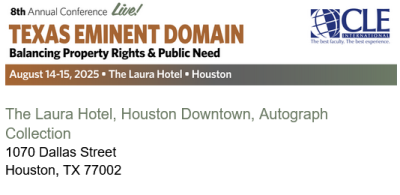
Mark your calendars — or better yet, register now — for the 8th Annual Texas Eminent Domain Conference (Houston), August 14-15, 2025.

We’ve attended in the past, and can report from first-hand experience that it is a great conference, chock-full of the information you need for eminent domain practice in the Lone Star State. 

Check out the agenda and speaker list., and thee to Houston!Continue Reading Register Now: 8th Annual Texas Eminent Domain Conference, Houston: August 14-15, 2025

One of the frustrations of challenging the power to take is … let’s say you win. Yay! You’ve stopped the taking!

So now what? Go back to your life safe in the belief that your property rights are secure? Maybe. If the government has had enough and says “no mas,” your win may be the end of it.

But what if the government really really wants your property? Can it come at you again, armed with with the blueprint your successful public use challenge just provided for how to do it right this time? Probably. There are few situations where the usual “one shot” principle in civil cases — also known as claim preclusion (res judicata to you traditionalists) — ties a condemnor’s hands and prevents it from taking a second, or third, or more shot.

So what about settling your public use challenge? If you

Continue Reading CA8: You Believed The County When It Promised In The Settlement Agreement To Not Take Your Land In The Future? Shame On You!

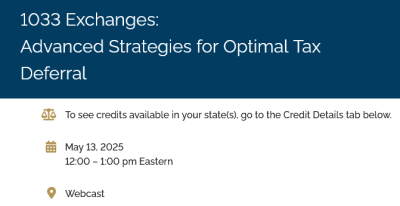
Screenshot 2025-05-04 at 11-03-11 1033 Exchanges Advanced Strategies for Optimal Tax Deferral ALI CLE

Want to learn of some of the options available to property owners whose land is taken by eminent domain (or, even more sadly, destroyed by a disaster)?

Then you should sign up for next week’s ALI-CLE webinar, “1033 Exchanges: Advanced Strategies for Optimal Tax Deferral.”

Here’s a description of the program:

When property is lost due to an involuntary conversion such as a taking by eminent domain, destruction by natural disaster, or theft, many clients assume they must immediately face a significant tax burden from compensation received. However, IRS §1033 provides a powerful alternative—tax-deferral through strategic reinvestment. Understanding the nuances of 1033 exchanges allows attorneys to guide clients through the process, ensuring they maximize tax benefits and rebuild wealth effectively.

Join us for this comprehensive CLE course designed to equip legal professionals with the knowledge and tools needed to navigate 1033 transactions with confidence.

With our colleagues Alan Continue Reading ALI-CLE Webinar: Tax Consequences Of Eminent Domain (May 13, 2025)

We had to read the facts of the Tennessee Court of Appeals’ opinion in City of Pigeon Forge v. RLR Investments, LLC, No. E2023-01802-COA-R3-DV (Apr. 20, 2025) a couple of times over, just to make sure we were understanding what was going on. But the effort was worth it, just because of the unusual arguments presented. Check it out.

RLR owned two adjacent properties, the first used for a hotel, the second for a duplex, parking area, and open green space. So far so good. The city took portions of each for a greenway. It also took temporary construction easements on each parcel. Check. The city sought immediate possession. Got it. The owner objected to public use and the quick take, but the trial court agreed with the city, and entered an order of possession. Understood.

Here’s where it gets squirrelly. RLR, the property owner, sought to enforce the order

Continue Reading It’s The Vibe: Taking Of Condemnee’s Property To Replace Property Taken From Condemnee Is A Public Use

Partial taking for highway project. You know what that means: severance damages. And you also know that often means a “general or special” benefits fight over how the remainder parcel may have been improved by the project, and whether these benefits can reduce the severance owed.

Before-the-project condition: undeveloped land on a frontage road with no nearby connection to the freeway. After-the-project condition: remainder property has direct freeway access, an increase in traffic to the site and easier ability to enter/exit, and curb and sidewalk improvements. The trial court concluded these specially benefited the remainder property, and could be offset against compensation.

In Utah Dep’t of Transportation v. Boggess-Draper Co., LLC, No. 20220875 (May 1, 2025), the Utah Court of Appeals disagreed. In accordance with a Utah Supreme Court decision, benefits that may be used to offset compensation must be those which “affect the land itself,” and increase “the

Continue Reading Friends Without Special Benefits: Direct Access To Interstate Is General Benefit

There’s a lot of detailed legal analysis in the Pennsylvania Supreme Court (Eastern District)’s opinion in Pignetti v. Pennsylvania, No. J-11A-2024 (Apr. 25, 2025). But in the end it boiled down to a simple concept.

The case was about what property constituted the larger parcel. As the court put it, where “the condemnation of one parcel may affect the use and the value of another to such an extent that the two parcels should be valued as one.” Slip op. at 1-2 (footnote omitted). In Pennsylvania, they apparently call this “plottage,” but the analysis is familiar. (Think “three unities” — or some combination thereof.)

The Pennsylvania Legislature codified what in a lot of other jurisdictions is a common law doctrine. The statute provides:

Where all or a part of several contiguous tracts in substantially identical ownership is condemned or a part of several noncontiguous tracts in substantially identical ownership

Continue Reading Pennsylvania: “Used Together” In Larger Parcel Statute Means “One Purpose”

The California Supreme Court has agreed to review and resolve a lower (California) court split regarding the standard of review a court should apply in challenges to a government taking of a privately-owned public utility.

In Town of Apple Valley v. Apple Valley Ranchos Water, No. E078348M (Feb. 13, 2025), the California Court of Appeal held that when a privately-owner public utility objects under the California Eminent Domain Code to the public use of a governmental takeover of the utility, the court must review the Resolution of Necessity with extreme deference (gross abuse of discretion). This means the reviewing court starts off with the presumption that the resolution is valid and its conclusions are true, and that no additional evidence may be considered to counter that conclusion.

One other Court of Appeal held otherwise, and the California Supreme Court agreed to resolve the divergence of analysis. Here’s

Continue Reading Cal Supreme Court Reviewing Necessity Challenge To Public Utility Takeover