We’re not even going to pretend we know what’s going on that spurred the Supreme Court of India to issue this ruling in Delhi Ag. Marketing Bd. v. Devi (Dead), No. 10757 (Mar. 20, 2025), either in the opinion itself, or especially behind the scenes.

But any judicial opinion that starts off like this will certainly grab our attention:

Turning the law of land acquisition on its head, the astonishing events that this appeal is founded on need to be narrated in some detail.

Slip op. at 1. Count us intrigued. (And besides, not knowing anything about India’s law of expropriation has never stopped us before, has it? See here and here, for example.)

With that out of the way, let’s go. 

Way back in the day (and here we’re talking 1963, so like really way back), the Board acquired 33 acres from Devi for a grain market.
Continue Reading India: There’s No Givebacks In Eminent Domain – Agreement To Return 3 Bighas And 5 Biswas To Former Owner Void

A short one from the U.S. Court of Appeals for the Eighth Circuit. 

The caption of WBI Energy Transmission, Inc. v. 189.9 rods, No. 24-1693 (Mar. 24, 2025), should tell you that this is a private-delegation federal taking, and indeed it is. Another Natural Gas Act taking by a private pipeline company. 

After WBI and a property owner couldn’t agree on selling a strip of land for a natural gas pipeline, WBI filed a federal condemnation action under the NGA. Eventually the parties settled on the amount of just compensation owing for the land. 

Under North Dakota law, a property owner is entitled to attorneys fees. So the owner here asserted it was entitled to such fees as part of the property. After all, full indemnity is part of its property rights, no? The District Court agreed, concluding that WBI was on the hook. 

If this all sounds

Continue Reading CA8: Private Delegee Of Federal Eminent Domain Power Does Not Owe Attorneys Fees Even If State Law Requires

Wondering what happened to that case we posted about last week, where our outfit is representing property owners in a federal court challenge to a Rhode Island town’s efforts to take their land by eminent domain?

Well, here’s the latest. The court just issued this Temporary Restraining Order. Read it for the details. This is our case, so we’re not going to say more here.

But for further details about what brought this about, read Christian Britschgi’s piece at Reason, “Town Secretly Seizes Developers’ Property Then Threatens Them With Trespassing Citation” (Mar. 18, 2025).

Temporary Restraining Order, SCLS Realty, LLC v. Town of Johnston, No. 25-00088-MRD-PAS (D. R.I. Mar. 19, 2…

Continue Reading Latest In Public Use Eminent Domain Pretext Challenge: Federal Court TRO

Eminent domain has been on our mind a lot lately

But did you know there’s an award-wining play, “Eminent Domain?” Neither did we. Based on a book, it appears.

Soon to be on the stage at Lincoln, Nebraska’s Lied Center for the Performing Arts, produced by the Angels Theatre Company. Here’s the summary:

Any Nebraska farmer or rancher worth their salt will tell you their connection to the land is equally as strong as their bonds to family, community, and their good name. When Rob McLeod is confronted with a threat underneath his land, he and his entire family discover how fragile and endangered their bonds will become.

An award-winning play, written by Nebraska playwright Laura Leininger-Campbell, Eminent Domain digs beneath the day-to-day struggles facing our family farms. Dig deeper, and the greatest threat to America’s Heartland is revealed: how can this way of

Continue Reading Anyone Up For A Road Trip To Nebraska For “Eminent Domain” In Lincoln This Month?

Purpose

Before we go further, a disclosure: this is one of ours.

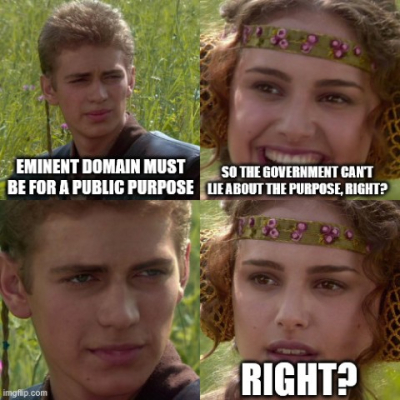
Here’s the Complaint for Violations of Constitutional and Civil Rights, filed yesterday by the Santoro Family in federal court in Rhode Island. This lawsuit challenges, under the Public Use Clause, a RI town’s eminent domaining the family’s land for the ostensible purpose of building a new municipal campus

Sounds like a “classic” public use, you say? Not so fast. As alleged in the complaint, the actual use, purpose, and necessity for the taking is something else: to stop the Santoros from building 250+ low- to moderate-income housing.

Because this is one of ours, we won’t say more. But here’s the story, from the Complaint:

1. SCLS Realty, LLC, and Sixty Three Johnston, LLC, family-owned homebuilders whose members are Lucille Santoro, Salvatore Compagnone, Ralph Santoro, and Suzanne Santoro (the plaintiff LLCs are referred to herein jointly as

Continue Reading Challenge To Sham Eminent Domain: The Government Can’t Lie About Why It Takes Property

Virginia eminent domain 2025

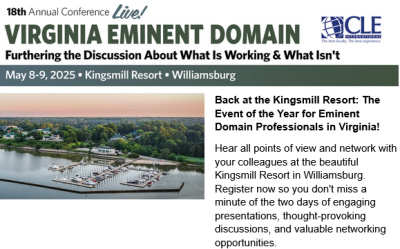
Virginians: now is a good time to register for the Virginia Eminent Domain Conference, May 8-9, 2025, at the Kingsmill Resort in Williamsburg.

We have spoken and attended the Conference in past editions, and can report that it is excellent. We’re looking forward to joining friends and colleagues again in The Burg in the spring. Check out the faculty and agenda, and then register and reserve your spot.

We’ll see you there.Continue Reading Virginia Eminent Domain Conference: May 8-9, 2025, Williamsburg

TX Em Domain 2025 Austin

Texans: now is a good time to register for the 24th Annual Texas Eminent Domain Superconference, March 27-28, 2025, at the Austin Country Club in Austin.

We spoke at the Conference a couple of years agolast year and in other editions, and can report that it is excellent. Check out the faculty and agenda, and then register and reserve your spot.Continue Reading Texas Eminent Domain Conference – Austin, March 27-28, 2025

We had the New Jersey Appellate Division’s opinion in Township of Jackson v. Getzel Bee, LLC, No. A-0590-23 (Jan. 31, 2025) in our queue to digest, when our colleague Joe Grather beat us to the punch with his analysis “Appellate Court Rejects Condemnation Due to Lack of Public Use or Purpose.”

So instead of repeating Joe’s summary and analysis, we’re going to recommend you read his. The short story is that the Township used eminent domain to take property, with the avowed public use being “open space,” which is generally a qualifying public use. The owner objected and the Appellate Division agreed that yes, open space may be a public use, but here, the record pointed to the property actually being used as a “currency” to “exchange for open space.” As Joe writes:

I’m not so sure we agree with the idea that the constitutional “public use&rdquo

Continue Reading NJ App Div: No Taking To Use The Property To Trade For “Open Space”

You should already know Short Circuit is the Institute for Justice’s frequently-updated podcast on important and interesting decisions from the federal courts of appeals (the “Circuit” part of the title, we assume).

If you are not already a regular listener you are missing out, because it is a fantastic and easy way to keep up with what is going on, and to hear insightful analysis.

We’ve visited the SC studios in the past, and this week made a return visit, joining host Anthony Sanders (Director of the Center for Judicial Engagement), and guest Justin Pearson (Managing Attorney of IJ’s Florida offices), to talk cattle feedlots, “new” vs. “old” property, North Carolina’s Law of the Land Clause, and methods of constitutional interpretation.

Here’s the episode summary, and show notes, from the Short Circuit site:

A long-time friend of the Institute for Justice, Robert Thomas, joins us this week. For

Continue Reading “I Like Old Property” – We Return To The “Short Circuit” Podcast To Talk Law Of The Land & Magna Carta

In our earlier post today, we noted that on the same day last month, the U.S. Court of Appeals for the Fourth Circuit issued two published opinions about the admissibility of evidence in federal eminent domain cases under the Natural Gas Act

In our post about the other case, we focused on the admissibility of the owner’s testimony regarding the value of her land, and noted that the second issue in that case — the admissibility of expert valuations — relied on the case we’re delving into in this post, Mountain Valley Pipeline, LLC v. 9.89 Acres of Land, No. 23-2129 (Jan. 27, 2025).

These are takings under Fed. R. Civ. P. 71.1. The district court excluded the valuation opinion of the owner’s appraiser. That opinion might have passed muster for admissibility under Federal Rules of Evidence 702 and Daubert, but the court concluded

Continue Reading District Court: Fed R Civ P 71.1 Increases Discretion To Exclude Experts. CA4: No It Doesn’t