


Here’s one where you have to stop and pause and ask “why?” Because most of the time, you’d think that an offer to the property owner made by DOT that included more compensation than DOT’s own appraisal recognized would be a good thing.

Apparently not here: DOT’s appraiser opined that the owner incurred no severance damages from the partial take, and therefore did not include any in the appraisal. His letter appraised compensation for the property taken at $79k. But DOT offered the owner more, a total of $133k. Its initial offer identified $79k for the land, about $1k for “easement rights,” and the balance for “loss of various site improvements” (as the court phrased it. But “[n]otably, the initial offer letter did not identify severance damages as a line item for compensation.” 

When the parties could not agree on a voluntary acquisition, and in anticipation of condemnation, DOT went back
Continue Reading Owner Objects To Being Offered *More* Compensation: DOT’s Offer Invalid Because It Included Severance Damages The Appraisal Omitted

Yesterday, our friends and colleagues at the Institute for Justice (Diana Simpson and Bob McNamara) welcomed us to their studios to record an episode of the Short Circuit” podcast.

We talked property, takings, Virginia oysters, the cert petition about Colorado eminent domain abuse, and how the Supreme Court of the Republic of the Philippines would handle cases like Berman v. Parker and Hawaii Housing Authority v. Midkiff

Listen in, and subscribe to the podcast (we don’t miss an ep). 

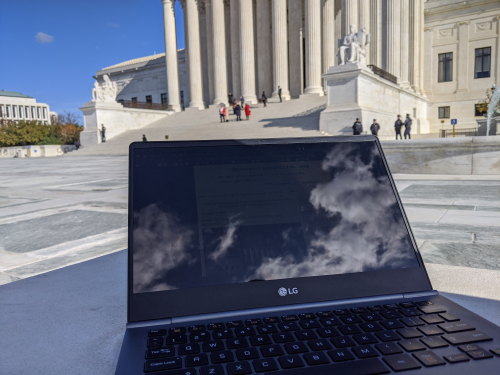
And yes, we really did write up yesterday’s blog post from the Supreme Court steps. Proof:

IMG_20191203_125502 (1)Continue Reading We Join IJ’s “Short Circuit” Podcast To Talk Virginia Oyster Takings, Colorado Wild Eminent Domain Abuse Cert Petition, And Berman International

Here’s decision we’ve been anticipating in a case and issue we’ve been following for a while, the question of whether private utilities can be held liable under an inverse condemnation theory for much of the damages caused by the recent California wildfires. 

Short story from the Northern District of California Bankruptcy Court: yes, private utilities can be liable in inverse condemnation:

What Debtors advocate here is to set aside a well-seasoned principle of strict liability. Failing that, they are seeking a solution, fire cost reimbursement, in search of a problem, CPUC’s refusal or unwillingness to allow recovery by a blameless (prudent) investor-owned utility. As noted, they cite no instance when the CPUC denied inverse condemnation cost reimbursement to a prudent operator. And it is the role of the legislative branch, not the judicial branch, to fix problems in advance. As recently as this past July, the California legislature refused

Continue Reading California’s “Well-Seasoned” Inverse Condemnation Strict Liability Principle Not Set Aside By PG&E’s Bankruptcy Court

Following up on the petition, filed last Friday, asking the Virginia Supreme Court to review a trial court’s demurrer which failed to recognize that the owners of a state lease to harvest oysters in the Nansemond River have a property interest . The court concluded that the city and santitation district possess a superior right to pollute the river with sewage.

The case arose when the city and sanitation district declared the oysterbeds “condemned” during certain times of the year because they put sewage into the river. They denied compensation, and the trial court held that Darling v. City of Newport News, 249 U.S. 540 (1919) subjected the lease owners to the city’s superior right to pollute.

We paid a visit to the site a couple of weeks ago to see the pollution source, and how the oysters are harvested in the river. The above video is from that

Continue Reading Videos: Oyster Takings On The Nansemond River

We were not as creative as our colleague Paul Henry (see below), but our Planning Co-Chair Joe Waldo and I wanted to personally invite you to join the “big guns” in our area of law at the 37th Annual ALI-CLE Eminent Domain and Land Valuation Litigation Conference, January 23-25, 2020, in Nashville, Tennessee.

We’ve assembled an excellent faculty, and an agenda that covers the hot topics of the day. Go here to view the complete faculty list and agenda. Water rights, Knick, appraisal, ethics, civil rights, and a whole lot more in three days of the longest (and we think best) conference in our area of law. Also, for those new to the field, Andy Brigham and Jack Sperber are again leading their “Eminent Domain 101” program. A great way to learn the topic, or for experienced lawyers to get a quick refresher on the basics. Your registration

Continue Reading Don’t Miss Out: Join The “Big Guns” And Secure Your Space At ALI-CLE’s Upcoming Eminent Domain & Land Valuation Litigation Conference (Jan 23-25, 2020, Nashville)

Here’s the video of (most, but not all of) the recent session featuring four lawprofs discussing “Originalism and Constitutional Property Rights” at the Federalist Society lawyers’ meeting. 

Interesting debate, all about the text of the Fifth and Fourteenth Amendments, the “original public meaning of the Takings and Due Process clauses, and all that heady stuff. Here were our major takeaways:

  • Professor Somin argued that decisions like Kelo and Berman are not consistent with the original public meaning of the terms of the Takings Clause. 
  • Professor Merrill asserted there’s a good textualist argument that the Public Use Clause is not a limitation on the government’s power to take. If there’s a private benefit taking, that is best handled by other parts of the Constitution (such as due process).
  • Also, from Prof. Merrill: between Kelo and the backlash, the backlash was the “true constitutional moment.”
  • Professor Lazarus thought the regulatory


Continue Reading What Is The Original Public Meaning Of The Fifth (And Fourteenth) Amendments?

Check this out: the Complaint, filed a couple of days ago in federal court against the State of New York (and others), that alleges the state’s recently-adopted rent control regulations is a taking (among other claims). 

It’s a long complaint so we shall leave it to you to delve into the details yourselves. Most interesting to us is that the complaint’s first named defendant is the State of New York as the State of New York.

What about Eleventh Amendment immunity, you ask? 

Read on. 

Compliant, 74 Pinehurst LLC v. State of New York, No. 1:19-cv-06447 (E.D.N.Y. Nov. 14, 2019) 

Continue Reading New Federal Court Complaint: State’s Rent Control Is A Taking

All seemed to be going well for the property owners in a Florida takings case. They obtained a satisfactory compensation judgment for the taking of their healthy citrus trees (yes, this is that case). And because Florida’s Constitution requires “full” compensation, they were also entitled to attorneys’ fees and costs. $13 million in compensation, nearly $1 million in fees. Took a while, but so far, so good.

That’s when the Florida Department of Agriculture really dug its heels in. It acknowledged it was obligated to pay compensation, but it simply refused to do so. It didn’t make a request to the legislature to appropriate money to satisfy the judgment, and claimed it has no obligation to do so. The legal equivalent of a middle finger at both the courts and Florida citizens:

Here, as discussed previously, the Department takes the position that it will make no payment of the

Continue Reading Florida Dep’t of Ag’s Middle Finger To The Courts And Property Owners: We Were Ordered To Pay Full Compensation…But We’re Not Going To

Check out this story by JD Morris (“PG&E renews push to avoid strict liability for 2017, 2018 fires“) in the San Francisco Chronicle, about the recent (and ongoing) California wildfires, and the issue of what has been called the “unusual,” “unique,” and “so-called” doctrine of inverse condemnation in that state’s courts.

Recall that the theory is that when private property is damaged by a wildfire and a utility’s equipment is a substantial cause (or in the words of a recent California Supreme Court opinion, there’s a “robust nexus” between the damage and some public purpose improvement), that is a taking or damaging under the California Constitution. Like all takings and damagings resulting in the obligation to provide just compensation, traditional tort notions of fault and negligence don’t play a role. As the U.S. Supreme Court noted in Armstrong v. United States, 364 U.S. 40 (1960)

Continue Reading California Utility: To Hold Us Liable For A Taking Would Be A Taking