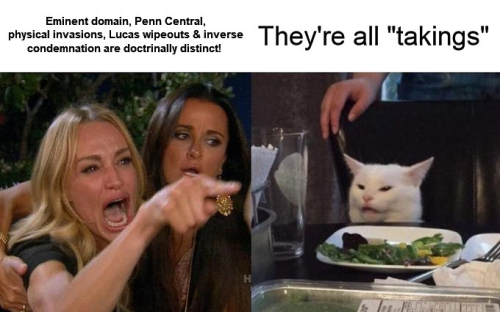
Here’s the latest in a case (and issue) we’ve been following. 

In Puntenney v. Iowa Utilities Board, 928 N.W.2d 829 (Iowa 2019), the Iowa Supreme Court answered a question that has been making its way around: what “public” does the “public use” requirement cover? For the Iowa Constitution, for example, does a taking have to be of direct benefit to the people of Iowa?

The court there addressed the issue by not answering the the question directly, but by concluding that the Iowa public is indirectly served by the taking of private property for a pipeline, even though there are no “onramps” or “offramps” for the oil in Iowa. The taking would have the other, usual, butterfly effect Iowa benefits: some jobs, cheaper gas, and the like. Kentucky and West Virginia courts have reached the opposite conclusion (the taking must directly serve the people of the state), but Ohio and

Continue Reading New Cert Petition: It’s Not Enough For A Condemnor To Invoke A “Classic” Public Use

A very short opinion we’ve been meaning to post for a while.

In Hickman v. Ringgold County, No. 19-0123 (Nov. 6, 2019), the Iowa Court of Appeals considered property owners’ claim that the taking of their land to create a access road for the neighboring concrete plant was not a valid public use. Seemed like a pretty good claim. After all, Iowa prohibits economic development takings:

“public use” or “public purpose” or “public improvement” does not mean economic development activities resulting in increased tax revenues, increased employment opportunities, privately owned or privately funded housing and residential development, privately owned or privately funded commercial or industrial development, or the lease of publicly owned property to a private party.

Iowa Code § 6A.22(2)(b).

And, in the type of testimony that would make every municipal lawyer cringe, a county supervisor admitted the taking was “to further develop the economics of the county”

Continue Reading “That said…” A Prohibited Economic Development Taking Is OK If It Is For A Road

One does not simply walk to nashville

You can also fly, drive, or bike to the upcoming 37th Annual ALI-CLE Eminent Domain & Land Valuation Litigation Conference. in Nashville. Limited space still available, so don’t delay further and register now. We’re on track to record attendance, so you don’t want to miss the best nationally-focused three-day program on our area of law.

Takings, Knick, compensation, appraisals … and a bit of fun thrown in. We have many new attendees, and many new speakers, too.  Continue Reading (Nearly) Last Chance To Join Us In Nashville For ALI-CLE’s Eminent Domain Conference

The holding of the Indiana Court of Appeals in City of Kokomo v. Estate of Newton, No. 19A-PL-1321 (Dec. 18, 2019) is deceptively simple: if a party does not own a formal interest in the property being taken, evidence of the damages which it incurred as a result of the condemnation isn’t relevant to the calculation of just compensation. 

That’s workable as a black-letter rule, we suppose. But what about the very common situation where, due to circumstances, someone with an obvious stake in property being taken had not formalized that interest prior to the condemnation? 

That appears to have been the situation in Newton, where the two condemned properties had been owned by real-party-in-interest (Bradley Newton)’s mother at the time of her death. The properties were used by a company she also owned, Kokomo Glass. When she died, her son Wesley became the owner of the two parcels

Continue Reading If You Want To Claim An Interest In A Condemnation Award, Formalize The Interest

Okyoda

It’s 2020, so out with the old, in with the new.

We like any opinion that starts off with “[t]he facts giving rise to this appeal are complicated but do not require a lengthy recitation.” Because that signals the opinion writer has done the hard work, because in order to explain complicated facts in a simpler way, the writer must have focused only on the critical facts (unlike a lot of brief and opinion writers). For that reason, we started off the New Year diving into the Supreme Court of Kansas’ opinion in GFTLenexa LLC v. City of Lenexa, No. 119278 (Dec. 6, 2019). It’s about the old problem of who is entitled to be compensated when property subject to multiple interests is taken. 

Here are the “complicated” facts: Oak Park owned land. It leased it to Centres. Centres, in turn, subleased it to Bridgestone for a tire shop. Later

Continue Reading Kansas: Tenant With An Interest In Property Who Knew It Was Being Condemned Is Precluded From A Later Inverse Claim

20170918_171029_Richtone(HDR)

We’re seeing a lot of “end of year” and “end of decade” wrap-ups, so figured we’d better chime in.

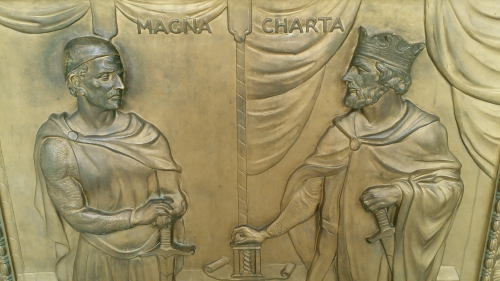
As the above graphic hints (this is detail of the doors of the U.S. Supreme Court), our biggest case of 2019 (and probably of the twenty-aughts) is Knick v. Township of Scott, 139 S. Ct. 2162 (2019). The federal courthouse doors are open again to federal takings claims. 

Yes, the U.S. Supreme Court doors were technically already open (via cert petitions from state supreme court takings cases), and Knick simply re-set the clock back to 1985, but if the two-thousand double-ohs were the decade of Kelo (a loss), will not the 2010’s be defined by Knick (a big win) even if the ruling came at the tail end of the decade?  

Compare where we are today with where in 2016 we thought we were heading

Continue Reading Biggest Case Of The Year…Or Maybe The Decade?

Quick quiz: a taking of private property for a public flood protection property is a “public use,” right?

Yes, but that wasn’t quite what the property owner had a problem with in a recent decision from the North Dakota Supreme Court, City of Fargo v. Wieland, No. 2019-153 (Dec. 12, 2019).

Rather, it was in the way the Resolution of Taking was worded. The owner asserted the wording was too vague, and allowed a “take now, decide what to do with the property later approach” that a California court had rejected in this case (and which a New Jersey court agreed with in this case). The ND court disagreed, concluding that the wording “flood protection project” and “real and meaningful flood protection” to be good enough to give the owner notice of what the condemnor was taking, and why. The court also affirmed that this issue was properly

Continue Reading ND SCT: It’s Enough That The Resolution Of Necessity Described The Public Use As “Flood Protection Project”

IMG_20191209_091814

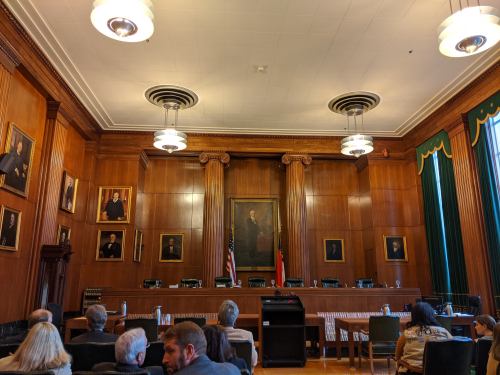
This time last week, we were sitting in the North Carolina Supreme Court’s (very beautiful) courtroom, above, having just observed oral arguments in a case we’ve been following for quite a while, Chappell v. NCDOT, No. 51PA19 (docket here). 

This case is the follow up (after remand) of the N.C. Supreme Court’s landmark decision in Kirby v. North Carolina Dep’t of Transportation, No 56PA14-2 (June 10, 2016), in which the court held that the “Map Act,” a statute by which DOT designated vast swaths of property for future highway acquisition, was a taking because the Act prohibited development and use of designated properties in the interim. The court concluded “[t]hese restraints, coupled with their indefinite nature, constitute a taking of plaintiffs’ elemental property rights by eminent domain.” The court remanded the case for a parcel-by-parcel determination of just compensation. On remand, the trial court concluded

Continue Reading NC Supreme Court Considers Just Compensation For Formerly Indefinite–But Now Temporary–“Map Act” Takings

Here’s the amicus brief we filed yesterday in a public use case we’ve been following that asks whether pretext and private benefit are irrelevant as long as the condemnor invokes a “classic” public use. In this case, the Colorado Supreme Court overturned the court of appeals’ conclusion that even though the purported purpose of the taking was to provide future possible public infrastructure, the overwhelming private benefit today meant the taking was not for public use. 

Here’s the cert petition

Southeastern Legal Foundation, Cato Institute, Owners’ Counsel, and NFIB Small Business Legal Center joined in the brief, which argues that the unusual circumstances (an obviously self-interested condemnor) lead to a reasonable suspicion that “a private purpose is afoot” (as Kelo put it), and thus the usual presumption of conceivable basis review is not warranted, and indeed, the courts should look at these type of takings with a particularly skeptical

Continue Reading New SCOTUS Amici Brief: Invoking A “Classic” Public Use Isn’t Enough When The Circumstances Reveal “A Private Purpose May Be Afoot”