Here’s the latest cert petition about an issue we’ve been following closely. Givens v. Mountain Valley Pipeline, LLC, No. ___ (July 3, 2019)

As regular readers understand, several federal courts of appeals recently have upheld giving prejudgment possession of property to a private pipeline condemnor once a district has ruled in favor of the pipeline that it qualifies under the three predicates in 15 U.S.C. § 717f(h).

These courts conclude that summary judgment — which recognizes that a private pipeline company with a FERC certificate may exercise eminent domain power under the NGA — is enough to also grant the pipeline possession of the land now, even though the NGA does not delegate the quick take power. In our view, these injunctions grant pipelines a substantive right and are an usurpation of Congress’ power to determine how the delegated eminent domain power gets exercises. The courts, however (with
Continue Reading New Cert Petition: Private Pipeline’s Preliminary Injunction In Natural Gas Act Taking Created New Substantive Rights

34s75v

We’ve resisted for as long as we can.

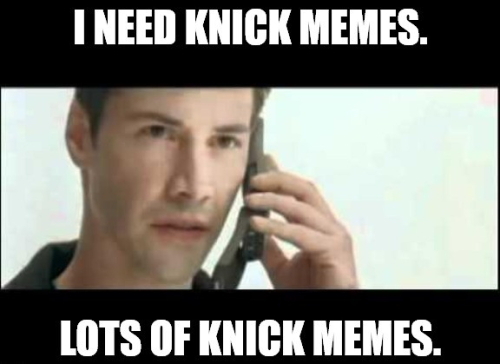
Here’s our take at telling the Williamson County and Knick story, 100% in memes.

Why, you may rightly ask? 

Well, it started with our Knick amicus brief, which included a meme that we thought captured well the injustice of property owners being prohibited by Williamson County from raising their federal constitutional claims in federal court (or anywhere, for that matter).

And then, as these things often do these days, the tail started wagging the dog. Readers didn’t want our cogent and deep analysis, they wanted more Knick memes. And rather than post those willy-nilly, we decided to do ’em all in a single post, and be done with it. 

So here you go. For those of you who dig this stuff, read on. If you think we missed any, or would like to send your own to fill

Continue Reading Knick, Entirely In Memes

Eminent domain lawyers know that even though the U.S. Supreme Court ruled against the property owner in Kelo, it acknowledged that there was a (slight?) hope in some cases where the condemnor’s stated public use or purposes is actually “pretext” to private benefit.

Pretext may be present in at least three situations: (1) when eminent domain is used to transfer the private property of one party to another private party where the magnitude of public benefits outweighs the private benefit; (2) when eminent domain is used for a one-to-one transfer of private property without a comprehensive, integrated, and carefully considered development plan; and (3) where a particular private party is identified before the taking. See Kelo v. City of New London, 545 U.S. 469, 478 & n.6 (2005). 

But in the 15 years since Kelo, the Court has never agreed to take up the question of how a property

Continue Reading Why Eminent Domain Lawyers Should Read The Supreme Court’s Census Case

Here’s the recording of last week’s Federalist Society teleforum on the issue “Is ‘Possess Now, Pay Later’ Constitutional in Private Pipeline Takings?” 
 
Stream it or download it here:
 

Here’s the summary of the podcast:

The U.S. Supreme Court will soon consider the third of several petitions for certiorari asking it to review a question which has split the lower federal courts: whether district courts have the power under the Federal Rules of Civil Procedure to issue preliminary injunctions in takings under the Natural Gas Act which allow private pipeline condemnors to obtain immediate possession of property, even though Congress has withheld the federal “quick take” power in the NGA.

The Third, Fourth, Ninth, and Eleventh Circuits have concluded that simply because Congress did not delegate to private pipeline condemnors the quick take authority—the power to obtain immediate title and possession of condemned property upon a deposit

Continue Reading Podcast Now Available: Is “Possess Now, Pay Later” Constitutional in Private Pipeline Takings?

20170918_171025_Richtone(HDR)

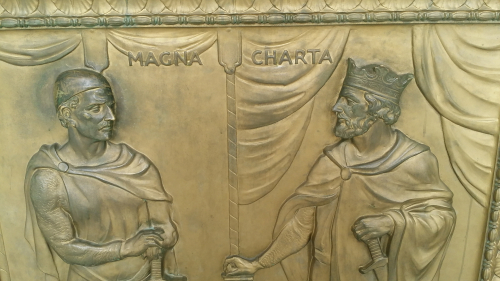
Yes, this is detail from the Supreme Court’s front door.

This is the first in what will be a short series of five posts with thoughts on the landmark decision in Knick. In this installment, a crash course in the extensive doctrinal background necessary to understand why the Knick Court did what it did. Here are the related posts:

* * * *

The opinions in last week’s ruling by a sharply-divided Supreme Court, Knick v. Township of Scott, No. 17-647 (June 21, 2019) employed a lot of very evocative language: “aborning,” “Catch-22,” “loot,” “shaky,” “sue me,” “overthrows,” “smashes,” “smithereens” “first crack,” “points for creativity.” But ultimately, the most important

Continue Reading Knick Analysis, Part I: After More Than 30 Years, Supreme Court Reopens The Federal Courthouse Door To Property Owners

This is the second in a series of five posts taking a look at last week’s landmark ruling by a sharply-divided Supreme Court, Knick v. Township of Scott, No. 17-647 (June 21, 2019). Here are the related posts:

In this post, we’ll take a look at the case which finally convinced the Supreme Court that it was time to revisit the Williamson County state-litigation ripeness rule, Knick v. Township of Scott, 862 F.3d 310 (3d Cir. 2017). What we call the Case of the Zombie Zoning Inspectors

* * * *

The Township of Scott, Pennsylvania, apparently

Continue Reading Knick Analysis, Part II: The Court Finds A Vehicle In A Zombie-Zoning Case

IMG_20190621_150358

This is the third in a series of five posts taking a look at last week’s landmark ruling by a sharply-divided Supreme Court, Knick v. Township of Scott, No. 17-647 (June 21, 2019). Here are the related posts:

In this post, we’ll take a deeper dive into the three opinions: Chief Justice Roberts for the five-Justice majority (Roberts, Thomas, Alito, Gorsuch, Kavanagh), Justice Thomas’ short stand-alone concurring opinion, and Justice Kagan’s dissent (joined by Justices Ginsburg, Breyer, Sotomayor, and Kagan).  

* * * *

BLUFs

Here are the bottom lines up front, the lenses though which we think you should read each of

Continue Reading Knick Analysis, Part III: What It Means To “Take” Property Without Just Compensation – “A bank robber might give the loot back, but he still robbed the bank.”

Ill_be_back

This is the fourth in our series of five posts with thoughts on the landmark decision in Knick. In this installment, the dissent. Related posts:

* * * *

We cannot mask our disappointment with the dissenting opinion. We usually appreciate Justice Kagan’s opinions and measured approach, even while dissenting. And after the first oral arguments in October, we thought there was a chance, albeit slim, that she might see things Ms. Knick’s way.

But even though we were pretty sure she would rule for the government, we didn’t anticipate as vehement a defense of Williamson County‘s “no violation until you sue the government for

Continue Reading Knick Analysis, Part IV: Why Not Let Sleeping Dogs Lie? The Dissent And Stare Decisis

One does knick meme

This is the fifth and last in our series of posts with thoughts on the landmark decision in Knick. In this post, we’ll be puling out our crystal balls, and doing a bit of forecasting. Here are the related posts:

 * * * *

The execrable state-litigation ripeness requirement is overruled. Ding-dong, the wicked witch is dead. No longer will our only federal review of a federal constitutional issue be limited to petitions for cert at SCOTUS. We can “simply” go to federal court. 

So now what?

Continue Reading Knick Analysis, Part V: What’s Next?

Kungfu

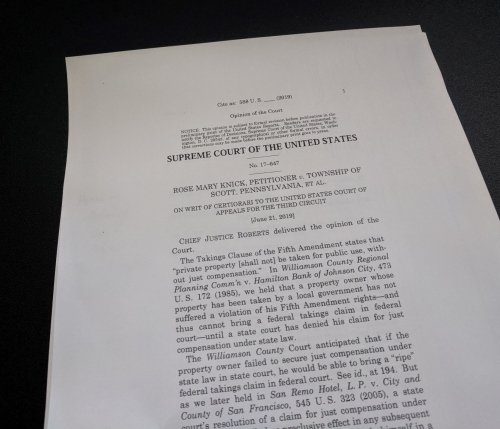
We’ll be doing a longer post with our thoughts on the U.S. Supreme Court’s landmark ruling in Knick v. Township of Scott, No. 17-647 (June 21, 2019). But here’s the big picture.

It appears that at least five Justices finally seem to understand what we in the property bar have been saying for decades – that the essence of a federal “takings” claim against a local or municipal government is that “by regulation, you have deprived my property of ‘productive use’ [as Chief Justice Roberts noted on page 14 of the slip opinion], and you have not compensated me.” So it is enough that the government hasn’t paid me, and I have no obligation to “ripen” my federal claim by chasing down the local government for compensation in state court.

So nearly 100 years after Justice Holmes famously opined for the Court in Pennsylvania Coal Co. v. Mahon,

Continue Reading Williamson County Overruled: After Nearly A Century, Supreme Court Finally Has Figured Out What A Regulatory Takings Claim Looks Like