One does knick meme

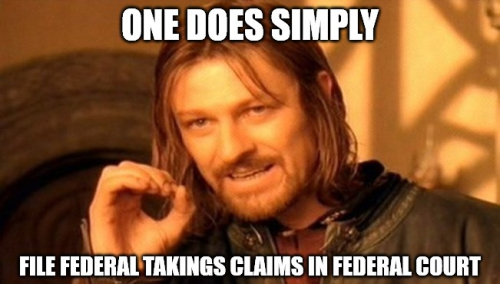
Property lawyers, dust off your Federal Rules of Civil Procedure, and federal judges your long vacay from dealing with regulatory takings and inverse condemnation cases is over, because this just in: by a 5-4 margin (Chief Justice Roberts authored the majority opinion, with Justice Kagan writing the dissent), the U.S. Supreme Court today finally (finally!) overruled the state-litigation prong of the Williamson County ripeness doctrine. Knick v. Township of Scott, No. 17-647 (June 21, 2019).

Yes, overruled. Not trimmed around the edges. Overruled. 

Here’s what our quick skim turns up as a critical passage:

The Court in Williamson County relied on statements in our prior opinions that the Clause “does not provide or require that compensation shall be actually paid in advance of the occupancy of the land to be taken. But the owner is entitled to reasonable, certain and adequate provision for obtaining compensation” after a taking.

Continue Reading “The state-litigation requirement of Williamson County is overruled.”
Here’s a case that’s pending in the New York Court of Appeals that has been briefed and is awaiting argument. 

In Natural Fuel Gas Supply Corp. v. Schueckler, No. 17-02021 (Nov. 9, 2018), the Appellate Division answered this question:

This appeal therefore presents a novel question of condemnation law: can a corporation involuntarily expropriate privately-owned land when the underlying public project cannot be lawfully constructed?

Slip op. at 1. 

The court stated it clearly: “We answer that question firmly in the negative.”

Like many projects, in order to be built this natural gas pipeline had a long and complex checklist. It needed approvals of FERC — a certificate of public convenience — under the Natural Gas Act. And certain approvals under the federal Clean Water Act. Which in turn meant it needed state enviro checkoffs, here a water quality certificate from a New York agency. It also needed to

Continue Reading NY Court of Appeals Considering Whether A Pipeline Can Take Property For A Project That Can’t Legally Be Built

IMG_20190608_141839_1

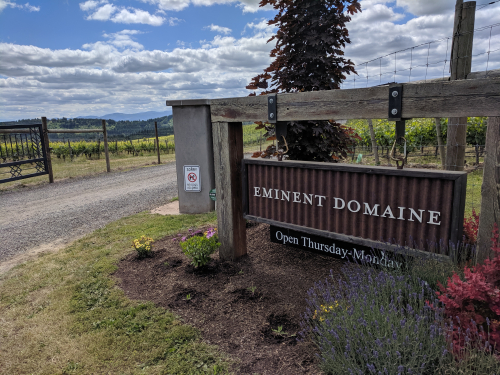
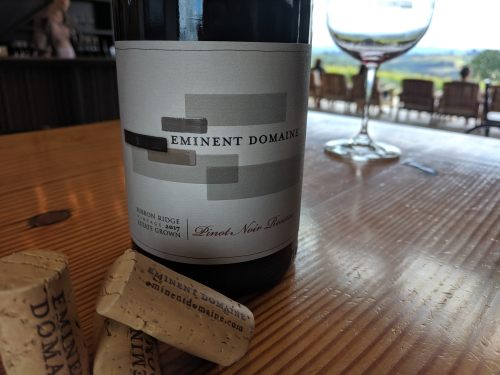
The title of this post isn’t poetic or figurative (like the windmills of your mind), it’s literal: for a field trip after the recent Oregon Eminent Domain Conference, we paid a visit to a nearby winery which — given its name, “Eminent Domaine” — we naturally could not resist. Besides, we already like their wines

The winery and estate vineyards are only a short drive from downtown Portland. Go past suburban Tigard (of Dolan v. City of Tigard infamy). Beyond the metro urban growth boundary. Avoid the guy living in an old jetliner parked in the woods.

Turn off the main road. 

IMG_20190608_160230

After leaving the pavement, you’ll end up on a gravel road which continues on just long enough for you to question whether you’ve perhaps strayed off the correct path. 

IMG_20190608_152129

You haven’t. You’ve just entered the Ribbon Ridge AVA, and in

Continue Reading A Detour To The Vineyards Of Eminent Domaine

A must-read for takings mavens. Property rights gurus Professor Gideon Kanner and Michael Berger have published a new article, The Nasty, Brutish, and Short Life of Agins v. Tiburon, 50 Urb. Lawyer 1 (2019). It’s the lead article in the latest volume of The Urban Lawyer, the law journal of our Section of the ABA, the Section of State and Local Government Law.

Barista’s note: since TUL ended its long-time editorial relationship with UMKC Law School last year, the journal has been published in-house, and we’ve taken on the role of Editor-in-Chief, in-between our lawyering and teaching day jobs. We recognize the efforts of our ABA editor, as well as our team of volunteer Associate Editors (our fellow lawyers who took on the responsibility of tech editing the pieces) in producing the journal. 

Kanner and Berger have written an informative (and entertaining) tour-de-force of modern regulatory takings law.

Continue Reading New Must-Read Article: Kanner & Berger, “The Nasty, Brutish, and Short Life of Agins v. City of Tiburon”

The Colorado Supreme Court issued an opinion in a case we’ve been following on public use in eminent domain. in which it reframed the Questions Presented.

In Carousel Farms v. Woodcrest Homes, No. 2018SC30 (June 10, 2019), the court reversed the court of appeals’ conclusion that a taking lacked a public purpose because even though the public might use the roads and sewers which the utility district (formed for the specific purpose of taking the property which the private-benefitted developer could not acquire by negotiation) said it would install in the future did not outweigh the overwhelming private benefit in the present. In the Court of Appeals’ words, “[w]hen the primary purpose of a condemnation is to advance private interests, even if there will be an eventual public benefit, the condemnation is not for a public purpose.” 

The Supreme Court turned that analysis upside down, concluding that a

Continue Reading Colorado: A Lot Of Private Benefit Today Does Not Overcome Smattering Of Possible Public Future Benefit

The details are yet to be posted on the web, but mark your calendars now for an upcoming (two weeks from today, on Friday, June 21, 2019) Federalist Society teleforum, produced by the Environmental and Property Rights Practice Group, about an issue that we’ve been following that is the subject of at least three recent cert petitions (two denied, one on the way): whether federal courts can issue preliminary injunctions in takings under the Natural Gas Act which allow private pipeline condemnors to obtain immediate possession of property, even though Congress has withheld the federal quick take power in the NGA.

Stay tuned for the details which will be posted soon. Our speakers will be Chris Johns (Texas) who is preparing the forthcoming petition, and Jeffrey Simmons (Wisconsin), who will present the condemnors’ viewpoint.  We’ll be moderating the program. 

Details on the way. Continue Reading Mark Your Calendars: Federalist Society Teleforum On Preliminary Injunctions In Natural Gas Act Takings: Is “Take Now, Pay Later” Unconstitutional? (Friday, June 21, 2019)

0606191053_HDR

Here are the links to the cases which were not in your materials. Theme of the day: amateurs! 

Our thanks to colleagues Jill Gelineau and Paul Sundermier for asking us to present. It was good to see our Oregon friends again. 


Continue Reading Links From Today’s Portland Eminent Domain Conference

In Berry v. City of Chicago, No. 1-18-0871 (May 22, 2019), a divided Illinois court of appeals reversed the dismissal of an inverse condemnation claim, holding that even though the potential damage was widespread, the plaintiffs might be able to show that they incurred damage beyond those incurred by the general public.

The case should be interesting to both inverse and straight takings mavens because the court split on how the “public in general” is defined: does it mean, as the majority essentially concluded, everyone served by the alleged condemnor, or (as the dissenting justice concluded) just those who were subject to the action which is claimed to be a taking (or, in eminent domain terms, the project)?

The complaint alleged: 

[T]he City embarked on a project to replace water mains and water meters throughout Chicago. In replacing the water mains and meters, however, plaintiffs allege that the City

Continue Reading How Is “The Public” Defined When It Comes To Special Damages?

Here’s one we’ve been waiting to drop for a while, on an issue we wrote about earlier this week.

In Puntenney v. Iowa Utilities Board, No. 17-0423 (May 31, 2019), the Iowa Supreme Court — taking a different view than Kentucky — held that a pipeline which runs through Iowa, but which does not have any “offramps” for oil in Iowa, will nonetheless promote the public convenience and necessity” for the people of Iowa.

The court’s reasoning boils down to this: a pipeline is a “traditional” public use.

The court first adopted Justice O’Connor’s Kelo dissent (along with the reasoning of Hathcock, Norwood, and SWIDA), concluding that economic development alone does not qualify as a public use under the Iowa Constitution:

Like our colleagues in Illinois, Michigan, Ohio, and Oklahoma, we find that Justice O’Connor’s dissent provides a more sound interpretation of the public-use requirement. If

Continue Reading We Are The World: Iowa SCT Finds Dakota Access Pipeline Will Promote The Public Convenience For Iowa, Even If Iowans Don’t Get Any Of The Pipeline’s Oil

An issue we’ve been tracking for a while — are takings for pipelines for the public’s benefit? — raises another question: how is “the public” defined?

Some courts, like Kentucky’s, define the public as the public which the jurisdiction serves. In the Bluegrass Pipeline case, for example, the court of appeals held that a natural gas pipeline which went through Kentucky, but did not have any offramps for the natural gas in Kentucky — was not “in public service” as required by that state’s eminent domain statutes. A Pennsylvania court adopted a similar rationale (even though it held a private pipeline could exercise eminent domain power because it planned gas offramps in Pennsylvania).

And in City of Oberlin v. FERC, No. 18-1248, the U.S. Court of Appeals for the D.C. Circuit recently heard oral arguments about whether FERC can consider

Continue Reading Are Pipelines For The Public’s Benefit? If So, What Public?