Here’s the Reply Brief in a case which we’ve been following (and in which we filed this amici brief). This is the one in which landowners are challenging the district court’s issuance of an injunction in a Natural Gas Act taking which allow a private condemnor to obtain immediate possession of the land being condemned even though the Natural Gas Act does not delegate to pipeline condemnors the quick-take power.

The Reply responds to the Brief in Opposition, and argues:

These decisions conflict with the basic structure of eminent domain, which grants condemnors the power to buy land by force—not occupy it by federal injunction. The decisions let pipeline companies exercise a formidable power that Congress has not given them. And for landowners in the path of pipeline projects, the decisions create grave burdens to which no other federal condemnee is subjected. Because only this Court can correct

Continue Reading SCOTUS Reply Brief Clears Up Misconception About Eminent Domain Actions
A law journal article worth reading (short, not too many distracting footnotes) on takings theory.

In Imperfect Takings, 46 Fordham Urban Law Journal 130 (2019), Professor Shai Stern writes about what he calls the “three safeguards” in eminent domain (due process, public use, and mandatory compensation), and how to evaluate the legality of takings when all three are not accomplished perfectly. He argues that his balancing model “allows the government to exercise its expropriation power properly even in imperfect circumstances, while still sufficiently protecting property owners and society from abuse of that power.”

Our thinking: in our experience, none of the bars for the three safeguards are all that high, so we are not convinced this model is new. Because this is what courts already do, no? In Kelo for example, the majority mostly shrugged its shoulders at a stricter reading of the public use requirement because it was

Continue Reading New Article: Imperfect Takings

As part of a federally-funded highway project, the WV DOT took a portion of parcels belonging to several property owners. The partial takings ended up landlocking one tract. So the DOT proposed building an access road to that parcel. The owners didn’t think this was the best idea, because “maintaining a road in that area would be unreasonably costly” because the area is steep and in a slide area. 

The owners counterclaimed, seeking an order to compel the DOT to take this landlocked track as an “uneconomic remnant” under the Uniform Relocation Act, which defines that term as “a parcel of real property in which the owner is left with an interest after the partial acquisition of the owner’s property and which the head of the Federal agency concerned has determined has little or no value or utility to the owner.” 42 U.S.C. § 4651(9).

The trial court concluded the

Continue Reading W Va: Decision To Take “Uneconomic Remnant” Lies Solely With Agency (Not The Owner, Not The Court)

The Arizona Corporations Commission has authority to regulate the sale, lease, assigning, mortgage of a public utility’s assets, including when those assets are “otherwise dispose[d] of.” These transactions need the Commission’s approval. 

The city intended to exercise eminent domain to take the assets of a water utility. This sure looked like a “friendly” condemnation: the city and the utility entered into a letter of intent “documenting the City’s intent to condemn substantially all the assets” of the utility, and “negotiations between the City and [the utility] were intended to result in condemnation, not a sale.”

But the city and the utility did not seek Commission approval. A developer objected, asserting the municipality’s condemnation of the utility was covered by the “otherwise dispose of” language. The Commission agreed, concluding that it could regulate the condemnation, and ordered it to be halted until the Commission approved it. 

In City of Surprise v. Arizona

Continue Reading Arizona: Eminent Domain Isn’t Voluntary (Even A “Friendly” Condemnation)

Thanks to Professor Michael Wara’s Twitter feed, here is what might possibly be the first and only example of a comic strip devoted to inverse condemnation.

Yes, it is on an advocacy site (the International Brotherhood of Electrical Workers Local 1245), and it doesn’t really go into the details of the doctrine, but come on, what did you expect? Just sit back and enjoy.

Continue Reading California Inverse Condemnation And Wildfires: The Comic

Here’s the Brief in Opposition, in Like v. Transcontinental Gas Pipe Line Co., LLC, No. 18-1206 (Apr. 17, 2019), the case which we’ve been following (and in which we filed this amici brief). 

This is the case in which landowners are challenging the district court’s issuance of an injunction in a Natural Gas Act taking which allow a private condemnor to obtain immediate possession of the land being condemned even though the Natural Gas Act does not delegate to pipeline condemnors the quick-take power.

Here’s the Question Presented as framed by the pipeline: 

Whether the decision of the court below affirming the issuance of an injunction granting possession of specific rights of way on each of the Petitioners’ properties by the district court under the Natural Gas Act, after a two day hearing, and after the district court granted partial summary judgment and determined that Transco had

Continue Reading BIO In “Take-First-Pay-Later” Natural Gas Act Condemnation

0412191003c_HDR

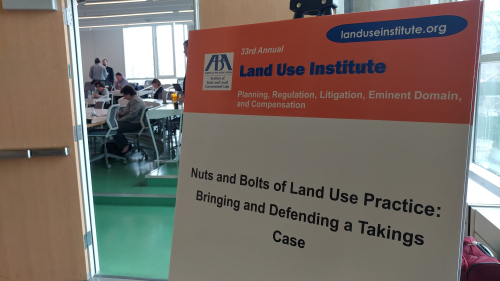
Here are the links from today’s two sessions (the first, federal water issues impacting local land use; the second, Bringing and Defending a Takings Case):

The morning started off with a talk by former Detroit Mayor (and Michigan Supreme Court justice) Dennis Archer, about Poletown, eminent domain, and economic

Continue Reading Links And Materials From Today’s Land Use Institute Sessions, Baltimore

Here’s the amici brief of the Owners’ Counsel of AmericaNew Jersey, Virginia, and West Virginia property owners; Cato Institute, and NFIB Small Business Legal Center which urges the Supreme Court to grant cert in a case we’ve been following for a while.  

As regular readers understand, several federal courts of appeals recently have upheld giving prejudgment possession of property to a private pipeline condemnor once a district has ruled in favor of the pipeline that it qualifies under the three predicates in 15 U.S.C. § 717f(h). These courts conclude that summary judgment grants a pipeline a “substantive” right, and therefore there’s no reason to not give it possession now by granting a Rule 65 injunction. 

But a close read of the language of section 717f(h) shows it is only about whether a private pipeline company may institute an eminent domain lawsuit to take property. In

Continue Reading New SCOTUS Amici Brief In Pipeline Case: Courts Keep Using “Order of Condemnation.” We Do Not Think It Means What They Think It Means

0401191044b_HDR

Great crowd today in Austin for CLE International’s Eminent Domain seminar, co-chaired by our colleagues Chris Clough, Sejin Brooks, and Christopher Oddo. We spoke about “National Trends and Developing Issues in Eminent Domain.” 

Here are the cases I referred to which are not included in your written materials:


Continue Reading Materials And Links From Today’s Austin Eminent Domain CLE

Here’s the cert petition filed recently in yet another case (seeking review of the Eleventh Circuit’s opinion) which challenges a federal court issuing an injunction in a Natural Gas Act taking allowing a private condemnor to obtain immediate possession of the land being condemned, even though the NGA does not delegate to pipeline condemnors the quick-take power. 

You know where we are on this issue. If not, check out our amicus brief which we filed in the Third Circuit which has the details of why we think this is wrong. 

There’s another cert petition on the same issue pending, and another likely coming.

Here’s the Question Presented:

The Court has long emphasized the strict construction of condemnation statutes, especially as against corporate delegates of this sovereign power. By the plain, undisputed terms of the Natural Gas Act, 15 U.S.C. § 717f(h), a pipeline company obtains title and

Continue Reading Another Cert Petition Challenging Quick-Take-By-Injunction In Gas Pipeline Takings