2wnyt3

Pop quiz: Quick! Name the races in the Triple Crown of horse racing… There’s the Kentucky Derby (check) … the Belmont Stakes (check) … and … oh yeah, the Preakness Stakes. We always almost forget that last one. 

But the City of Baltimore sure hasn’t. Because the home city of Pimlico racetrack and the aforementioned Preakness Stakes has sued the owner of the race and track in eminent domain, to take the race so it doesn’t leave town like the Colts did when they bolted for Indianapolis literally in the middle of the nightFool me twice, says Baltimore … shame on me!

Read that again. Baltimore is trying to condemn a horse race. A freaking horse race. (Before we posted this, we checked our calendar to make sure it wasn’t April 1. Suspected we were getting pranked. Nope. Then we checked with news sources. Found a bunch.

Continue Reading All Your Race Are Belong To Us: Baltimore Is Condemning The Preakness Stakes (We’re Serious)

IMG_0123

Last week, author Howard Mansfield joined us at the William and Mary Law School for two sessions about his recently-published book, “The Habit of Turning the World Upside Down – Our Belief in Property and the Cost of That Belief.”  His book is about property, property rights, and what he has discovered about how these ideas are processed by the American psyche.

The first session was open to the entire student body, faculty, and public, and the highlight was Mr. Mansfield reading some of his favorite passages from his book. The second session was a student-only chat about some of the themes that he emphasizes. 

If you were not able to join us in-person, listening will be able to give you a sense of why we think this book is a timely rumination on what “property” means, both good and not-so-good. 

If you can’t stream the audio above, Continue Reading Audio: Readings From “The Habit of Turning The World Upside Down”

Header image LUI 2019

Come join us at the 33rd Annual Land Use Institute, in Baltimore, Maryland, April 11-12, 2019.

As the brochure notes:

This Annual Land Use Institute program is designed for attorneys, professional planners, and government officials involved in land use planning, zoning, permitting, property development, conservation and environmental protection, and related litigation. It not only addresses and analyzes the state-of-the-art efforts by government to manage land use and development, but also presents the key issues faced by property owners and developers in obtaining necessary governmental approvals. In addition, the entire approach of the program is to provide practice pointers that give immediate “take home value” by focusing on topics relevant to the average practice of the attendee.

The keynote will be delivered by Dennis Archer, former mayor of Detroit (and former Justice of the Michigan Supreme Court, and former President of the ABA), speaking about “Detroit’s New GM Plant from

Continue Reading 33rd Annual Land Use Institute: Baltimore April 11-12, 2019

Here’s the cert petition we’ve been waiting to drop.

If you follow this blog, you know we are all over the issue of the quick-take-by-injunction scheme that private condemnors have cooked up, and which a majority of federal courts go along with. 

Here’s the issue: can a private condemnor exercising the delegated eminent domain power under the Natural Gas Act may obtain prejudgment possession of the property to be condemned by way of a preliminary injunction, when Congress has not delegated the ability to obtain prejudgment possession? 

Knowing nothing else, you might think the obvious answer was “no.” When Congress doesn’t delegate the power to obtain prejudgment possession, the courts can’t grant prejudgment possession. But a host of federal appeals courts have held otherwise. Recently, the Fourth, Sixth, and Eleventh Circuits have joined the Third Circuit in allowing a NGA condemnor to obtain prejudgment possession of property, even

Continue Reading New Cert Petition: No “Take-First-Pay-Later” In Natural Gas Act Condemnations

Our colleague Dwight Merriam was recently interviewed on the radio about issues surrounding the existing and proposed wall and fence along portions of the southern border.

If you want to get educated on this issue, here’s the quick way to do it.

Dwight discusses funding, emergency powers, the Declaration of Taking Act, and other topics. You may not be practicing where border wall issues are among your cases. But trust us: even so, if you tell people you are an eminent domain lawyer at a cocktail party, the first thing someone is going to ask is what your thoughts are on the border wall. Doesn’t matter if you are in a state far from the border. And if you aren’t familiar with the border wall issues and able to chat about them, they will conclude you are a bad eminent domain lawyer. So get educated! Here’s your chance. 

Dwight has

Continue Reading Dwight Merriam Interviewed On Border Wall Legal Issues

Who among us doesn’t possess a lot of goodwill for doughnuts? We know we sure do. 

So when we think of “Los Angeles,” what comes to mind: sunshine, beaches, Hollywood, and sprawl? No. What comes to mind are chili, hot dogs, and doughnuts. Those items — more precisely, the roadside architecture which establishments that hawk these foods employ — just sing “LA” to us. Especially doughnuts.

So the California Court of Appeal’s recent opinion in Los Angeles County Metro. Transit Authority v. Yum Yum Donut Shops, Inc., No. B276280 (Feb. 26, 2019) grabbed our attention. And not just for its spelling of “donut,” because the case involved a donut shop, and the recovery in eminent domain for the loss of business goodwill, two things we love.   

There, the MTA condemned a doughnut — donut — shop in central LA. Store 58 to

Continue Reading Cal App Finds Goodwill For Donuts: Shop Owner Entitled To Loss Of Goodwill Damages, Even Where It Has Not Mitigated The Entire Loss

Here’s the motion and proposed amicus brief we filed earlier this week, in a case we’ve been following about natural gas pipelines, eminent domain, and immediate possession.

As we noted here, a panel of the U.S. Court of Appeals for the Fourth Circuit recently concluded that a private condemnor under the Natural Gas Act could obtain immediate possession of property it is in the process of condemning, even though the NGA does not delegate the quick take power. All three judges concluded that this case is “on all fours” with the Fourth Circuit’s earlier decision in East Tennessee Nat. Gas Co. v. Sage, 361 F.3d 808 (4th Cir. 2004), which held that even though Congress did not delegate the quick take power in the NGA, a preliminary injunction under Rule 65 of the Federal Rules of Civil Procedure could achieve the same result, and thus there was

Continue Reading New Amicus Brief: Private Natural Gas Act Condemnors Can’t Use Rule 65 Injunctions To Short-Circuit The Straight Takings Process

Kansas colleague Chris Burger has published an article in the Kansas Bar Journal with the intriguing title, “Sanguine Doves in the Hands of the State or How the Power of Eminent Domain has Few Practical Restraints.” We dare you to resist downloading it and reading.

Thanks to Chris for allowing us to repost it (since most of us are not members of the Kansas Bar). It’s a short article and won’t take too much of your time, but there’s some valuable information there, even if you are not barred in Kansas. We especially appreciated the section on “drafting gamesmanship” and the quotes from the Kansas Supreme Court Justices on pages 31-32, this one in particular:

Left unchecked by flood walls erected either by the people’s representatives or by the people’s constitution, the power of the state will flow like an encroaching ocean into and through every available chink

Continue Reading New Article: Sanguine Doves in the Hands of the State; or How the Power of Eminent Domain has Few Practical Restraints

17CA0595-PD

Here’s the latest in a case we’ve been following, involving what Colorado calls “bad faith” condemnations. 

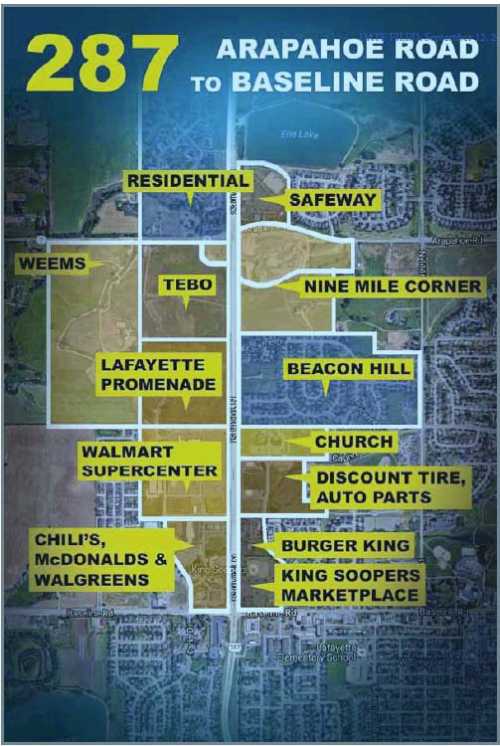
In this order, the Colorado Supreme Court has declined to review the Court of Appeals’ conclusion that a taking ostensibly to preserve open space and a buffer zone between two municipalities, was an invalid exercise of the eminent domain power because the true reason for the taking was to prevent the condemnee-municipality from luring a big-box retailer, King Sooper, to its territory and away from the condemnor’s. 

So even though the case has ended with a whimper and not a bang, this does mean that the Court of Appeals’ hard look at the actual motives of the condemnor — and not merely its stated purpose — is the way to do things. The court examined the factual record, and not just the stated reasons for the taking, and tested whether the condemnor’s

Continue Reading Colorado Supreme Court Denies Cert In “Improper Motive” Condemnation

JD Morris has the story at the San Francisco Chronicle, “California’s strict wildfire liability rule hangs over bankrupt PG&E.”

The story is about inverse condemnation of course, and how California law applies that doctrine in cases involving what look like natural disasters, most notably the state’s recent experiences with major wildfires.

We provided comments on whether an insurance fund might make some sense (because isn’t the mail goal of inverse liability to spread the economic burden of public benefits?). And the story also picks up on the recent 2-1 Ninth Circuit decision on how inverse claims which have not been reduced to judgment get treated in bankruptcy

The wildfire fund alternative Paulo identified could be evaluated by a new committee focused on wildfires and utilities that was authorized by Dodd’s bill, SB901. Gov. Gavin Newsom appointed his three members to the committee just last

Continue Reading SF Chronicle: “California’s strict wildfire liability rule hangs over bankrupt PG&E”