Kearney had her property taken. The school district doing the taking said it wanted to put a septic system on the property, and so commissioned a percolation study. But then it decided that instead, it would connect to a sewer system. The state court jury believed neither side’s appraiser completely, rejecting both Kearney’s appraisal ($1.4 million), and the district’s ($850k), and instead settled on $953,000. 

After trial, Kearny learned about the percolation study. For whatever reason, the district hadn’t disclosed the results, something that Kearney apparently believes was critical to value. On that basis, she sought a new trial, and when the Superior Court denied it, sought and was denied relief in the Court of Appeal (that court essentially put the blame on her, noting “that Kearney should have more timely and thoroughly pursued discovering the test results before trial”).

Finding no relief in state court, she went across the street
Continue Reading Ninth Circuit: New Trial Motion, Not Federal Lawsuit, Is Condemnee’s Only Chance To Show Suppressed Evidence Affected Compensation Award

We think you should pay attention to the South Carolina Supreme Court’s opinion in South Carolina DOT v. Powell, No. 2016-000594 (Aug. 8, 2018). Indeed, it is a short opinion, and worth a read in its entirety. The reason why we think it is important is that it analyzes an issue that confuses many: the partial loss of access as the result of a condemnation.    

Quick facts: DOT’s highway project resulted in the taking of a part of Powell’s commercially-zoned, undeveloped property. The parcel has “easy access” to the adjacent US Highway 17 via an intersection. DOT’s appraiser thrice valued the 0.183 acres that DOT was taking from Powell between $68k and $71k.

But right before trial, DOT amended its plans, which resulted in a loss of easy access, even though the roads which directly abut Powell’s property were not altered or closed. “Travelers on the Bypass could reach

Continue Reading South Carolina: No Segmenting A Taking – Once Condemnor Takes Property, Loss Of Indirect Access Is Compensable

TR

We usually don’t cover trial court orders, but this one is short, and, we think, worth your time reading. 

The issue before the North Dakota District Court (Ward County) was the award of attorneys’ fees following a successful necessity challenge by a landowner. In North Dakota, the award of fees and costs to a defendant is within the trial court’s discretion.

The condemnor didn’t object to the award of fees, but the court undertook its own review to determine the complexity and difficulty of the case. The judge correctly noted that “[i]n most eminent domain cases, the issue of necessity never arises.” Order at  7. The order continued:

In his brief in support of his motion for fees, attorney Boughey cites to recent United States Supreme Court authority to support his argument that questioning the necessity of a taking, and standing up to the often heavy-handed authority

Continue Reading “A Lawyer May Spend A Lifetime Working For That One Magnificent Hour” – ND Court Awards Fees For “A Good Day”

IMG_20170726_134028

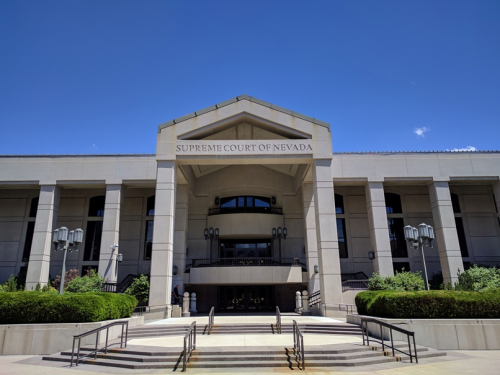
A quick one from the Nevada Supreme Court (pictured above).

In Clark County v. HQ Metro, LLC, No. 71877 (Aug. 2, 2018), the unanimous court concluded that the owner of property at the time the condemnor obtained an order of possession (in Nevada, the term apparently is “order of occupation”) is the party entitled to compensation, and not the party owning the property when the condemnor actually entered the property. 

Quick facts: to build a power line, Nevada Power Company condemned property owned by HQ Metro, and leased to Clark County. Nevada power got an order of occupation entitling it to enter the land to construct the line. But before it actually entered, HQ sold the land to Clark County. 

The question: who gets compensation? The parties agreed that when the taking occurred was the dispositive legal question. Did it occur when the court granted the order allowing physical

Continue Reading Nevada: “Taking” Occurs Upon “Substantial Government Interference” With Property Rights

Here’s the opinion in a case we’ve been following. In Berkley v. Mountain Valley Pipeline, LLC, No. 18-1042 (July 25, 2018), the U.S. Court of Appeals for the Fourth Circuit held that the federal Natural Gas Act allows the Federal Energy Regulatory Commission to delegate eminent domain authority to Mountain Valley, and that any challenges to that authority must be done via the NGA’s administrative review process.

Under the NGA, once FERC makes a finding of future public convenience and issues a certificate, a pipeline company like Mountain Valley which has been issued a certificate is automatically transferred the power to take private property as a plaintiff in a federal court condemnation action. The NGA provides for an administrative process to challenge the issuance of a certificate, which begins with the request for a rehearing in FERC. If FERC denies that, the next step is judicial review of the administrative record

Continue Reading Fourth Circuit: Challenge To Natural Gas Act Delegation Of Eminent Domain Power Must Go Through Admin Process First

Here’s what we are reading (or listening to) this Tuesday:


Continue Reading Tuesday Reading List – Flood Takings, Cuba Property, Beach Access, And … Space Aliens

Clare Trapasso has a Realtor.com piece on what a Justice Kavanaugh could mean for real estate, property, and land use issues, “What Supreme Court Nominee Brett Kavanaugh Could Mean for Real Estate,” where she correctly notes that “while commentators have been scrutinizing Kavanaugh’s record on hot-button topics like abortion and immigration, there’s been little discussion of what a more conservative court could mean for home buyers, sellers, and owners.”

She asked us for input, and here’s what we said:

“The Supreme Court has done some very interesting things on land use law that affect homeowners,” says Robert Thomas, a real estate attorney specializing in land use and eminent domain at the Honolulu-based law firm of Damon Key Leong Kupchak Hastert.

Thomas expects more property-related cases will make their way to the Supreme Court, brought by people hoping that the new bench will increase their odds of a

Continue Reading What Might A Justice Kavanaugh Mean For Takings, Land Use, And Other Issues?

20180717_135234_HDR

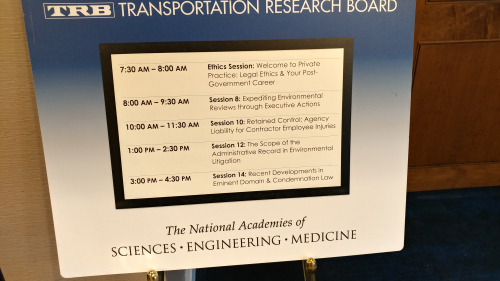
Here are the cases and other items I either spoke about or mentioned at today’s Transportation Research Board‘s 57th Annual Workshop on Transportation Law in Cambridge, Massachusetts:


Continue Reading Links And Materials From Today’s Transportation Research Board Session