


Here’s the amici brief we’re filing in an important Public Use case we’ve been following.

In St. Bernard Port, Harbor & Terminal District v. Violet Dock Port, Inc., No. 2017-C-0434 (Jan. 30, 2017), the Louisiana Supreme Court upheld the taking by the St. Bernard Port, Harbor, and Terminal District of a Mississippi River docking facility downriver from New Orleans. The Port took the entire VDP facility, made no change in how the property was used, and eventually turned over operation of the facility to a “hand-picked” private operator. The owner challenged the power to take, as well as the compensation awarded. We filed an amicus brief on the issue of compensation, arguing that just compensation isn’t limited to fair market value, but the jury must be allowed to consider replacement cost for a unique property like VDP’s facility. 

The Louisiana Supreme Court held that the Port has the power
Continue Reading SCOTUS Amici Brief: Kelo Revisited – Louisiana Case Is An Opportunity To Clarify Eminent Domain Pretext

To lawyers, the word “and” between two clauses in a statute means that the requirements of both clauses must be met (aka “conjunctive”), while the word “or” signifies that either of the requirements are enough (“disjunctive”).

So you might think that when asked to interpret whether a statute that allows pipeline companies to enter land before a possible taking if those entries are necessary to satisfy regulatory requirements “and” to select the most advantageous route, the Virginia Supreme Court would easily conclude that both are required. 

Here’s the statute:

Any firm, corporation, company, or partnership, organized for the bona fide purpose of operating as a natural gas company as defined in 15 U.S.C. § 717a, as amended, may make such examinations, tests, hand auger borings, appraisals, and surveys for its proposed line or location of its works as are necessary (i) to satisfy any regulatory requirements and (ii) for the selection

Continue Reading Virginia: “And” Means “Or” – Eminent Domain Entry Statute Not Strictly Construed

The Colorado Supreme Court has agreed to review a public use case we’ve been following with keen interest, Carousel Farms Metropolitan District, No. 18SC30 (July 2, 2018), one we noted was the “most interesting” such case of 2017

The Court of Appeals held that the actual purpose of the taking was private, so it didn’t matter that the public was actually going to use the property being taken. In short: 

When the primary purpose of a condemnation is to advance private interests, even if there will be an eventual public benefit, the condemnation is not for a public purpose

Slip op. at 18. Read our summary of the case here for more details. 

The condemnor sought discretionary review, and the Supreme Court agreed to consider these issues:

[REFRAMED] Whether the court of appeals should review for clear error a trial court’s determination that a condemning authority sufficiently demonstrated

Continue Reading Colorado Supreme Court To Review Major Eminent Domain Case: Does Public Use Save A Taking From A Private Purpose?

A metro-area transit district condemned a portion of a residential lot for a light-rail line. The property was owned by a LLC, which in turn was owned by a family trust. The condemnor offered $19k as compensation, but the trust thought it was worth a lot more: $280k.

One of the big issues contributing to the difference was the loss of parking which would result from the taking. The condemnor wanted to introduce evidence that the family trust which owned the LLC, also owned adjacent and nearby parcels. Thus, the argument went, these parcels were in “common ownership,” and the loss of parking caused by the taking “could more easily obtain right to access [an area] that could be used for on-site parking.” 

The trial court kept out that evidence via an in limine ruling. No “unity of use,” and therefore the parcels should not be considered as one. After the

Continue Reading Oregon Appeals Court Reminds Condemnors: Eminent Domain Valuation Is Focused On What The Market Would Have Paid For The Taken Property

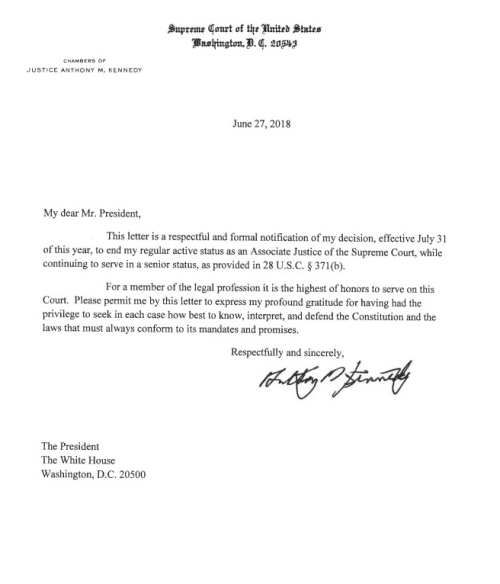
Letter

Some good (Dolan, Lucas), some bad (Kelo, Murr), some … not sure (Lingle).

But now, things get interesting.

Let’s just say that we’re not totally convinced this letter from Justice Kennedy announcing his retirement isn’t “fake news,” since it does not list the four factors he considered in deciding to step down.   Continue Reading Kennedy, J. (ret.)

This one is more for our muni law friends, but today’s post also has two eminent domain angles. 

Anyone who has been to a city council meeting knows at least one fellow like this, considered a pain-in-the-butt by officials. A gadfly, who testifies on seemingly every issue. This is Fane Lozman, eminent domain protester (among other things). Familiar to readers as the Houseboat Guy. Or, more accurately, the “Floating Home” Guy who took the City of Riviera Beach, Florida to the U.S. Supreme Court once before, on the arcane issue of whether his floating home was a houseboat subject to admiralty jurisdiction. The Court held it wasn’t, and wasn’t. 

The houseboat affair wasn’t the end of it for Mr. Lozman, who already was “an outspoken critic of the City’s plan to use its eminent domain power to seize homes along the waterfront for private development,” according to the latest

Continue Reading Arrested Eminent Domain Protester Still Can Sue City For First Amendment Violations

A quick check of the Supreme Court’s docket in the Knick v. Township of Scott case shows that no less than 18 amici briefs have been filed top side. Not all of them in support of the Petitioner mind you (two, the briefs of the United States and of the American Planning Association, are in support of neither party, or ask the Court to impose a specific remedy), but whoa, that’s still a lot. 

Shows us how much a case about a very technical aspect of takings law can generate huge participation, reflecting how important the issue of whether a property owner can file a federal takings claim in federal court truly is. 

So you don’t have to read each one (although we encourage you to do so), here’s our quick summary of each: 


Continue Reading Takings Ripeness Of Apparent Interest: Eighteen—18!—Amicus Briefs In Knick. Here’s Your Rundown.

It’s a go for next Monday, June, 11, 2018, and the exclusive Honolulu screening of Little Pink House,” the feature film about the Kelo v. City of New London case.

There are still some seats left, so if you are even thinking of attending, buy your ticket here, right now.

We’ve seen the film. It is a compelling piece, and very accurate to the real story (with a few concessions to the art form, of course). If you know eminent domain law, you will like this movie (spoiler alert!). And if you aren’t that familiar with eminent domain, be prepared to be educated and entertained.

Thanks to Honolulu real estate agent (and victim of eminent domain) Choon James, for setting this up. 

More here

Also, for those of you on the Big Island, a reader notes that there are multiple screenings of LPH over

Continue Reading One More Reminder: Seats Still Available For June 11 Honolulu Screening Of “Little Pink House”

Here’s the latest in a case we’ve been tracking, the City of Missoula, Montana’s takeover of a privately-owned water system. In 2016, the Montana Supreme Court held that the city could exercise its power of eminent domain to take the property for a “more necessary” public use. The court allowed the city to take the company, and on remand, the lower court determined compensation. There was also a follow up case on who pays property taxes on land while it is being condemned (the owner, although it may eventually have a claim for a refund from the city once the condemnation is completed and title transfers). 

In City of Missoula v. Mountain Water Co., No. DA-17-0272 (June 5, 2018), the Montana Supreme Court considered the payment of attorneys’ fees and costs. After the owners–the water company itself and its “upstream” owner–rejected the city’s offer of $50 million, the condemnation

Continue Reading Montana: When An Eminent Domain Case Is Complex And Requires Out-Of-Town Talent, A Statutory Cap On Attorneys’ Fees May Not Apply

Recently, Pennsylvania property owners filed two cert petitions (download here and here) asking the U.S. Supreme Court to review this question:

Whether the Hazardous Liquid Pipeline Safety Act (HLPSA)1 preempts the Pennsylvania Public Utility Commission’s (PUC) jurisdiction to issue Certificates of Public Convenience resulting in eminent domain power when the HLPSA states it has exclusive jurisdiction, and when the PUC specifically states it does not have jurisdiction.

———-

1. Also commonly referred to as the Pipeline Safety Act of 1979 (PSA).

The crux of the argument is that the Pennsylvania PUC and courts were preempted by a federal statute from accepting Sunoco’s assertion that its pipeline (which is to run from Ohio to Delaware via the petitioners’ Pennsylvania properties) is purely an intrastate pipeline, and not an interstate pipeline as defined in the statute:

Sunoco Pipeline (hereinafter “Sunoco”) seeks to build, and is currently building, an interstate

Continue Reading New Cert Petitions: Can Pennsylvania Redefine What Counts As An “Interstate” Pipeline Under Federal Law?