As we reported earlier (“Mississippi: Statute That Says No Private Takings For Access Within City Limits Means Just That“), as in many other states, in Mississippi, a private property owner may institute eminent domain proceedings to take a neighbor’s land when doing so is necessary for a landlocked parcel to gain ingress and egress. In that case, the Mississippi Supreme Court held that the requirements of the statute must be adhered to by a private condemnor, and invalidated the taking.

But the court rejected the owner’s request for attorneys’ fees as part of the appeal because the statute provides that these costs are recoverable “in a separate action.”

After the court issued its opinion, the property owner sought attorneys’ fees under a separate statute in the eminent domain code, but the special court concluded the statute didn’t apply because the Supreme Court “has made it abundantly clear that

Continue Reading Private Condemnor Liable For Attorneys Fees When Condemnation For Access Road Fails
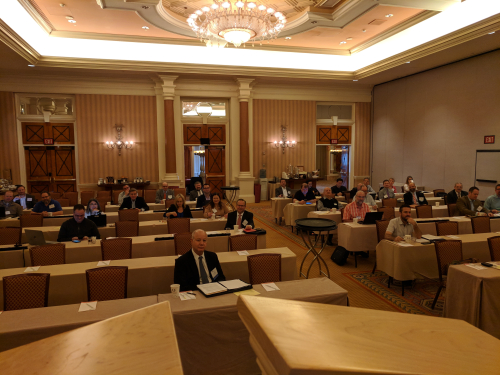
Back in October, the William and Mary Law School awarded U. Hawaii lawprof David Callies the Brigham-Kanner Prize at a two-day conference in Williamsburg. Our summary of the conference is posted here.

We spoke at the conference, at the first panel entitled “The Future of Land Regulation and a Tribute to David Callies,” along with Professors Shelly Saxer and Jim Ely, and past B-K Prize winner Michael Berger. Of course, Professor Callies also delivered his opening remarks.

The law school has posted the audio from that session, which you can listen to here, or stream it above (via Soundcloud). 

We’re in the process of transforming our remarks into a short essay, to be submitted to the Brigham-Kanner Property Conference Journal if you want to wait for the expanded version. (Feb. 13, 2018 update: here’s the draft article.)Continue Reading Brigham-Kanner Podcast: “The Future Of Land Regulations And A Tribute To David Callies”

We’ve all heard the story of what may be the very first recorded eminent domain action — or at least the first case of eminent domain abuse — the Old Testament’s telling of the story of Naboth’s Vineyard.

You remember: Naboth the Jezreelite owned a vineyard that had been in his family for a while, but King Ahab wanted to make better use of the land to plant his own stuff. So he offered to buy it, but Naboth said no. So Ahab’s wife Jezebel (yeah, that Jezebel) told him “King up, man, you are the King. And it’s good to be the king. We’ll get that land.” So she plotted, and cooked up some false charges against Naboth. And after he was stoned to death, the King grabbed the land.

King James said it better:

And it came to pass after these things, that Naboth the Jezreelite

Continue Reading Naboth’s Vineyard – Site Of The First Reported Case Of Eminent Domain Abuse – Discovered?

So begins a clip from the forthcoming feature film “Little Pink House,” the picture about the Kelo v. New London case. A phrase that many of us are familiar with, no doubt.

Those of you who are following along with the film remember that even before it was completed, we interviewed its producer, Ted Balaker, at the 2016 Austin ALI-CLE Eminent Domain Conference. Based on Jeff Benedict’s 2009 book, Little Pink House: A True Story of Defiance and Courage, the film stars Catherine Keener (Capote) as Susette Kelo and Jeanne Tripplehorn (The Firm, Basic Instinct) as the head of the New London Redevelopment agency. Ted gave us an inside look at the film (which had completed principal filming, but was not yet edited), brought some photos from the set, and gave us a preview of what the film covers. 

Now

Continue Reading Art Imitating Life: “Mrs. Kelo, I have great news!” – ALI-CLE’s Advance Screening Of “Little Pink House”

The South Dakota Supreme Court’s opinion in Montana-Dakota Utilities Co. v. Parkshill Farms, LLC, No. 28174 (Dec. 13, 2017), resolved both a public use question, and one of compensation. In other words, something for every takings maven, no matter your interest. Read on!

This was a taking of permanent easements by publicly-regulated but privately-owned utilities. The owner asserted that just compensation and damages was $840,000. The condemnors valued the take at “only $73,097.” Slip op. at 3. The jury awarded $95,046.

The power-to-take question was whether the condemnation of private property by the power companies was “for public use” because the land taken was not going to be open to the public, nor were the transmission lines. Under South Dakota law, a taking is for public use when the property itself is going to be used by the public. But this was not as simple as the property owners

Continue Reading Taking Of Power Line Easement Is For Public Use Because Public Has Right To Use The Electricity

DRCKziGVoAAr-Em

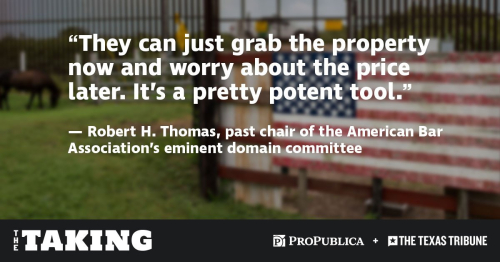
Here’s a story on which we’ve been waiting a while. ProPublica, which holds itself out as “an independent, nonprofit newsroom that produces investigative journalism with moral force,” has published a series of stories on eminent domain, focused on the border wall. As the above blurb notes, we served as one of the story’s sources.

The first piece in the series, “The Taking,” is a tour-de-force. It quickly traces the history of eminent domain (stretching back to Magna Carta, even), and rightly focuses on how the power of eminent domain has been used to take property from the politically powerless, detailing James Baldwin’s famous comment to U.S. Attorney General Robert Kennedy in the 1960’s that “blight removal” was in fact “negro removal.” Kelo is there, of course, as are the post-Kelo reforms. Even the Yellow Book gets a shout out.

But the focus of this series is

Continue Reading “Abuse, Mistakes and Unfairness” In Border Wall Eminent Domain (But It’s Not Just Happening There)

IMG_20171211_090714This photo of the view from the lectern at the start of the day
proves we really
were in the room and not distracted by all the distractions
possible in Las Vegas

Here are the materials and cases which I spoke about earlier today at the CLE International Eminent Domain Conference in Las Vegas. I had the lead off session on updates, and my talk focused on cases that I didn’t cover in the written materials:


Continue Reading Links And Materials From Today’s Las Vegas Eminent Domain Conference

A very interesting public use opinion from the Colorado Court of Appeals. In Carousel Farms Metropolitan District v. Woodcrest Homes, Inc., No. 2017COA149 (Nov. 30, 2017), the court invalidated an attempted taking of Woodcrest’s property, concluding that the condemnation was neither for a public purpose, nor necessary for that purpose.

The facts of the case are straightforward, and rather than paraphrase, we’ll just quote the opinion:

¶ 1    Appellant, Woodcrest Homes, Inc., owned a .65-acre parcel of land (referred to as Parcel C) outside the Town of Parker. Century Communities, Inc., and its subsidiaries (collectively, the Developer) acquired the parcels to the north and south of Parcel C, with a plan to create a development — Carousel Farms — comprising all three parcels. Under its agreement with the Town, the Developer could not move forward with its development plan until it acquired Woodcrest’s land.

¶ 2    Woodcrest, though

Continue Reading Attempted Taking For Public Road Not A Public Purpose, Not Necessary: Alter Ego Developer, Not The Public, Is Beneficiary Of The Taking

HNLrail

The work on what turned out to be the first phase on Honolulu’s billions-of-dollars rail project from Kapolei to the Ala Moana Shopping Center isn’t even close to being done yet, but the Honolulu Authority for Rapid Transportation looks like it is thinking ahead to Phase 2, and extending the line from the shopping center to the University of Hawaii in Manoa (where the commuting students are), or maybe Waikiki (where the tourists are). 

We say “what turned out to be the first phase,” because you will recall that as originally conceived the rail would run from Kapolei to the UH, but was then scaled back when that plan was too expensive, too ambitious. Now that the election is behind us, and the money sort of is flowing again, maybe not. 

Problem is, there’s a lot of residential and commercial development between the shopping center and the UH and Waikiki

Continue Reading Project Announcement: Honolulu Rail May Be Coming To A Neighborhood Near You

The latest in the “Map Act” inverse cases out of North Carolina. This is a longer post, but you really will want to read the summary, or just pick up the opinion and read it.

These are the cases in which the N.C. Department of Transportation, under the power of the state’s Map Act, for decades has designated private property for future acquisition for highway corridors, which prevented present use and development, but hasn’t bothered to actually take the properties.

Hundreds of property owners sued in inverse condemnation (the North Carolina Supreme Court denied class action status). More on the issue and the N.C. Supreme Court’s landmark opinion in Kirby v. N.C. DOT, which concluded the properties’ designation was a taking, here. The cases were remanded for trials for what should have been compensation and damages calculations, but the DOT instead sought to reboot the cases, and

Continue Reading NC App: State Does Not Have Sovereign Immunity From Takings: “sovereign immunity must be juxtaposed with the contrary sovereignty of the individual, whose natural rights preceded government and were enumerated in the federal Bill of Rights”