Flooding

For obvious reasons, much of our recent traffic has come to the blog looking for information or cases about inverse condemnation and flooding. So instead of having you chase down links through a search engine or our Search page, here are some of the more popular links regarding government liability for flooding: 


Continue Reading Flooding And Inverse Condemnation Links

What do takings mavens think about when they hear “New York City” and “takings?” Probably the granddaddy case of them all, Penn Central. Or maybe Courtesy Sandwich Shop, or Loretto. All good ones, landmarks. 

But this post isn’t about a visit to the sites of those cases (not to worry, we’ll get to Grand Central soon), or even about a matter that ended up in the official reports, but about a New York eminent domain story that has been more lost to time, and which is now being rediscovered and recognized. It’s a visit to Seneca Village.


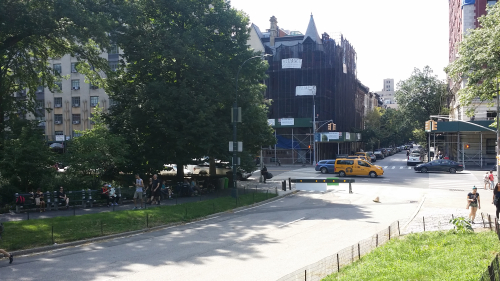
20170813_151125

You wouldn’t know it today, but just inside the boundary of what is now Central Park, right near the West 85th Street entrance, once was “the largest community of free African-American property owners in antebellum New York.”  Beginning in 1825, this locale was home to up to 250 residents in 70

Continue Reading New York City Takings Pilgrimage, Central Park Edition

As we head into the long holiday weekend (although some of us may be working), we offer this for your hammock reading, a forthcoming article by University of Virginia Law School lawprof Molly Brady, about a subject we’re all familiar with, but which we bet most of us have never given much thought, “The Damagings Clauses” in state constitutions. 

A majority of state constitutions (our own included) have provisions prohibiting the “damaging” or injuring of property. As Professor Brady’s article starts:

Twenty-seven state constitutions contain a clause prohibiting the “damaging” or “injuring” of property for public use without just compensation. Yet when compared to its relative, the Takings Clause of the federal constitution—which says that private property cannot be “taken” for public use without just compensation—the ways in which state courts interpret and apply their “damagings clauses” have remained opaque and virtually unstudied.

This Article provides the first comprehensive analysis of state damagings clauses. It traces the clauses to the threats to private property posed at the turn of the twentieth century as a result of rapid infrastructural improvement. These state constitutional provisions were meant to fix perceived inequities resulting from strict application of takings law: many jurisdictions would not recognize a right to compensation when public works affected use rights and drastically devalued property but did not physically invade or appropriate it. Drafters envisioned the damagings clauses as a powerful bulwark for property owners whose livelihoods and homes were affected yet not touched by public works. However, as state courts were tasked with the brunt of the interpretive work, their rulings coalesced around a variety of doctrinal limitations that severely undercut the clauses’ potency. As a result, modern interpretations of the clauses mainly provide coverage in a variety of contexts where the offending activity would already qualify as a physical-invasion taking under most federal precedents.

This Article argues that the damagings clauses deserve broader applications in condemnation law. Damagings comprise a more limited and historically supported category than regulatory takings, for which courts have long awarded compensation. Moreover, courts already try to mandate compensation for some of these types of injuries by manipulating ordinary takings law, leading to unnecessary doctrinal confusion. As a new wave of infrastructural growth looms, it is time for professors and practitioners to return their attention to these forgotten provisions of the state constitutions.

This is a vitally important topic. We’ve argued recently that state constitutional analysis —  and not so much the Fifth Amendment — could be the center of gravity in takings cases, and Professor Brady’s article gives structure to the argument.

Go to SSRN, print it out, pour yourself a cold lemonade* and hit the hammock. 

—————–

* Here’s my legal lemonade story: many years ago, I was privileged to have spent time with Professor Charles Black after he retired from teaching at Yale and was serving as an emeritus lawprof at Columbia. We would sit outside the toaster (the law school building on 116th Street, so named because of its brutalist architecture; as the New York Times put it, “…the law school building, a structure likened both to a toaster and a penitentiary…”) so he could smoke his pipe, and I could nurse a coffee. The talk, invariably, was about constitutional law, one of his specialties, and how many terms in that document were subject to a range of interpretations. Topic this day was the “natural-born Citizen” clause, a provision that in those days had not reached the public prominence it would two-plus decades later. We went back and forth debating the possible meanings, but in the end, Prof Black remarked that the only other time he heard the phrase “natural-born” was back in the days of his Texas roots, when, on one hot summer’s day, his companion quaffed a cool glass of lemonade and remarked “that’s the best natural born lemonade I’ve ever had.” Seemed as good a definition as any. 

Continue Reading For Your Holiday Reading: Molly Brady, “The Damagings Clauses,” 104 Va. L. Rev. ___ (forthcoming 2018)

A quick one from the Ninth Circuit in a federal condemnation case. In Montanore Minerals Corp. v. Bakie, No.15-35707 (Aug. 16, 2017), the court, somewhat surprisingly concluded that a condemnation in federal court should have been stayed by the district court pending resolution of a state court quiet title action.

We say “somewhat surprisingly” because the standard of appellate review in the case is abuse of discretion, which gives a lot of leeway to the district court, and often, in our experience, results in it taking a lot to convince the court of appeals that it should reverse. Not here.  

Although there were no less than eight — count em, eight — “factors” which the court of appeals had to analyze and balance (what I call “throw into a blender and hit the on switch”) to determine whether Colorado River abstention was warranted.

Eight factors? And you thought

Continue Reading 9th Cir On Parallel Universes: Federal Condemnation Should Wait For State Quiet Title Action

Topdowloads

We received a nice (although automatic) email note this morning from SSRN, letting us know that our draft article on Murr v. Wisconsin, Restatement (SCOTUS) of Property: What Happened to Use in Murr v. Wisconsin?, “was recently listed on SSRN’s Top Ten download list for: Property, Land Use & Real Estate Law eJournal.”

Before we got too excited, we remembered that this means only that the article has been downloaded a grand total of 58 times. Which tells us that the “Property, Land Use & Real Estate Law eJournal” is a pretty niche market. But hey, we’ll take accolades where we can get them. We’re at the bottom end of the list, but are just happy to be in such stellar company.  Check it out: there are other things on the list that takings mavens will like reading. Like this article. And this one.  Continue Reading We’re Number 10! We’re Number … 10?

We’ve been offline lately, hanging out at the ABA Annual Meeting in New York, so haven’t had time to post, even though there is a lot to post about.

Thankfully, our colleague Brad Kuhn at the California Eminent Domain Report is on the ball, and has written up his thoughts about the California Court of Appeal’s decision in the case involving a Silicon Valley billionaire, surfers, beach access, and … California. 

We will have some thoughts once we find the time to sit down and write them up, but in the meantime, please read Brad’s thoughts on the case at “Court Holds Temporary Injunction on Martins Beach Access Dispute Does Not Constitute a Taking.”

More shortly. Continue Reading Cal Eminent Domain Report On The Strange “Martins Beach” Decision

IMG_20170811_095148
Regulato Takings!

A modest but very knowledgeable crowd joined us today at the ABA Annual Meeting in New York for a panel discussion and analysis of Murr v. Wisconsin. Here is the recording of our portion of the presenation (10mb mp3).

Here are links to some of the materials which we and the others discussed: 

Continue Reading Murr v. Wisconsin Sound Bytes From The ABA Annual Meeting Program

Chair Reception SLG 8-11-2017 invitation

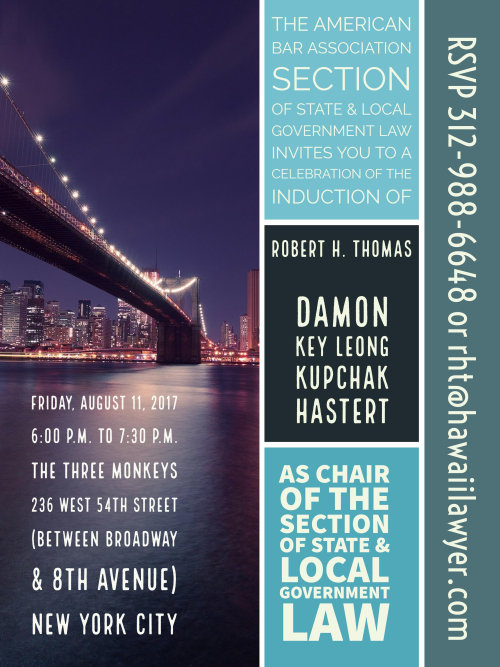
If you are scheduled to be in or near New York City on Friday, August 11, 2017, please consider attending one or both of the following events:

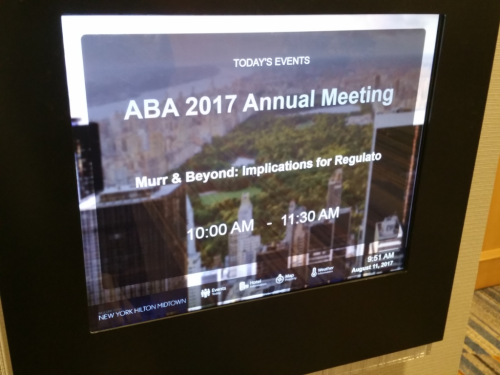
  • 10-11:30am, Midtown Hilton, Concourse E, Concourse level:Murr and Beyond: Implications for Regulatory Takings.” Yes, Murr is the case that keeps on giving, and has already given CLE providers numerous opportunities to add to their coffers. The ABA is sponsoring this program, which includes the lawyers for the two main parties, and two (me included) lawyers who do this kind of thing. Come,  join your colleagues for a roundtable discussion of the case, and more importantly, what comes next. With John M. Groen, Principal Attorney, Pacific Legal Foundation, Sacramento,CA; Robert Thomas, Damon Key Leong Kupchak Hastert, Honolulu, HI; Hon. Misha Tseytlin, Solictor General , WI Dept. of Justice, Madison,WI; and Nancy Stroud, Land Use Attorney, Lewis Stroud & Deutsch, Boca Raton, FL. Our


Continue Reading ABA CLE, NYC: “Murr and Beyond: Implications for Regulatory Takings” – Aug 11, 2017

FERC

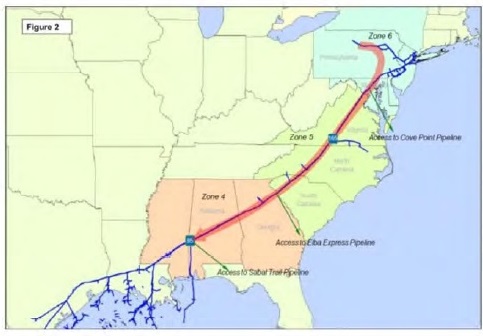
Here’s one that is taking a slightly different approach to challenging the taking of private property for privately-owned pipelines. Definitely a hot-button topic these days. 

In this federal court complaint, the plaintiff landowners challenge the approval by the Federal Energy Regulatory Commission of a private pipeline company’s exercise of eminent domain. The complaint seeks, among other things, a declaratory ruling that delegation of eminent domain power by Congress to FERC under the Natural Gas Act, and FERC’s further delegation of the power to pipeline companies, is unconstitutional.

You should read the whole thing, just to get a flavor. More on the filing here, from the Washington Post, and here from the local paper. 

Will this approach succeed? Your guess is as good as ours. 

Verified Complaint, Berkley v. Mountain Valley Pipeline, LLC, No. ____ (W.D. Val. filed July 26, 2017) 


Continue Reading Challenge To Natural Gas Pipeline Takings In Virginia – Delegation To And By FERC Is Unconstitutional

Check this out, the latest cert petition from the Institute for Justice (Kelo), in a case we’ve been following.

This one asks a question that has been kicking around in the lower courts for a long time, and has long bothered we who represent property owners who have to eat the often-massive losses to a business which come about as a direct result of eminent domain (and which condemning agencies and the courts almost invariably determine are “consequential” losses, not compensable.

The U.S. Supreme Court, in Kimball Laundry Co. v. United States, 338 U.S. 1 (1949), held that “an exercise of the power of eminent domain which has the inevitable effect of depriving the owner of the going-concern value of his business is a compensable ‘taking’ of property,” and you would think that would take care of the question of whether such losses are part of just

Continue Reading New Cert Petition: Does The Fifth Amendment Require Compensation For Destroying Business In A Taking?