Okay, we get it: the text of a statute is the text, and it says what it says. And Virginia’s “buyback” statute — which says that if a condemning agency hasn’t started the project for which property was condemned within 20 years, the agency must reconvey it to the owner upon demand — dictates that the owner must buy it back at the “original purchase price.” 

And the Virginia Supreme Court in Kalergis v. Commissioner of Highways, No. 161347 (Oct. 26, 2017) concluded that “original purchase price” means exactly that — the price for the property which the condemning agency paid back in the day, regardless of whether or how the agency altered the property in the intervening 20 years. And there’s something about that conclusion that doesn’t quite sit right. 

There, VDOT acquired the property from Mr. and Mrs. Kalergis in 1994, taking about 1/2 of their 26-acre

Continue Reading “Buyback” Statute Requires Owner Pay Premium After Condemnor Devalues Property
Here’s the Reply Brief and Brief in Opposition in Jarreau v. South LaFourche Levee District, No. 17-163 (cert. petition filed July 31, 2017), the case asking the Court to consider whether a property owner whose business is destroyed due to an exercise of eminent domain is entitled to just compensation for business losses.

The issue goes back at least to Kimball Laundry Co. v. United States, 338 U.S. 1 (1949), where the Court held that “an exercise of the power of eminent domain which has the inevitable effect of depriving the owner of the going-concern value of his business is a compensable ‘taking’ of property.” But the Louisiana Supreme Court held no, the condemnor only had to pay for the land. The dissenting Justice there noted:

Defendant is in the dirt business and owns land from which he digs and sells dirt. The government is entitled to “appropriate&rdquo

Continue Reading Reply Brief And BIO In SCOTUS Just Comp Case: “Real And Serious” Split On Whether Condemnor Can Just Pay For Land, But Not Businesses, Destroyed By Eminent Domain

Here’s one we’ve been meaning to post for a while because it is on one our favorite (sub)topics: attorneys’ fees in eminent domain. Indeed, it is about what we consider a very interesting subtopic of the subtopic, the question of whether an owner can recover attorneys’ fees for the efforts expended in recovering attorneys’ fees, the aptly-named “fees on fees” question. We did a case like this a few years ago in the Hawaii Supreme Court, and have been hooked ever since. 

The opinion, Tri-County Metro. Trans. Dist. of Oregon v. Aizawa, No. S064112 (Oct. 5, 2017), is from the Oregon Supreme Court, and overall, may not be that relevant to your specific jurisdiction because it focuses on the court’s interpretation of the Oregon fee-shifting statute and a rule of civil procedure. Thus, your mileage may vary back home. But we encourage you to review it anyway (even in

Continue Reading Oregon: Legislature Didn’t Preclude Condemnee From Recovering “Fees On Fees”

The complete agenda and faculty list has now been posted on the ALI-CLE website, and early registration is open! Go now and reserve your spot. 

We paid a visit to Charleston recently, the venue for our January 2018 conference, to scout it out. We can report that we’re going to have a great time, for sure. When we polled you last year, you selected Charleston as your first choice (a new city for the Conference), and it is shaping up to be a very good selection. In addition to the usual lineup of CLE programming, there are a ton of things to see and do in the area. We recorded a short video down at the “four corners of law” (the intersection of Meeting Street and Broad Street), to give you a preview (the weather was much better than in our 2016 preview video, too).

As an added

Continue Reading 2018 ALI-CLE Eminent Domain Conference – Agenda And Faculty Now Posted

IMG_2931

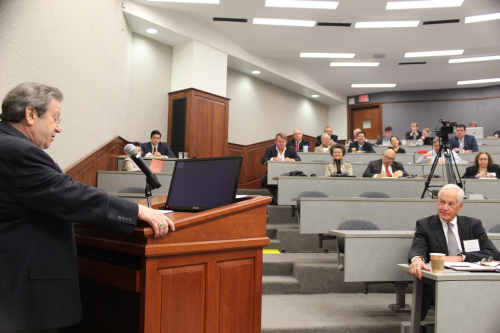
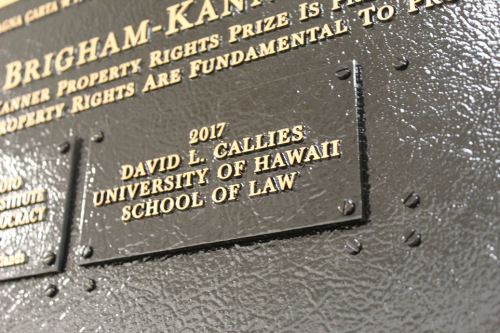
University of Hawaii Law School Professor David Callies last night was presented with William and Mary Law School’s Brigham-Kanner Property Rights Prize which is “presented annually to a scholar, practitioner or jurist whose work affirms the fundamental importance of property rights.” 

As W&M notes about Professor Callies, a “prolific scholar whose work explores land use, property, and state and local government law, Callies has lectured around the world and authored or collaborated on about 90 articles and 20 books. He has been a member of the prestigious American Law Institute since 1990 and is the Benjamin A. Kudo Professor of Law at the University of Hawaiʻi at Mānoa. Prior to entering academia, he was an attorney in private practice and an assistant state’s attorney.”

IMG_3028

We’re spending today in a series of panels which explore and build upon Professor Callies’ lifetime of work. Michael Berger, a past Prize winner, kicked off

Continue Reading Professor David Callies Awarded William & Mary Law’s Brigham-Kanner Property Rights Prize

A quick one since we’re in transit, and don’t really have time to post much. But that doesn’t mean that the Fifth Circuit’s opinion in Boerschig v. Trans-Pecos Pipeline, L.L.C. , No.  16-50931 (Oct. 3, 2017), isn’t worth your time to read in-depth. 

Here’s the setup:

Texas law allows a natural gas utility to condemn land for “public use.” Tex. Util Code § 181.004; Tex. Const. art. I, § 17(a). Trans-Pecos Pipeline, LLC exercised that authority and initiated a condemnation proceeding to obtain a 50-foot wide permanent right-of-way and easement on John Boerschig’s ranch. The ranch is along the route of a 148-mile pipeline Trans-Pecos is constructing in west Texas that terminates at the Mexican border in the middle of the Rio Grande.

Boerschig contends that by ceding condemnation power to a private company, Texas eminent domain law offends due process. His argument principally relies on the private nondelegation

Continue Reading 5th Circuit: Texas Delegating Eminent Domain Power To A Private Pipeline Isn’t A Due Process Problem

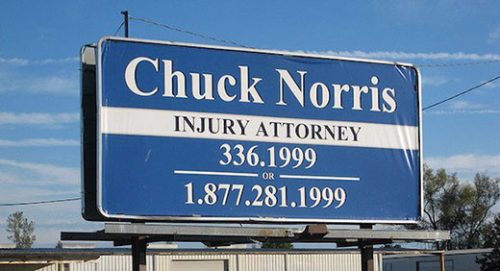
Chucknorris
No, this isn’t the billboard.

As the title of Dep’t of Transportation v. Adams Outdoor Advertising of Charlotte LP, No. 206PA16 (Sep. 29, 2017) might indicate, this is a condemnation case involving billboard valuation in North Carolina. But the issues in the case go much deeper, we think.

On the surface, the North Carolina Supreme Court resolved a question of which state statute applies when the DOT acquires land on which an income-generating billboard is located: a statute which requires DOT to pay “fair market value of the property at the time of the taking” when it takes property for highway purposes (Article 9), or a statute which requires inclusion of the “value of the outdoor advertising” in compensation when certain prohibited billboards on leased land are condemned (Article 11) in order to remove them. The billboard was one of those now-prohibited billboards (it was a nonconforming use, since

Continue Reading NC: Evidence Of Rental Income From A Billboard Is Admissible In Just Comp Trial

ALI-CLE2018

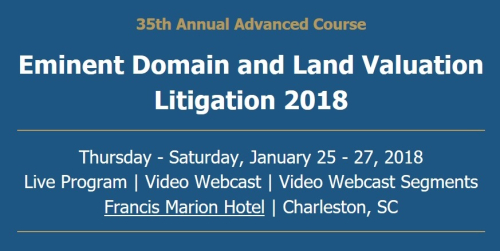
It’s not too early to reserve your spot at the 35th Annual ALI-CLE Eminent Domain and Land Valuation Litigation Conference, to be held at the Francis Marion Hotel in historic downtown Charleston, South Carolina, January 25-27, 2018. 

We’re finalizing the Conference details, but can report that the program will, as usual, feature expert presenters from across the nation, and both an in-depth update on the subjects we love, and a “101” track for those new to the field or who would appreciate a refresher. Check out some of the topics:

  • Takings and Damaging by Flood: Case Selection Advice For Savvy Practitioners
  • Quarterbacking the Case: Blocking Defenses, Controlling the Witnesses, and Converting for Verdicts
  • We’ve Been Working on the Railroad: Utility Crossing Disputes
  • Protecting Your Record,and Anticipating Appeals
  • Lucas 25 Years Later: Property Rights in the Age of Global Warming
  • Building and Growing Your Eminent Domain Practice With


Continue Reading 2018 ALI-CLE Eminent Domain Conference: Early-Bird Registration Discount Now Posted

DSCF3369

Back when the opinion was first released, we posted a list of Murr v. Wisconsin links. Now that Court is nearly back from its summer vacation, here’s an updated list:

Will there be more? No doubt. Murr is the takings case that keeps on giving. Continue Reading The Takings Case That Keeps On Giving: Murr Round-Up, Continued

20170918_171304_Richtone(HDR)

Here’s the amici brief we’re filing today in a case we’ve been following, Jarreau v. South LaFourche Levee District, No. 17-163.

As the name of the case indicates, this one is out of Louisiana and the Question Presented asks whether the Fifth Amendment’s Just Compensation Clause requires that an owner be made economically whole when her business is destroyed as the consequence of an exercise of eminent domain.

There’s a lower court split, and the U.S. Supreme Court has weighed in on the subject in the famous case of Kimball Laundry Co. v. United States, 338 U.S. 1 (1949), in which the Court held that the owner was entitled to so-called “business losses” when the government took the laundry. Many lower courts have distinguished Kimball Laundry, however, holding that it only applies when the government actually takes the business involved, and was not deciding that the Just Compensation

Continue Reading New Amici Brief: “The reality is that “just compensation” is, in application, often neither just nor results in compensation.”