Our thanks to Bobby Debelak for having us back on as a guest on his Eminent Domain Podcast.

We’re long-time fans of the pod (naturally), and it was good to get together with Bobby and talk a bit of shop.

Here’s a description of our session:

Robert Thomas joins Bobby Debelak to discuss the most interesting legal developments from 2024, cases to watch next term, and previews the 2025 ALI-CLE conference to be held in San Diego at the end of January 2025. At the end, a musically themed cross-examination includes Robert’s dream set list of 70s bands.

Our three set list entries: the first, a classic, timeless sound; the second might reveal our “square” proclivities; while the may be a selection The Dude may not approve.

Check it out above, on Spotify, or wherever you get your pods!Continue Reading Latest Ep, Eminent Domain Podcast: Podworthy Cases, ALI-CLE, And 1970s Bands
PXL_20240821_114525464.MP
How it started.

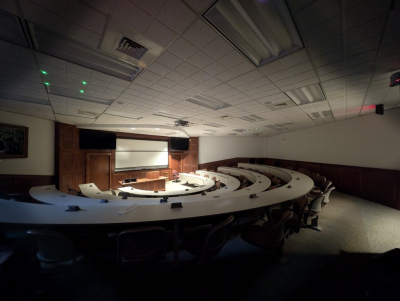
Once again, our fall duties included teaching two property law courses at the William and Mary Law School: Eminent Domain & Property Rights, and Land Use Controls. We started in mid-August, and just wrapped the classroom portion of the courses earlier this week. I say “classroom portions” because although we are done with classwork, the courses are not done, and the students are presently deep into writing their final papers (we don’t do an exam in either course). Then comes grading, and a welcoming of the students as full-fledged colleagues in the Dirt Law Bar.

Many law schools feature Land Use Law courses, but only a few are so bold as to include a course on Eminent Domain and Property Rights in their offerings (and a substantial three-credit course, at that). William and Mary Law School is an excellent and very appropriate place to study these topics.

Continue Reading Another Semester Of Dirt Law In The Books

Thanks to lawprof Donald Kochan for the heads-up: the “Word of the Day” in today’s New York Times is … “eminent domain.”

Defined by the piece as:

“the right of the state to take private property for public use; the Fifth Amendment that was added to the Constitution of the United States requires that just compensation be made”

Ugh. The “right?” No mate, it’s a sovereign power, not a right.

The piece then challenges the reader:

Can you correctly use the word eminent domain in a sentence? Based on the definition and example provided, write a sentence using today’s Word of the Day and share it as a comment on this article. It is most important that your sentence makes sense and demonstrates that you understand the word’s definition, but we also encourage you to be creative and have fun.

OK, we’ll have a go. How’s this for

Continue Reading NYT Word Of The Day: “Eminent Domain”

We usually don’t cover unpublished opinions, but the New Jersey Appellate Division’s reasoning in Hudson County Improvement Authority v. Mariana Properties, Inc., No. A-2686-22 (Oct. 29, 2024) stuck in our craw a bit. 

This is an eminent domain case in which the Authority is taking an easement and intends to construct one of the most “New Jersey” forms of infrastructure, a “jug handle” turn. The stated public use supporting the taking:

The Easement would create a jug handle allowing trucks heading west on the Bellevue Turnpike to turn left onto Crosspike Drive. The Spine Road would provide access to a public facility, the New Jersey Transit Grid Traction Power System Project, and three new industrial warehouses. To do so, the Spine Road would cut across the Property and leave the Property’s southeastern corner , fronting the Belleville Turnpike, separate from its larger remainder. The Easement would total

Continue Reading NJ App: “Public Use” Is What Condemnor Says It Is, Not What Use Actually Will Be Made

2025 San Diego

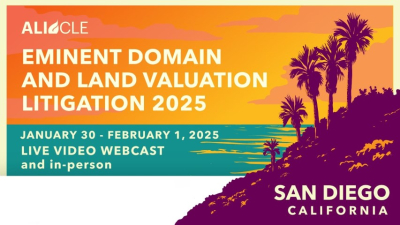
Get ready to join your colleagues and friends in San Diego for the 42d ALI-CLE Eminent Domain & Land Valuation Litigation Conference.

The 41st Conference was in New Orleans. Here’s a report of that event, and here are our reports from prior conferences in Austin and Scottsdale.

Here are some of the highlights of the upcoming Conference:

  • Property Rights at the Supreme Court: DeVillier and Sheetz and What’s Next
  • Slow Take: Possession, Rent, Relocation, and Offset
  • The Jury’s View: How Jurors See Your Case
  • From Penn Coal to Penn Central: How to Prove “Too Far”
  • Leveraging Expertise in Eminent Domain Litigation: Working with Land Planners, Engineers, and Other Predicate Experts
  • Kelo at Twenty: What Changed, What Didn’t, and What’s on the Horizon
  • Viva Las Vegas: How the Nevada Judiciary Upheld Property Rights in 180 Land’s Inverse Condemnation Taking
  • Ethics: Guiding the Trolley: Perspectives on Professional Ethics in


Continue Reading Registration For The 42d ALI-CLE Eminent Domain & Land Valuation Litigation Conference Is Underway (Don’t Miss Out!)

We’re not going to pretend to fully understand the Supreme Court of India’s recent decision in Property Owners Ass’n v. State of Maharashtra, No. 2012-2022 (Nov. 4, 2024) for obvious reasons (plus, the judgement and various opinions and dissents total 193 pages).

But we post it here because we think it gives some insight how other jurisdictions and cultures view expropriation, and the role of property rights in free societies.

Some background. The Constitution of India (article 39(b)) has been held by the Supreme Court to embody a concept known as “constitutional socialism.” It provides:

The State shall, in particular, direct its policy towards securing–

(b) that the ownership and control of the material resources of the community are so distributed as best to sub serve the common good.

Not quite the Fifth Amendment, is it?

Indeed, Justices of the Supreme Court have opined that constitutional

Continue Reading Blight Redevelopment & Eminent Domain, India Style: Private Property As A Basis For “Economic Democracy”

Here are the cases and other materials we discussed in today’s Section of State & Local Government Law Land Use group meeting on takings:


Continue Reading Links From Today’s ABA Land Use Session

Access
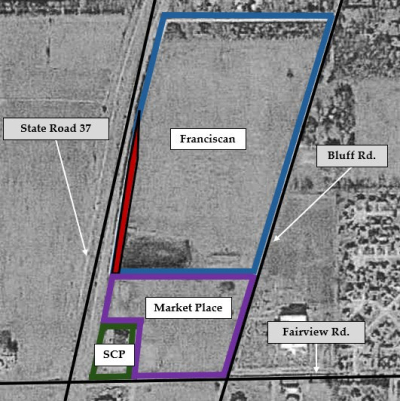
We like it when courts include photos and maps.

The Indiana Supreme Court’s ruling in State of Indiana v. Franciscan Alliance, Inc., No. 245-PL-118 (Oct. 31, 2024) isn’t all that surprising. After all, the State’s eminent domain action did not take access to the undeveloped property, and the owner was not entitled to compensation for the change in traffic flow brought about by the closure of an intersection. This increased the “circuitry of travel,” but did not cut off the parcel.

Here’s how the court framed the issue:

Here, there is no question that the State’s condemnation of Franciscan’s 0.632-acre strip of land is a taking requiring just compensation. Likewise, it is indisputable that this condemnation amounted to a taking of SCP’s easement rights over that strip of land. But the record confirms that the State has already paid compensation for those easement rights. Thus, the only question

Continue Reading Indiana: No Compensable Property Right In Traffic Flow; No Compensation For Impairment Of Access

Those of you who are students of eminent domain and the public use requirement know that in Berman v. Parker, 348 U.S. 26 (1954), the Court (in)famously held, “when the legislature has spoken, the public interest has been declared in terms well nigh conclusive.”

Not only was the Court in Berman signalling that it was washing its hands of the Public Use Clause, but that case also — less overtly — revealed a shift from examining the use the property was to be put, to the purpose for which the property was being acquired, or as the above quote highlights, where a taking furthers the public interest. (A shift that, if you missed it, the Court confirmed in Midkiff where it held the eminent domain and police powers are “coterminous,” and both are reviewed under the deferential rational basis standard.)

If that wasn’t clear enough, the majority in Kelo

Continue Reading Nevada: Private-to-Private Takings By Privately-Owned Utilities Are OK, Even Though State Constitution Prohibits “transfer … from one private party to another”

Here’s the latest in our series of cases which in effect say “when you settle, you’re done.”

In State ex rel. Gideon v. Page, No. 2024-0573 (Oct. 10, 2024), the Ohio Supreme Court made short work of an argument that the trial judge in an eminent domain case lacked jurisdiction to enforce a settlement agreement after she vacated an earlier entry of dismissal. The objecting party asserted that the court’s earlier dismissal deprived it of jurisdiction to vacate the dismissal itself, and enforce the settlement agreement.

Although the party which asked the court to vacate the dismissal did not cite Rule 60(b), the court held that was a mere technical defect, and “a trial court may, upon motion, vacate a final judgment, order, or proceeding for multiple reasons …” Slip op. at 5. In short, the Supreme Court wasn’t too bothered by the details. See slip op. at 7

Continue Reading Ohio: Settlement Means You’re Done