ABA State and Local 2017-2017 conferences image

Mark your calendars for this Friday, June 16, 2017, at 2:00 p.m. Eastern Time for a free talk we’ll be giving, “Regulatory Takings: Emerging Issues.” 

Yes, it’s free, but there’s a catch: this talk is sponsored by the ABA Section of State and Local Government Law’s Land Use Committee, and you have to be a Section member (or be willing to join us). One of the benefits of being a member is that you can sign on to these bi-monthly calls and learn about the latest developments in the broad range of topics the Committee covers. Ping me if you want to sign up.  

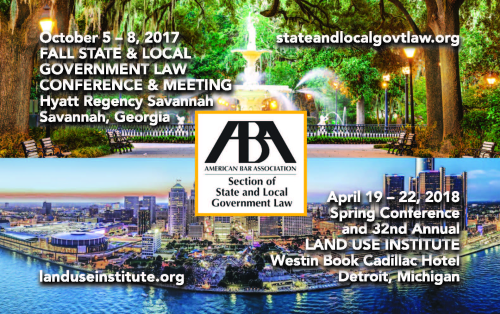
And what’s the deal with the graphic above? Well, starting in August 2017, I’ll be taking over as Chair of the Section (assuming my ABA colleagues do not come to their senses before then), and the big focus of the Chair is to

Continue Reading Upcoming Free Takings Talk (Friday, June 16, 2017). But There’s A Catch…
As we noted recently, we don’t usually post trial court decisions. But there are exceptions. The Northern District of Florida’s recent order in Sabal Trail Transmission, LLC v. Real Estate, No. 16-cv-00063-MW-GRJ (June 5, 2017), is one of those exceptions. 

First of all, our New York City colleague Michael Rikon beat us to the punch, and posted a summary of the case on his blog yesterday. Read it.

The issue, as Michael notes, is whether federal or state law applies in a federal Natural Gas Act taking by a private pipeline in federal court. In Sabal Trail, the big difference why choice of law matters is that under the Fifth Amendment, just compensation does not include attorneys’ and other fees, while under Florida’s “full compensation” provision (which we noted here), a property owner may recover fees and costs. 

The District Court rejected the pipeline’s

Continue Reading Florida’s “Full Compensation” Rule (Attorneys’ Fees!) Governs In Federal Natural Gas Act Taking By Private Pipeline

A fascinating case from the U.S. Court of Appeals for the Tenth Circuit involving an attempt by a private utility company to take property which is now tribal land. 

In Public Service Co. of New Mexico v. Barboan, No. 16-2050 (May 26, 2017), there wasn’t a question that a federal statute prohibited a utility company from taking “tribal land.” The big issue was what land fell within that definition.

The Navajo Nation owned undivided fractional interests in two parcels which the utility claimed it needed for a electric transmission line. The problem wasn’t that the land was currently owned by the Navajos, and thus was tribal land, but that it originally had been allotted to individual Navajos during the time in which the federal government was making such individual allotments. Eventually, the Nation obtained fractional interests in the two parcels via a “buy back” consolidation program (14% for one

Continue Reading 10th Circuit Not Bothered By Holdouts: No Condemnation Of Tribal Land, Even If Formerly Allotted To Individuals

Update 6/6/2017: LA denizen Professor Gideon Kanner wrote about this case a couple of years ago on his blog.

* * * *

For those of you in the Los Angeles area, you may want to check out an upcoming lecture at the Central Library.

On Thursday, June 8, 2017 at the Mark Taper Auditorium, the library is presenting “Siege at Fort Anthony,” about a 1964 eminent domain battle stemming from the “ill fated” Hollywood Museum, a vanity project of “motion picture industry heavyweights headed by Sol Lesser, Gregory Peck, Mary Pickford and Walt Disney, decided to create a museum showcasing the history of movies, radio and television to be located across the street from the Hollywood Bowl.”  

Everyone but Mr. Anthony left on their own:

The place: The Cahuenga Pass, opposite the Hollywood Bowl.

The conflict: An eminent domain showdown between, on

Continue Reading Upcoming Lecture: LA Eminent Domain Showdown – To Condemn A Mockingbird

IMG_20170526_144554

Welcome to a new entry in the eminent domain and takings blogosphere, Texas colleague Clint Schumacher‘s Eminent Domain Podcast. Yes, you don’t have to read to get your takings updates, you can listen while you work, while you work out, or while you drive or fly. Go here to subscribe or download episodes via his website, or here for iTunes.

Clint has formatted his program very cleverly, with an Opening Statement, Direct Examination (in-depth discussion of the topics), Cross-Examination (a “lightning round” quick-question-and-answwers), and Closing Arguments.

He was kind enough to ask me to be his inaugural guest, and we spent some quality time discussing the Honolulu rail project, recent interesting cases, the “three unities” test, the annual ALI-CLE Eminent Domain Conference, and … Kevin Bacon. Don’t miss that.

Click here to open this first episode in a new window

Clint and his firm also produce

Continue Reading Clint Schumacher’s New Eminent Domain Podcast

Here’s the latest in a case we’ve been tracking, the City of Missoula, Montana’s takeover of a privately-owned water system. Last year, the Montana Supreme Court held that the city could exercise its power of eminent domain to take the property for a “more necessary” public use. The court allowed the city to take the company, and on remand, the lower court determined compensation. But the case is not yet final, and the final order of condemnation has not issue. Which means that title and possession still remain with the water company and not the city.

The follow up, Mountain Water Co. v. Montana, No. 16-0469 (May 16, 2017), involves the question of who is responsible for paying property taxes. After the city instituted the taking, the water company asked the Montana Department of Taxation agree that the company was not liable for the payment of property taxes. The

Continue Reading Who Owes And Who Pays Taxes On Property Being Condemned?

Seattle

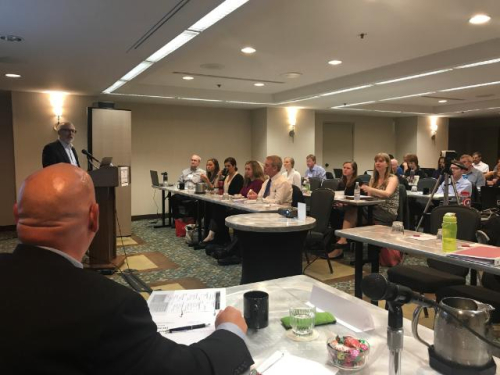
My thanks to Bart Freedman (K&L Gates) and Kinnon Williams (Inslee Best Doezie & Ryder) for asking me to speak on national takings and inverse condemnation issues at yesterday’s Eminent Domain conference in Seattle.

As you can see, the room was packed and standing room only. Here are the cases and issues I mentioned during my talk, “National Takings Trends, Hot Practice Areas, and Property Rights in the Age of Trump:”


Continue Reading Cases And Links From Washington Eminent Domain Conference

Here’s a rundown of the commentary on Bay Point Properties, Inc. v. Mississippi Transportation Commission, No. 16-1077 (cert. petition filed Mar. 3, 2017), a case which seeks review of a decision by the Mississippi Supreme Court. We represent the petitioner.


Continue Reading Commentary On Bay Point: SCOTUS Should Review This Just Comp Case

Kauaipark

Yesterday, the Hawaii Supreme Court issued a unanimous opinion opinion authored by Justice Nakayama in an eminent domain case we’ve been following. We filed an amicus brief in the case supporting the property owner on one of the three issues presented, too. More on that below. 

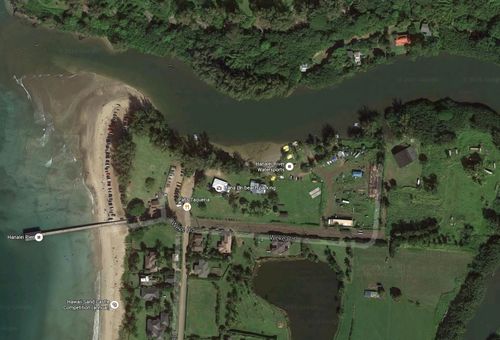
The case involves three parcels on Kauai — one of which is owned by a fellow who has been a thorn in the County’s side — which were condemned by the County for the expansion of a public beach park. The County was taking Parcels 49, 33, and 34. Sheehan owned 49, and HRH, an entity incorporated in the Cook Islands, owned 33 and 34. Sheehan asserted his use of Parcel 49 stretched across 33, 34, and Area 51 — a portion of another Parcel but not a separate record lot. He claimed to use Area 51 pursuant to an easement. 

The owner sought

Continue Reading Hawaii Supreme Court – Major Eminent Domain Opinion: Larger Parcel, Deposit

Here’s the Reply Brief we’re filing today in Bay Point Properties, Inc. v. Mississippi Transportation Commission, No. 16-1077 (cert. petition filed Mar. 3, 2017), a case which seeks review of a decision by the Mississippi Supreme Court. We represent the petitioner.

The brief responds to the MTC’s Brief in Opposition, and rather than paraphrase our arguments, we’re just going to copy-and-paste them below, after we link to the other briefs in the case:


Continue Reading SCOTUS Cert Reply Brief: Mississippi Can Rewrite Its Easement Laws, But It Can’t Avoid Compensation When It Takes Property