


25103267

Here’s what we’re reading today: 

Continue Reading Area 51 Taking, Dodger Stadium Taking, Attorneys’ Fees
This case — a related case, actually — has been up to the West Virginia Supreme Court before. SeeWest Virginia: DOT Should Not Have Mined Privately Owned Limestone Without Owner’s Permission.” But even though the underlying facts were the same (the DOT mined limestone from private property without first buying it from the landowner), the issues presented in West Virginia Dep’t of Transportation v. Veach, No. 16-0326 (Apr. 17, 2017) were somewhat different.   

In Veach, after the Supreme Court affirmed the earlier case, DOT’s new counsel sought to repudiate a stipulation which prior counsel entered into with the property owners, by which the parties agreed that the landowner owned the limestone. DOT now argued that West Virginia law was that the state owned these mineral deposits, not private landowners.

The trial court rejected this tactic, and the Supreme Court affirmed. The DOT didn’t show that the stipulation

Continue Reading West Virginia: Condemnor Must Abide By Stipulation, Even If Contrary To Law

Spiderman

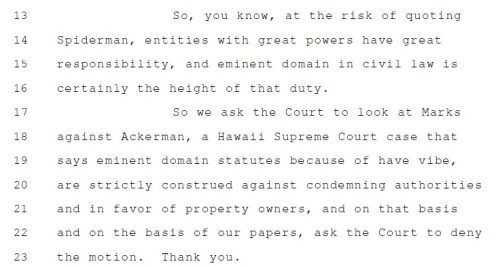
Thank you, Justice Kagan, for giving us a citeable Spider-Man reference (Kimbel v. Marvel Ent. LLC., 135 S. Ct. 2401, 2415 (2015) (“[I]n this world, with great power, there must also come—responsibility”)), and to The Castle, just for being a good, quotable eminent domain movie.Continue Reading When You Quote Both “Spider-Man” And “The Castle” In Your Eminent Domain Hearing

The Supreme Court yesterday issued an opinion in an expropriation case we’ve been following.

No, Bolivarian Republic of Venezuela v. Helmerich & Payne International Drilling Co., No. 15-423 (May 1, 2017), isn’t about redevelopment, or public use and the like, but about the nationalization by Venezuela of oil exploration equipment. The owner of the seized property predictably didn’t get far in the Venezuelan legal process, so brought suit in U.S. federal court for damages for the taking. The DC Circuit, as we noted here, held that Venezuela didn’t enjoy immunity. Game on! 

The unanimous Supreme Court disagreed – it turned out that the corporate owner of the drilling equipment is a Venezuelan citizen, and thus, international law isn’t available as a remedy for a taking of its property by the Venezuelan government (the international law remedy is only available to foreigners whose property is wrongly seized).

Continue Reading Kelo, Venezuela Edition: It’s Not Our Problem If Foreign Governments Expropriate Their Own Citizens’ Property

Do you really need an excuse to visit Seattle? If you do, and want to earn some CLE credit while you’re at it, check it out the brochure for the upcoming Eminent Domain seminar on May 18, 2017. This is a one-day program that focuses on the hot topics in our area of law. We’ll be speaking about “Changes in National Public Policy” and the latest developments in eminent domain and takings law. 

Agenda and full registration information here

Come, join us. 

7th Annual Eminent Domain Seminar, Seattle, Washington, May 18, 2017 

Continue Reading Seattle Eminent Domain Conference, May 18, 2017

The Pennsylvania DOT wanted to take a part of the Szabos’ property. Fine. But when it filed the declaration of taking, the DOT wasn’t as careful as it should have been, and the plans which it submitted with the declaration noted “[s]ome property lines were labeled as ‘probable [sic] correct.'”

Good enough for DOT, but not good enough for the Szabos, who hired a surveyor. The survey confirmed that indeed, DOT “misidentified” a part of the Szabo property as belonging to someone else. Thus, DOT’s plans “understated the amount of property owned by the Szabos taken as part of the condemnation. Therefore, the Department condemned more of the Szabos’ property than the Declaration indicated.”  

They told the DOT, but it didn’t listen. So they sought an evidentiary hearing to determine the nature and extent of the property taken. The trial court said no, and the Szabos appealed.

DOT argued

Continue Reading “And The Survey Says…” Condemnor Sloppiness Will Not Be Tolerated

Here’s the recording of the March 20, 2017 oral arguments in Murr v. Wisconsin, the e “larger parcel” or “denominator” case.

The printed transcript is posted here, and our summary of the arguments is posted here. Our preview of the arguments, which includes link to the briefs, is here.

Continue Reading Murr Oral Argument Recording

Under Nebraska law, Natural Resource Districts possess the power of eminent domain, delegated to them by the state legislature. The question in Estermann v. Bose, No. S-15-1022 (Apr. 7, 2017) was whether four of those NRD’s could, in turn, re-delegate that power to a new agency which they jointly formed under the Interlocal Cooperation Act, a Nebraska statute which allows such things.

This new agency — the only-could-be-named-by-government “N-CORPE” (Nebraska Cooperative Republican Platte Enhancement) — was formed to regulate and manage water to comply with the Republican River Compact. Part of its duties included a “stream flow augmentation project” to manage ground and surface water, a portion of which required it to institute condemnation proceedings to take a portion of Estermann’s land for a flowage easement.

In a separate lawsuit, Estermann sued, seeking an injunction prohibiting the taking because N-CORPE did not possess the power of eminent domain.

Continue Reading Nebraska: OK To Delegate Eminent Domain Power From Natural Resource Districts To Join Agency

Here’s the third amicus brief filed in support of our cert petition in Bay Point Properties, Inc. v. Mississippi Transportation Commission, a case asking whether the Just Compensation Clause prohibits a court from instructing an inverse condemnation jury that it must value taken property as if it was burdened by a highway easement which the jury found as a matter of fact had been abandoned. 

This brief was submitted by a stellar group of public interest organizations and legal scholars: Cato Institute, the NFIB Small Business Legal Center, Reason Foundation, Southwest Legal Foundation, NARPO (the National Association of Reversionary Property Owners), the Property Rights Foundation of America, and Professor James Ely (property and easement expert), Shelley Ross Saxer (land use and takings), and Ilya Somin (eminent domain, among other subjects).

The brief, authored by Thor Hearne and his Federal Takings team, Cato’s Ilya Shapiro, and

Continue Reading SCOTUS Amicus Brief: Forcing The Jury To Pretend A Terminated Easement Still Encumbered Land Violated Just Comp Clause

Here’s another amici brief (on behalf of the Virginia Institute for Public Policy, and Owners’ Counsel of America, authored by takings/SCOTUS superstar Michael Berger) supporting the cert petition we filed last month which asks the U.S. Supreme Court to review a decision of the Mississippi Supreme Court. Here’s the amicus brief which Pacific Legal Foundation filed earlier

This post has the background on the case and issues.

The VIPP/OCA brief argues:

1. It is important for the Court to reassert the primacy of federal law as determining the baseline protection provided to private property owners by the 5th and 14th Amendments. Although the issue should not be at large, a number of courts — as exemplified by the Mississippi Supreme Court — are seeking to secure for themselves the right and the power to redefine property in such a way as to confiscate private property for the use of

Continue Reading Another Amici Brief Supporting SCOTUS Cert Petition: “Ordering The Jury to Return A Verdict For Peanuts Instead Of Millions” Violates Just Comp Clause