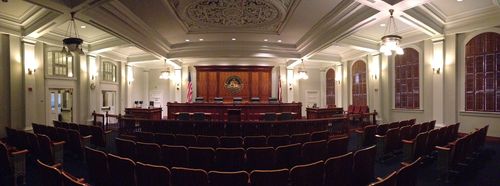
Photo

Tomorrow, Thursday, October 6, 2016, at 10:00 a.m. at Aliiolani Hale, the Hawaii Supreme Court will hear oral arguments in a case we’ve been following (we filed an amicus brief in the case, supporting the property owner on the first Question Presented), County of Kauai v. Hanalei River Holdings, Ltd., No. SCWC-14-0000828. 

The case is a taking by the County of several parcels on the north short of Kauai, but the main issue in the case — do parcels need to physically touch in order for the jury to consider them part of a larger economic parcel — goes well beyond this one case. The Honolulu rail project, probably the biggest eminent domain project in Hawaii’s history, is underway, and the larger parcel issue could arise is more than a few cases there. What we thought was settled doctrine in Hawaii law was thrown into question by the

Continue Reading Oct 6, 2016: HAWSCT Oral Argument In Eminent Domain Case: Do Parcels Need To Touch To Be Part Of A “Larger Parcel”

ALI2017 - Copy
ALI2017

We’ve teased some of the details on the 2017 ALI-CLE Eminent Domain and Land Valuation Litigation and Condemnation 101 Conference, to be held at the Westin San Diego, January 26-28, 2017, but here are the details you’ve been waiting for.

This is the “big one,” our annual 3-day festival of all things eminent domain, property, takings, inverse condemnation, and just compensation. Truly national in scope, this is the 34th annual edition, and the one conference you must attend. Our 2016 conference in Austin was one of the best in years, and we’re on the way to replicating it in 2017, with a great venue in an exciting city. 

Look for the web and printed brochures to show up in your mailboxes, but in the meantime, here are some of the highlights (we’ll post more in the next few days):

  • Relocation, relocation, relocation: we are featuring two sessions on this


Continue Reading Details: ALI-CLE Eminent Domain And Land Valuation Conference – San Diego, January 26-28, 2017

There’s a lot of pages in the Pennsylvania Supreme Court’s opinion (and two concurring opinions) in Robinson Township v. Commonwealth of Pennsylvania, No. J-34A-2016 (Sep. 28, 2016), and the good stuff from the headline starts on page 78. But to understand the case, you need a bit of background.

Pennsylvania has been one of the hotbeds of property owner objections to natural gas (including the related fracking extraction method) and other pipeline projects, and this case was a lawsuit by several townships and municipal officials challenging a state statute which made fracking and eminent domain easier for the gas companies. The townships asserted this went beyond what the state legislature had the power to allow, because it was “special legislation” designed to help a particular industry, and not applicable to all, and allowed an unconstitutional taking of private property for private use. The court held the statute was special

Continue Reading Pennsylvania Supreme Court: Delegation Of Eminent Domain Power To Pipeline Companies Violates Fifth Amendment’s Public Use Clause

 IMG_20160929_102807
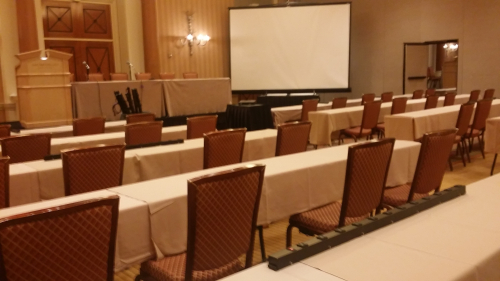
During. Good crowd.

20160929_074511
Before. Note the power strips on the tables.
Well played, Caesar’s, well played
.

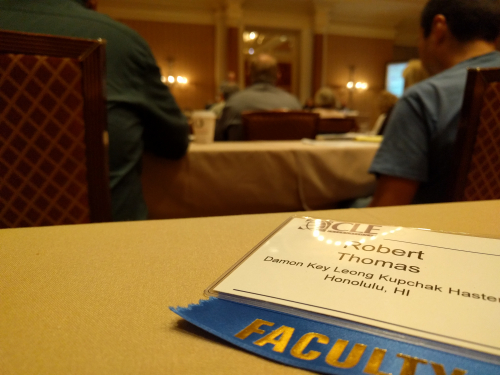
To supplement your written materials, here are the decisions and other materials which we spoke about this morning at the CLE International Eminent Domain seminar:


Continue Reading Links And Notes From Today’s Las Vegas Eminent Domain Seminar

This one is kind of Colorado specific, but there are lessons here for the rest of us.

In Colorado Dep’t of Transportation v. Amerco Real Estate Co., No. 16SA75 (Sep. 26, 2016), the Colorado Supreme Court prohibited the DOT from taking Amerco’s land (leased to U-Haul) for a highway project because the transportation commission had not first determined via the process required by statute that the taking would serve the public interest.

U-Haul argued these statutes required the commission to adopt a resolution — based on a report by the chief engineer — to establish that the taking of this specific property would be in the public interest, and that it wasn’t sufficient that these things were done for the project in general. The DOT asserted that an earlier resolution by the transportation commission gave the DOT all the power it needed, because it had delegated the power to acquire

Continue Reading When Statute Requires Commission Approve Taking, DOT Can’t Do It

2016 BrighamKanner Property Rights Conference Program_Page_01

As we noted here, this year’s Brigham-Kanner Property Rights Conference honoring Hernando de Soto will to be held in The Hague, Netherlands, at the International Court of Justice on October 19-21, 2016.

To push out word, the Owners’ Counsel of America kindly produced a press release announcing our participation in two of the panel discussions, “Property’s Role in the Fundamental Political Structure of Nations,” and “Defining and Protecting Property Rights in Intangible Assets.” 

We mention it here only to note, as this post’s headline states, this may be the only press release (ever?) to mention Hugo Grotius. Left unanswered: how to pronounce “Grotius.”

“I am honored to have been invited to speak at the Brigham-Kanner Conference, especially when the Conference is honoring Hernando de Soto, whose work on property rights has had such international influence,” said Thomas. “I’m also glad the Conference will be held at

Continue Reading Maybe The Only Press Release Ever To Cite Hugo Grotius

Eminent Domain Las Vegas print brochure--final - Copy

Do you really need an excuse to visit Las Vegas in the interregnum between its brutally hot summers and the winter high season? Probably not.

But if so, here’s your opportunity. Plus, you can earn CLE credit.

CLE International is putting on “Eminent Domain 2016: Current and Emerging Issues for Litigators” at Caesar’s Palace, September 29-30, 2016.

The Planning Chairs for the program, our colleagues Darius Dynkowski, Autumn Waters, and Kermitt Waters, have assembled a great lineup of topics and speakers, including panels on highway projects, power lines, pipeline takings, and municipal takeovers of local utilities. As if to prove the “international” part of its name, the program will also include a session on “Injurious Affection and the Canadian Approach to Damages for Partial Takings” presented by our Toronto colleague Shane RaymanWe’ll kick off the conference, speaking about “Eminent Domain

Continue Reading Eminent Domain Conference, Las Vegas (September 29-30, 2016)

Check this out, a follow-up to our earlier post about the Texas Supreme Court opinion in which the property owner pushed back against a taking of a part of his ranch by a water district by forming his own water district, thus creating a situation where one governmental entity was trying to take another governmental entity’s property by eminent domain. And you know what that means: a “superior public use” issue. Created from whole cloth. As we wrote, “bravo, Sir!”

The Texas Supreme Court held that in these cases, the trial court needs to first resolve the immunity issue, before it gets to valuation. An entirely sensible approach, in our outside-looking-in perspective. 

Read more about that case and the property owner in this article from D Magazine, the city mag of (you guessed it) Dallas-Fort Worth: “A Gentleman Rancher’s Guide to Fighting Tarrant Regional Water District.” Like

Continue Reading Southern Fried Takings: “A Gentleman Rancher’s Guide to Fighting Tarrant Regional Water District”

Entry statutes are in the news lately. As we reported here for example, the California Supreme Court recently saved California’s entry statute from unconstitutionality by implying a requirement for a jury trial (and other eminent domain protections) when the entries which the condemnor seeks to undertake constitute takings.

In that case, the party seeking entry proposed to bore and fill holes on the property. Which meant that the entries were undoubtedly permanent physical appropriations. This triggered the requirement that the entry conform to the eminent domain process, such as having a jury determine just compensation. Thus, the court understood that in the absence of its reformation of the statute (i.e., rewriting it), the entry process as applied would be unconstitutional. We’ll save for another post our commentary on the California Supreme Court’s approach.    

But such details didn’t concern the North Dakota Supreme Court in its opinion applying that

Continue Reading ND: Entry Statutes Are Not Takings, Even If There’s A Physical Invasion

Kauaipark

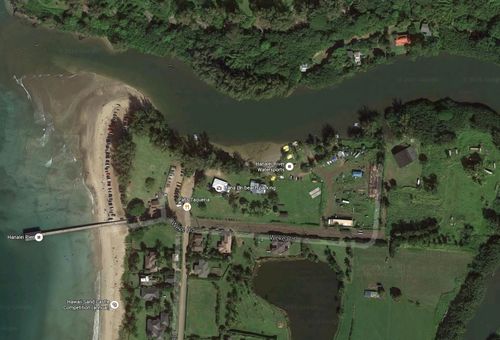
In a case we’ve been following in which the County of Kauai is condemning several Hanalei-area parcels to expand an adjacent public beach park, the Hawaii Supreme Court has accepted certiorari and agreed to review these three questions:

QUESTION NO. 1.: Must two parcels physically abut in order for the jury to consider whether they are part of a larger parcel?

QUESTION NO. 2: Where there are multiple properties being condemned from different owners, does statutory interest on a conditional deposit only accrue after each condemnee establishes an entitlement to its portion of the deposit?

QUESTION NO. 3: Does Haw.Rev.Stat. § 101-19 enable a condemnor to withdraw a portion of its estimate of just compensation after deposit with the Court and after taking possession of the property?

We filed an amici brief on Question 1, arguing that “[t]wo parcels need not abut in order for an eminent domain jury

Continue Reading HAWSCT Agrees To Review Eminent Domain Case: Larger Parcel, Interest, And Reducing The Deposit