


ALI-CLE-2016-masthead

We’re exactly one month away from the 2016 Eminent Domain and Land Valuation Litigation / Condemnation 101 Conference, which runs from January 28-30, 2016, in Austin, Texas. 

Together with our friends and colleagues Joe Waldo, Jack Sperber, and Andrew Brigham, we think we’re put together a pretty good program that covers a lot of ground. This is the first time the conference has been to Austin, and we’re hoping for a good turnout. 

Here’s the full agenda for the program. 

If you have not already signed up, there is more than enough room, and there’s still time.

If you haven’t yet pulled the trigger, we’d like to convince you to come. So over the next few days, we’re going to be posting highlights from the agenda, featuring our stellar faculty.

  • We’ll start off with a talk welcoming us to the city by Austin Mayor Steve Adler


Continue Reading Counting Down To The ALI-CLE Eminent Domain Conference (Austin, Jan 28-30, 2016)
2010-03-24 15.25.46

More from our end-of-year clearing of the opinion hopper.

Winston Churchill reportedly said, “Never give in–never, never, never, never, in nothing great or small, large or petty, never give in except to convictions of honor and good sense. Never yield to force; never yield to the apparently overwhelming might of the enemy.”

Well, the case of City of Memphis v. Tandy J. Gilliland Family LLC, No. W2014-02472-COA-R3-CV (Dec. 16, 2015) might prove the point.

The opinion was the second time the Tennessee Court of Appeals considered issues regarding the taking of the Gilliland Family’s land by the Memphis Light, Gas, and Water Division (nice use of the Oxford comma there, MLGW) for utility poles. The first time up, the question involved public use. The court concluded the taking was for public use, even though MLGW allowed the poles to be shared by private telecommunications and cable providers. In the

Continue Reading Tenn App And The Churchill Principle: On Further Review, We Goofed

510E5lC3ILL._SX331_BO1,204,203,200_

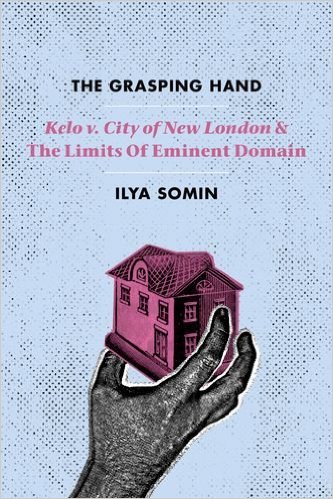
Whatever you might celebrate at this time of year — Christmas, Chanukah, Kwanzaa, Festivus, or whatever (or even if you don’t celebrate anything except good cheer and gift giving) — here’s our suggestion for the gift for the takings nerd in your life: Professor Ilya Somin’s fantastic book, “The Grasping Hand: Kelo v. City of New London & The Limits Of Eminent Domain.”

It’s a book that is both scholarly and readable, and filled with details, history, and perspective. You can’t do better than this. Available as both an e-book and in hardback (for you luddites).

Highly recommended. 

Note: Professor Somin is one of the featured speakers at the upcoming ALI-CLE Eminent Domain and Land Valuation conference in Austin, Texas (January 28-30, 2016) where he will talk about the book and recent developments in our favorite area of law. 


Continue Reading Holiday Gift Suggestion For Takings Nerds: Lawprof Somin’s Kelo Book “The Grasping Hand: Kelo v. City of New London & The Limits Of Eminent Domain”

A shorter one today. In Catalina Foothills Unified School Dist. No. 16 v. La Paloma Prop. Owners Ass’n, Inc. No. 1 CA-CV 14-0838 (Nov. 24, 2015), the Arizona Court of Appeals held that a statutory grant of power to school districts to take property for “buildings and grounds” also implied the power to take property to access those buildings and grounds.

The School District acquired La Paloma’s vacant land in a stipulated eminent domain judgment, promising that the only access to the new campus from an adjacent private road also owned by La Paloma would be on foot. The road was used by residents of the La Paloma subdivision for vehicular access.

Well, you know how these things go when you make agreements with entities with the power of eminent domain, and sure enough, after the District built a new campus, it decided that it also needed vehicular access

Continue Reading Ariz App: Statute Giving School District Power To Take “Buildings And Grounds” Implies Power To Take Roads

The headline of this post is clickbait, of course, since the California Court of Appeal didn’t formally file an amicus brief in favor of the government in Property Reserve, Inc. v. Dep’t of Water Resources, No. S217738, a case now pending in the California Supreme Court. But the court’s opinion in Young’s Market Co. v. Superior Court, No. D068213 (Nov. 19, 2015), published late last week, sure does seem like a brief in support of the Department of Water Resources in that case. 

Property Reserve is the case which has been briefed and is awaiting oral arguments, in which the California Supreme Court is considering whether precondemnation entries sought by the California Department of Water Resources conform to the “entry statute,” or are so extensive as to be takings triggering the protections of the eminent domain code. In that case, a different Court of Appeal

Continue Reading Court Of Appeal Files Pro-Condemnor Amicus Brief In Cal Supreme Court “Entry Statute” Case

A quick one from the Georgia Court of Appeals. In Fincher Road Investments, LLLP v. City of Canton, No. A15A1290 (Nov. 13, 2015), the court held that a condemnee was entitled to recover attorneys’ fees and costs when the condemnor abandoned a taking, and was entitled to recover just compensation for the temporary cloud which the condemnation placed on the property.

This started as a quick-take, and the City deposited $787,400 with the court, after which the court declared that the City had title. The owner objected to the taking itself, and to the amount of compensation. After the court denied the owner’s petition to set aside the taking, the owner appealed. The court of appeals held the trial court should have considered certain facts about the timing of notice of the condemnation. When the case was remanded, the City told the trial court it no longer wanted the

Continue Reading Ga App: Property Owner Entitled To Temporary Takings Damages In Addition To Attorneys’ Fees When Condemnor Drops Case

Here’s the recently-published brochure with more details about the ALI-CLE Eminent Domain and Land Valuation LItigation conference, set for Austin in January 2016. 

In the coming days and weeks, we’ll be posting more details about the conference. Our co-planning chairs Joe Waldo, Jack Sperber, and Andrew Brigham have assembled a great agenda, taught by the usual stellar faculty. If eminent domain, appraisal, or land use is your thing, you really should attend. 

33d Annual ALI-CLE Eminent Domain and Land Valuation Litigation Conference, Jan. 28-30, 2016, Austin, TX

Continue Reading ALI-CLE Eminent Domain And Land Valuation Conference: Full Brochure

Here’s the amicus brief we filed today on behalf of our Owners’ Counsel of America colleagues in Livingston v. Frank, No. 15-470 (cert. petition filed Oct. 9, 2015). That’s the case in which the Florida District Court of Appeal held that the interest generated by quick-take deposits is not the private property of the condemnee, and therefore it is not a taking when the clerk of the court gives 90% of the interest to the condemnor.

Our brief argues that the Florida court rewrote the rules of who owns the deposit in order to save the statute which allows the clerk to give the interest on the deposit to the condemnor. There’s a strong “judicial takings” flavor to the brief, even though we don’t think it’s necessary for the Court to go down that path expressly in order to take the case and reverse.  

Here’s the Summary

Continue Reading New SCOTUS Amicus Brief: There’s No IOU’s In Eminent Domain – Quick-Take Deposit Belongs To The Property Owner

As we noted here, the government is taking the property belonging to a Nevada family which is immediate adjacent to the infamous super-secret “Area 51” site.

For more details on the story, read “The Unlikely Struggle of The Family Whose Neighbor is Area 51.” It tells the history of the property, the alleged past misdeeds of the government, and the family’s current eminent domain struggles which are now in the valuation phase. It’s a great read.

The most interesting tidbit? The family’s lawyers have demanded a jury trial. In a federal taking.  We all know that you don’t get a jury in a federal condemnation. But why not? The demand for a jury isn’t necessarily a crazy one, as this other case — which also seeks a jury in a federal inverse condemnation action — shows.  

For more, see this story from the Las Vegas Sun.Continue Reading Valuation And “The Area 51” Taking

Those of you who represent property owners on the business end of eminent domain who practice in Florida and the few other states which allow recovery of attorneys’ fees, consider yourselves lucky: the rest of us poor slobs who practice in places where they are not permitted — either as a component of a constitutional command of just compensation, or by legislative grace — are envious.

We understand that to force a property owner to bear its own fees and costs to recover just compensation — compensation which the condemnor should have offered in the first place — effectively denies just compensation, and allows a condemnor to get away with an inadequate offer simply because it may make little economic sense for the property owner to fight back with a lawyer. Each dollar spent on attorneys is a dollar less the owner gets for her property.   

But even if

Continue Reading Florida: When Govt Excessively Litigates An Eminent Domain Case, “Full Compensation” Requires Payment Of Attorneys Fees